

Enjoy the benefits of a premium membership!
Upgrade Account
-
TalkBass has been independent since 1998. Add your voice.
Create a free account to reply to discussions, view embedded media, and browse with fewer display ads.
Join free Log in
Want zero display ads or expanded classifieds tools? Compare plans.
You are using an out of date browser. It may not display this or other websites correctly.
You should upgrade or use an alternative browser.
You should upgrade or use an alternative browser.
EBS Magni 500
- Thread starter abarson
- Start date
More options
Who Replied?

When you use an exclamation point right after IMHO, it's no longer quite so humble....
I agree. Sorry about that, I'll remove it.
I did so cause I know there's a lot of unconditional love the Rumble series, and I didn't want to get into a long argument here (it's an EBS thread), but I'm solid about my point...
Just to be clear, this was not meant as a challenge, nor was it an attempt to hijack the thread - I was just curious, as an amateur player with no professional experience. I have heard a lot of people say that they regard the Rumbles as unsuitable for professional applications, and I was wondering why that was. Incidentally, you were quite clear about why you thought so, which is fine, but you didn't really explain why you think having the effects loop and XLR out post EQ/master is a bad thing. I'd be interested to hear your thoughts.I agree. Sorry about that, I'll remove it.
I did so cause I know there's a lot of unconditional love the Rumble series, and I didn't want to get into a long argument here (it's an EBS thread), but I'm solid about my point...
Last edited:
Sure, I can explain. (I'm sorry if my English is not clear, not my native language).
The most problematic thing for me on my Rumble is the XLR DI out. Every amp manufacturer seems to do it a different way:
- Some will use PRE EQ signal (level unmodified by the first gain stage / preamp input pot). This is just like if you use a direct box before the amp. The advantage of this is your signal is unmodified whatever tweaking you do on your amp (level, EQ, comp, etc.). Many soundmen will prefer that, because it allows the musician to do anything on the amp without any influence on what's being feed into the FOH and monitor consoles.
- Some other amps will have the XLR signal sourced POST EQ. That way, the signal feed to the XLR will be affected by the EQ you do on the amp. If your amp has an INPUT/GAIN level pot + a MASTER pot, the level of the XLR out will usualy be affected by the INPUT level. To me, it should not be affected by the MASTER. Why? Cause if you sound check at a specific amp level, and then during the show you need more (or less) power, you're going to turn the MASTER level of your amp, and if the XLR out is taped after the master (like in the Rumble, and some other amps as well) the signal level you send to the soundman will be modified as well. And soundmen don't like that, believe me! Now, if you're uncomfortable on stage and need to modify something, you have to do it softly/slowly, etc. If you do +10 db level, the soundman will hate you (and also probably all the other band members, as their monitor returns will also be affected). Also, some players will like a very scooped tone, per example, +10 bass, -10 mid, +10 treble, etc. per example. While some amplifiers could actually sound...... good (sight).... with a setup like that, there's many chances that it'll be a nightmare for the soundman. Not always a win/win situation. With a POST signal, you always need to carefully consider what you're doing on your amp, because it will affect everyone, soundman, musicians, audience.
- And then there's the new Fender fashion of doing POST EQ / POST MASTER volume and also with a cabinet SIMULATOR (not sure if all Fender amps are like that, but for sure I know the Rumble 40, 100, and the 100T are). The cab simulator could be a good idea for someone who's doing some home studio work. You plug your bass in the Rumble, then the XLR out direct in your soundcard and there you go with a coloured tone, like a mic'ed cabinet. The problem with that is that you're stuck with that tone! You can't change the mic. You can't change the mic position. And you can't disable the cab emulator! I say, IF I want a mic'ed cabinet type of tone, I'll just mic the amp MYSELF. A good mic won't cost a lot these days (once again, an SM57 is perfectly fine) and it's not a big problem to bring (or ask) a mic on a live gig, or in the studio, when you think about it. However, the problem appears IF I do NOT want a mic'ed cab tone. I would have to use a DI, before the amp, which is viable.... BUT: what you have to understand is that in many professional gig setups, musicians will use in-ear monitors. When I gig, I like to plug my bass in my amp, and send my DI out signal POST EQ to the soundman. Doing so, I can slightly EQ my tone up to my likings in my in-ear monitors (while considering what I'm sending in the PA of course). And same if I'm using wedge monitors. Having an EQ is handy in many situations. Using my TC Electronic RH450 amp, it allows me to EQ, compress, distort and MUTE myself (when I tune or swap instrument), which is very useful. I could not do that with a DI or with a PRE signal feed XLR out. I would need some extra stuff, pedals, more wiring, power supplies, etc. And I like my setup as simple as possible. Not many amps are as complete as the TC though, but a simple 3 band (parametric mids) would be enough for 90% of my gig, and the EBS offers that.
Regarding the Effects loop connection, you need to understand gain staging to see why having these connections post master volume is a non sense... Example: you want to use that old MXR Phase 100 pedal you have for a special effect during the gig. That pedal sounds terrific, vintage, vibey, etc., but as with many vintage pieces of equipment, it comes with noise! Hiss... So you connect the MXR through the effect send/return. As the MASTER level is before the send/rtn connections, the output of the MXR will always be at 100% maximum level in the amp, even if you turn down the master pot. Hiss will always be there, loud. ALSO, like I said in my previous post, if you need to drive the volume of the amp louder, the level being sent to the Effect SEND plug (to the pedal) will be modified, and could definitely distort that old MXR pedal. Any piece of gear could be connected there, btw. Same principle... (Obviously, it would be a better idea to connect a pedal like the MXR 'before' the amp, but that was just an example). I'm not sure if any other amp manufacturers design effect send/rtn like that, but to me (as a studio guy and live soundman) it's a complete non sense.
Sorry if this is too technical. I tried to make it clear as much as possible... Study the block diagram, you'll see what I mean.
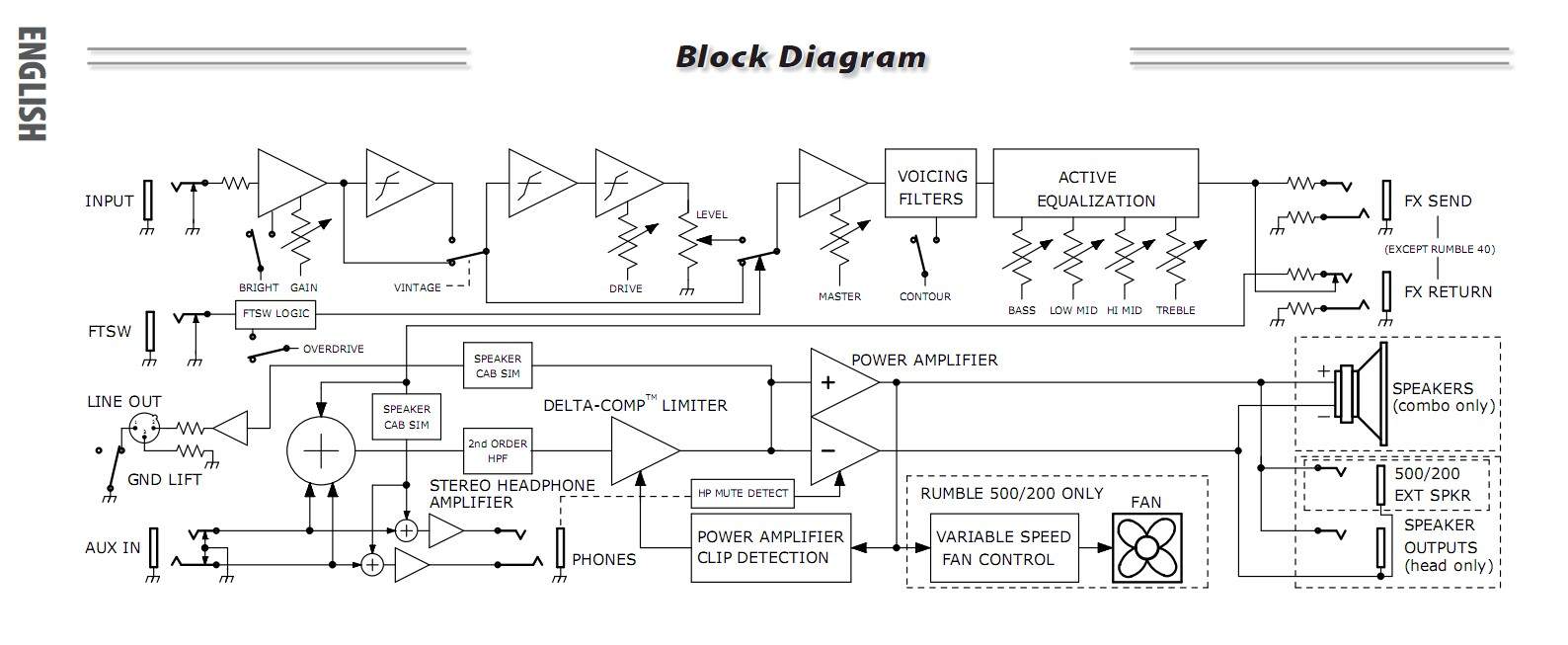
The most problematic thing for me on my Rumble is the XLR DI out. Every amp manufacturer seems to do it a different way:
- Some will use PRE EQ signal (level unmodified by the first gain stage / preamp input pot). This is just like if you use a direct box before the amp. The advantage of this is your signal is unmodified whatever tweaking you do on your amp (level, EQ, comp, etc.). Many soundmen will prefer that, because it allows the musician to do anything on the amp without any influence on what's being feed into the FOH and monitor consoles.
- Some other amps will have the XLR signal sourced POST EQ. That way, the signal feed to the XLR will be affected by the EQ you do on the amp. If your amp has an INPUT/GAIN level pot + a MASTER pot, the level of the XLR out will usualy be affected by the INPUT level. To me, it should not be affected by the MASTER. Why? Cause if you sound check at a specific amp level, and then during the show you need more (or less) power, you're going to turn the MASTER level of your amp, and if the XLR out is taped after the master (like in the Rumble, and some other amps as well) the signal level you send to the soundman will be modified as well. And soundmen don't like that, believe me! Now, if you're uncomfortable on stage and need to modify something, you have to do it softly/slowly, etc. If you do +10 db level, the soundman will hate you (and also probably all the other band members, as their monitor returns will also be affected). Also, some players will like a very scooped tone, per example, +10 bass, -10 mid, +10 treble, etc. per example. While some amplifiers could actually sound...... good (sight).... with a setup like that, there's many chances that it'll be a nightmare for the soundman. Not always a win/win situation. With a POST signal, you always need to carefully consider what you're doing on your amp, because it will affect everyone, soundman, musicians, audience.
- And then there's the new Fender fashion of doing POST EQ / POST MASTER volume and also with a cabinet SIMULATOR (not sure if all Fender amps are like that, but for sure I know the Rumble 40, 100, and the 100T are). The cab simulator could be a good idea for someone who's doing some home studio work. You plug your bass in the Rumble, then the XLR out direct in your soundcard and there you go with a coloured tone, like a mic'ed cabinet. The problem with that is that you're stuck with that tone! You can't change the mic. You can't change the mic position. And you can't disable the cab emulator! I say, IF I want a mic'ed cabinet type of tone, I'll just mic the amp MYSELF. A good mic won't cost a lot these days (once again, an SM57 is perfectly fine) and it's not a big problem to bring (or ask) a mic on a live gig, or in the studio, when you think about it. However, the problem appears IF I do NOT want a mic'ed cab tone. I would have to use a DI, before the amp, which is viable.... BUT: what you have to understand is that in many professional gig setups, musicians will use in-ear monitors. When I gig, I like to plug my bass in my amp, and send my DI out signal POST EQ to the soundman. Doing so, I can slightly EQ my tone up to my likings in my in-ear monitors (while considering what I'm sending in the PA of course). And same if I'm using wedge monitors. Having an EQ is handy in many situations. Using my TC Electronic RH450 amp, it allows me to EQ, compress, distort and MUTE myself (when I tune or swap instrument), which is very useful. I could not do that with a DI or with a PRE signal feed XLR out. I would need some extra stuff, pedals, more wiring, power supplies, etc. And I like my setup as simple as possible. Not many amps are as complete as the TC though, but a simple 3 band (parametric mids) would be enough for 90% of my gig, and the EBS offers that.
Regarding the Effects loop connection, you need to understand gain staging to see why having these connections post master volume is a non sense... Example: you want to use that old MXR Phase 100 pedal you have for a special effect during the gig. That pedal sounds terrific, vintage, vibey, etc., but as with many vintage pieces of equipment, it comes with noise! Hiss... So you connect the MXR through the effect send/return. As the MASTER level is before the send/rtn connections, the output of the MXR will always be at 100% maximum level in the amp, even if you turn down the master pot. Hiss will always be there, loud. ALSO, like I said in my previous post, if you need to drive the volume of the amp louder, the level being sent to the Effect SEND plug (to the pedal) will be modified, and could definitely distort that old MXR pedal. Any piece of gear could be connected there, btw. Same principle... (Obviously, it would be a better idea to connect a pedal like the MXR 'before' the amp, but that was just an example). I'm not sure if any other amp manufacturers design effect send/rtn like that, but to me (as a studio guy and live soundman) it's a complete non sense.
Sorry if this is too technical. I tried to make it clear as much as possible... Study the block diagram, you'll see what I mean.

That's quite clear. Thank you for taking the time to explain so thoroughly. I've also asked around over at the Rumble Club, and it does seem that opinion is divided on the subject. However, your input is much appreciated.Sure, I can explain. (I'm sorry if my English is not clear, not my native language).
The most problematic thing for me on my Rumble is the XLR DI out. Every amp manufacturer seems to do it a different way:
- Some will use PRE EQ signal (level unmodified by the first gain stage / preamp input pot). This is just like if you use a direct box before the amp. The advantage of this is your signal is unmodified whatever tweaking you do on your amp (level, EQ, comp, etc.). Many soundmen will prefer that, because it allows the musician to do anything on the amp without any influence on what's being feed into the FOH and monitor consoles.
- Some other amps will have the XLR signal sourced POST EQ. That way, the signal feed to the XLR will be affected by the EQ you do on the amp. If your amp has an INPUT/GAIN level pot + a MASTER pot, the level of the XLR out will usualy be affected by the INPUT level. To me, it should not be affected by the MASTER. Why? Cause if you sound check at a specific amp level, and then during the show you need more (or less) power, you're going to turn the MASTER level of your amp, and if the XLR out is taped after the master (like in the Rumble, and some other amps as well) the signal level you send to the soundman will be modified as well. And soundmen don't like that, believe me! Now, if you're uncomfortable on stage and need to modify something, you have to do it softly/slowly, etc. If you do +10 db level, the soundman will hate you (and also probably all the other band members, as their monitor returns will also be affected). Also, some players will like a very scooped tone, per example, +10 bass, -10 mid, +10 treble, etc. per example. While some amplifiers could actually sound...... good (sight).... with a setup like that, there's many chances that it'll be a nightmare for the soundman. Not always a win/win situation. With a POST signal, you always need to carefully consider what you're doing on your amp, because it will affect everyone, soundman, musicians, audience.
- And then there's the new Fender fashion of doing POST EQ / POST MASTER volume and also with a cabinet SIMULATOR (not sure if all Fender amps are like that, but for sure I know the Rumble 40, 100, and the 100T are). The cab simulator could be a good idea for someone who's doing some home studio work. You plug your bass in the Rumble, then the XLR out direct in your soundcard and there you go with a coloured tone, like a mic'ed cabinet. The problem with that is that you're stuck with that tone! You can't change the mic. You can't change the mic position. And you can't disable the cab emulator! I say, IF I want a mic'ed cabinet type of tone, I'll just mic the amp MYSELF. A good mic won't cost a lot these days (once again, an SM57 is perfectly fine) and it's not a big problem to bring (or ask) a mic on a live gig, or in the studio, when you think about it. However, the problem appears IF I do NOT want a mic'ed cab tone. I would have to use a DI, before the amp, which is viable.... BUT: what you have to understand is that in many professional gig setups, musicians will use in-ear monitors. When I gig, I like to plug my bass in my amp, and send my DI out signal POST EQ to the soundman. Doing so, I can slightly EQ my tone up to my likings in my in-ear monitors (while considering what I'm sending in the PA of course). And same if I'm using wedge monitors. Having an EQ is handy in many situations. Using my TC Electronic RH450 amp, it allows me to EQ, compress, distort and MUTE myself (when I tune or swap instrument), which is very useful. I could not do that with a DI or with a PRE signal feed XLR out. I would need some extra stuff, pedals, more wiring, power supplies, etc. And I like my setup as simple as possible. Not many amps are as complete as the TC though, but a simple 3 band (parametric mids) would be enough for 90% of my gig, and the EBS offers that.
Regarding the Effects loop connection, you need to understand gain staging to see why having these connections post master volume is a non sense... Example: you want to use that old MXR Phase 100 pedal you have for a special effect during the gig. That pedal sounds terrific, vintage, vibey, etc., but as with many vintage pieces of equipment, it comes with noise! Hiss... So you connect the MXR through the effect send/return. As the MASTER level is before the send/rtn connections, the output of the MXR will always be at 100% maximum level in the amp, even if you turn down the master pot. Hiss will always be there, loud. ALSO, like I said in my previous post, if you need to drive the volume of the amp louder, the level being sent to the Effect SEND plug (to the pedal) will be modified, and could definitely distort that old MXR pedal. Any piece of gear could be connected there, btw. Same principle... (Obviously, it would be a better idea to connect a pedal like the MXR 'before' the amp, but that was just an example). I'm not sure if any other amp manufacturers design effect send/rtn like that, but to me (as a studio guy and live soundman) it's a complete non sense.
Sorry if this is too technical. I tried to make it clear as much as possible... Study the block diagram, you'll see what I mean.
View attachment 856670
That's my main gripe with the Rumble series. Instead of concentrating on "aux input" and stuff, they would behave and look slightly more pro, if fx send return and line out was pre master. One can wonder what they'd been smoking when they designed that one. Especially as it affects the effects.(!). Changing the nomencalture for "fx send return" to "preamp out - power amp in" is not a good idea or vice versa.
Regarding the EBS Magni 500. I find those combos very peculiar, and have my suspicions on why they released it anyway. THEY HAVE FERRITE SPEAKER DRIVERS. The 2x10 is as big as the 1x15 and produces about the same range of bass. The 2x10 goes even deeper. No neodynium.
Regarding the EBS Magni 500. I find those combos very peculiar, and have my suspicions on why they released it anyway. THEY HAVE FERRITE SPEAKER DRIVERS. The 2x10 is as big as the 1x15 and produces about the same range of bass. The 2x10 goes even deeper. No neodynium.

EBS has three lines of cab, "Pro", "Neo", and "Classic". Only the Neos have neodymium drivers. Last I knew, the "Pro" and "Neo" lines were made in Sweden, while the "Classics" were made in China, like the Reidmar heads, so I'd be utterly unsurprised if the Magni uses ferrite drivers. It is perhaps worth noting that the new, Chinese-built Classicline 210 cab is spec'ed to 55Hz, while the higher-priced (but older design) Proline 210 is "only" spec'ed down to 70Hz (but is 3dB more efficient).Regarding the EBS Magni 500. I find those combos very peculiar, and have my suspicions on why they released it anyway. THEY HAVE FERRITE SPEAKER DRIVERS. The 2x10 is as big as the 1x15 and produces about the same range of bass. The 2x10 goes even deeper. No neodynium.
Tried them now at this weekends trade fair in Gotheburg. While sturdy, and tried to lift them. Oh dear...! Sounded decent and good, but nothing spectacular though. Others makes this too. Tough competition out there. Why they bother with same dimensions in two combos, one with a 15 and one with two 10s drivers beats me. Asked then why and they came with elusive salesman answers and tried to pitch me one...both their 1x15 magni and 2x10 magni goes down the same frequency. So very little to differ there between the two.
While EBS gear is great this one beats me...they're like 46 lbs or something.
While EBS gear is great this one beats me...they're like 46 lbs or something.
First, the solidity of the overall amp. The Rumble are definitely on the cheap side. The wood is very fragile. We want lightweight, they have to cut somewhere...
Second, like I said, the DI out is crap. I feel the speaker emulator is there to help home studio user to have a 'tone', but it's not a logical way of doing things in my book. If you go DIRECT, you want direct (not speaker emulated), so a good place to tap the signal is just post EQ. Then, if I want a speaker tone, I just use a $100 SM57 and tune it myself. Having a speaker emulator on the XLR out really is a bad bad idea, IMHO.
Third, the Effects Send/Return circuit, that is 'after' the master volume. Again, a complete non sense, think about it... At low level, any noise coming from what you insert there is gonna be audible at 100% volume. Also, if you drive the output hard (suppose you need full volume on a gig), you might distort a pedal, or whatever is insterted... The insert definitely needs to be AFTER the pre-amp but BEFORE master volume. Pre or post EQ is another debate. I do prefer post EQ, but definitely NOT post master!
I don't know who designed that circuit, but I cannot beleive it's someone who plays bass and use that amp in the real world! Just can't believe that...
The overall tone is somewhat pleasing though. Perfect for garage rehearsal. But not PRO use. At that price point, I can't complain though. Nice 'littl' amp.
Agree, this is one of my beefs about reviews. In authorized magazines with skilled personell, they at least ought to bring this one up, as a "consequence" or "drawback" but no one has done this as of yet as far as I know. Just skimming the surface. So by that definition it's NOT a professional product. Professional products doesn't have fx send return after master volume as well as speaker emulator in direct ouput.
One can wonder what they've been smokin when they designed that part. I am on my third 100 W Rumble now, since the first two "broke down" within warranty period, and I didn't harm them in any way. Will see how long this will last. I do have lined it out though, but I am wary and vigilant of turning on any knob once that connection is made.
It really is an odd product line. I was guessing that they invented it as a way to use up original Reidmar assemblies that were likely to go unsold as the Reidmar 750 gets into the market, but the whole point of the Reidmar was that it was their first lightweight class D product. Putting it in a heavy combo makes less sense. Maybe they see it as a stopgap replacement for the discontinued Gorm combos, but clearly that would be done better with a Reidmar 750 amp section and neodymium speakers - more power, more features, less weight. Also more money, but people don't buy EBS for the price, and it would be foolish for EBS to forget their professional user base to go chasing after the Rumble market.Tried them now at this weekends trade fair in Gotheburg. While sturdy, and tried to lift them. Oh dear...! Sounded decent and good, but nothing spectacular though. Others makes this too. Tough competition out there. Why they bother with same dimensions in two combos, one with a 15 and one with two 10s drivers beats me. Asked then why and they came with elusive salesman answers and tried to pitch me one...both their 1x15 magni and 2x10 magni goes down the same frequency. So very little to differ there between the two.
While EBS gear is great this one beats me...they're like 46 lbs or something.
The EBS heads Reidmar 250 and 750 are great. I used to own a Reidmar 250, but the fan noise became too prominent even though it's "just" 250 watts. However, they don't have this built in limiter that gets in the way on loud levels of other lightweight amps. There's some things to Magni series as they have got that FX send return right, and on top of that has a separted pre out and power amp in dedicated line. I e you can use two together if you like. One Magni 500 with 2x10 cab and the other with 1x15 and use only the power amp of the other one. As well as additional speakers.
I just thought that with these "new" things, they could've incorporated some "smart" invention or connection that made it more of a "killer" deal. That you bought these units in spite of the weight just because this or that. Found out something that no one else has. The combo market is a crowded place with stiff competition. Say, I would love to hook up two of them but be able to use some sort of built in cross over filter, so have only everything below 50 hz taken care of by the other one power amp. Then you can control the volume yourself of certain frequencies and have not to taken care of the frequency range of 40 - 15 K Hz within +- 6 db range. This + - 6 db you can take care of yourself. Like I would see that crossover connected with biamping or even triamping to come with that weight. I e separate power amps for tweeter and low end drivers. Or - say - concentric speakers, with the tweeter in the middle of the bass driver. But still biamped. Biamped sounds louder (very) compared to the same amount of wattage driven to a single ended driver. You could drive 200 w for the 15 and 50 for the tweeter. Say, just as an example. That would mitigate some of the weight issues.
Or something like that, to differ from others.
Don't forget that these combos are mainly still Reidmar 250 heads stucked inside a cabinet. No 750 head.
Thus, 250 W only on the 1x15 combo, and listed 300W on the 2x10 combo. 50 W difference.
The 300W 2x10 combo has a specd frequency range from 50-20K and the 250W 1x15 30 - 20K. And difference in weight is like 1.7 LBS.
So the "500" in the Magni is not a name for anything remotely close to the power it makes. Also the heads separate (250/470 Reidmar) weighs 3.2 KG (6.2lbs) alone. The rest of the 17 KG goes to the rest of the cabinets and drivers? 2x10 drivers at 6-7 kilos each?
Seems a little bit odd bringing two of these to market. One of them would've been enough.
I just thought that with these "new" things, they could've incorporated some "smart" invention or connection that made it more of a "killer" deal. That you bought these units in spite of the weight just because this or that. Found out something that no one else has. The combo market is a crowded place with stiff competition. Say, I would love to hook up two of them but be able to use some sort of built in cross over filter, so have only everything below 50 hz taken care of by the other one power amp. Then you can control the volume yourself of certain frequencies and have not to taken care of the frequency range of 40 - 15 K Hz within +- 6 db range. This + - 6 db you can take care of yourself. Like I would see that crossover connected with biamping or even triamping to come with that weight. I e separate power amps for tweeter and low end drivers. Or - say - concentric speakers, with the tweeter in the middle of the bass driver. But still biamped. Biamped sounds louder (very) compared to the same amount of wattage driven to a single ended driver. You could drive 200 w for the 15 and 50 for the tweeter. Say, just as an example. That would mitigate some of the weight issues.
Or something like that, to differ from others.
Don't forget that these combos are mainly still Reidmar 250 heads stucked inside a cabinet. No 750 head.
Thus, 250 W only on the 1x15 combo, and listed 300W on the 2x10 combo. 50 W difference.
The 300W 2x10 combo has a specd frequency range from 50-20K and the 250W 1x15 30 - 20K. And difference in weight is like 1.7 LBS.
So the "500" in the Magni is not a name for anything remotely close to the power it makes. Also the heads separate (250/470 Reidmar) weighs 3.2 KG (6.2lbs) alone. The rest of the 17 KG goes to the rest of the cabinets and drivers? 2x10 drivers at 6-7 kilos each?
Seems a little bit odd bringing two of these to market. One of them would've been enough.
Last edited:
I don't know if I would call all of the Rumble series "unprofessional". The only thing - and my yardstick - I go for when calling anything unprofessionall bass amp is when it's below 60-70 W. Those 40 W rumbles and even EBS small 8" 30 watts session combos I call "unprofessional" no matter how sturdy they're built. Anything below 100 W is actually for home use only. Professional means regularly gigging and touring, sessioning musician.
I think I would be better off buying a EBS Reidmar 750 head (700W) @726 USD plus any neocab of choice, their own NeoLine or Barefaced cabs. The weights outweights (!) the cost. Even cheaper go for the EBS Reidmar 250 head instead, and any cab of choice. You can swap them out, get additional cabinets and brands of you choice to stack under the Reidmar head.
I think I would be better off buying a EBS Reidmar 750 head (700W) @726 USD plus any neocab of choice, their own NeoLine or Barefaced cabs. The weights outweights (!) the cost. Even cheaper go for the EBS Reidmar 250 head instead, and any cab of choice. You can swap them out, get additional cabinets and brands of you choice to stack under the Reidmar head.
Their most succesful thing was/is their Session 60W combo. All transistor all ferrite driver, 10 inch. I used to own that one too, and it was more perfect for acoustic electric guitars and harmonica, and JAZZ archtop guitars than it was for bass. Once I got a 5er I thought the 10 inch and 60W didn't cut it at all. But by and large, I would really love to have some kind of amp that was just as suitable for guitar, bass, keyboards, and whatnot. But it's hard. People detects this, and it dawns to them slowly when trying things out on the amp that it wasn't originally made for. That small sucker was at 16 Kg anyway, 32 lbs.
However, mine picked up RF from a cell phone antenna station a couple of blocks away. When turning down the blinds of the window, the RF interference went away. No such thing with the Rumble...can play it in broad daylight...
However, mine picked up RF from a cell phone antenna station a couple of blocks away. When turning down the blinds of the window, the RF interference went away. No such thing with the Rumble...can play it in broad daylight...
Last edited:


