
Enjoy the benefits of a premium membership!
Upgrade Account
-
TalkBass has been independent since 1998. Add your voice.
Create a free account to reply to discussions, view embedded media, and browse with fewer display ads.
Join free Log in
Want zero display ads or expanded classifieds tools? Compare plans.
You are using an out of date browser. It may not display this or other websites correctly.
You should upgrade or use an alternative browser.
You should upgrade or use an alternative browser.
Double Bass Edgar Meyer Technique
- Thread starter Natmain
- Start date
More options
Who Replied?Stick_Player
Inactive
- Nov 13, 2009
- 4,149
- 937
- Disclosures
- Endorser: Plants vs. Zombies Pea Shooters
All he told me is that he turns his cell phone off.

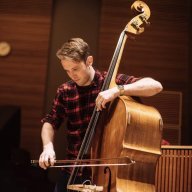
he tunes his bass EBEA. I switched to this tuning myself and I've really been enjoying it playing out and practicing. I find that my instrument projects better like this and it helps provide a more desirable mix with my band. We are a 4 piece string band btw. You must purchase solo gauge strings to replace the standard A, D, & G strings if this is something that interests you. I suppose this doesn't cover actual exercises but it's something to consider when watching or listening to him play

I attended a Master Class that Edgar gave at Central Michigan many years ago. The thing that stayed with me was that after the most advanced student had completed his piece and Edgar had given a few pointers, Edgar then asked him how many hours a day he was practicing. The student replied somewhere in the neighborhood of 4 hours a day. Edgar shook his head and literally said, "not even close. If you want to succeed, you have to be thinking 10 - 12 hours daily."
So, that kind of goes along with the earlier statement about practicing slowly; in the sense of taking the time to get each and every phrase and method exactly right. Exactly right.
So, that kind of goes along with the earlier statement about practicing slowly; in the sense of taking the time to get each and every phrase and method exactly right. Exactly right.
Stick_Player
Inactive
- Nov 13, 2009
- 4,149
- 937
- Disclosures
- Endorser: Plants vs. Zombies Pea Shooters
... Edgar shook his head and literally said, "not even close. If you want to succeed, you have to be thinking 10 - 12 hours daily."
Thinking or practicing 10-12 hours a day?
Physically practicing a Double Bass 10-12 hours a day is insane, and I would guess, physically impossible.
Thinking. Absolutely.
Even a guy like Edgar does many, many more things than just play the Double Bass.
He composes, plays Viola da Gamba, Piano, Banjo, probably more instruments, teaches, listens, travels, rehearses, performs, runs the "Edgar Myer Business", cooks. And that's the short list.
Time management and focus are key -- NOT the total number of hours.
Some people can barely get out of their bedroom within 24 hours, others can run the world with the same amount.
NO ONE has any more time than the next.
Many great players went through periods in their lives where they were indeed playing/practicing that many hours a day, especially around their college years. In order to reach that level, you simply have to put the work in. That is one of the biggest differences between players that do it for a living and players that don't. If you are in a major symphony orchestra that puts on concerts 3-7 nights a week, rehearses around that schedule, and you also teach, have a solo career, play in chamber ensembles, do studio work etc. then there is a good chance a lot of your days involve at least 3 hours of playing at work before any practicing occurs. If you are Edgar Meyer, then a typical day likely involves some practice/playing for the joy of playing, but more often than not he is also rehearsing, teaching, recording, or performing as well. He has created a life where he can immerse himself almost completely in music, where a lot of musicians have day jobs and other commitments that take them away from music making.
College is probably the closest most people who do not (yet) make music for a living get to complete immersion. In my final year of my undergrad, I had over 20 hours of scheduled time with my instrument, be it rehearsals, lessons, master classes etc. and then practiced and had a band on top. That's three hours a day, seven days a week of time I had to have my instrument in my hand, and I would often add four or more with practicing and other music, getting me close to 7-8 hours a day. I met pianists that did play 12+ hours a day. I am in no way suggesting that I am anywhere near Edgar Meyer as a bassist, but it's not too much of a stretch for him to be suggesting to a college student to do 10-12 hours a day.
Another thing worth considering is Edgar's technique. I have yet to see another classical bassist use economy of motion to the extent he does, or create half the sound he has with twice the effort. When you watch him play, his left hand floats around the instrument, and his right hand thinks about holding the bow. Many players, especially students, exert much more energy and play with a large amount of tension. If you are using extraneous motion and even the slightest bit tense, then 10-12 hours a day would result in all sorts of injuries. Relaxing is definitely the key, and is what makes it possible.
Focused, meaningful playing is important and does yield far greater results than just mindlessly putting in endless hours, but eventually you fine tune your focus as well. My most out of tune practicing now is significantly more in tune than my best practicing was 10 years ago. And I am greatly disappointed with myself now, where I would have been quite happy a decade ago. I am sure Edgar has unfocused or bad days too, but the difference is that he has set the bar high enough that even a bad day for him would be a pretty amazing day for most of the rest of us.
College is probably the closest most people who do not (yet) make music for a living get to complete immersion. In my final year of my undergrad, I had over 20 hours of scheduled time with my instrument, be it rehearsals, lessons, master classes etc. and then practiced and had a band on top. That's three hours a day, seven days a week of time I had to have my instrument in my hand, and I would often add four or more with practicing and other music, getting me close to 7-8 hours a day. I met pianists that did play 12+ hours a day. I am in no way suggesting that I am anywhere near Edgar Meyer as a bassist, but it's not too much of a stretch for him to be suggesting to a college student to do 10-12 hours a day.
Another thing worth considering is Edgar's technique. I have yet to see another classical bassist use economy of motion to the extent he does, or create half the sound he has with twice the effort. When you watch him play, his left hand floats around the instrument, and his right hand thinks about holding the bow. Many players, especially students, exert much more energy and play with a large amount of tension. If you are using extraneous motion and even the slightest bit tense, then 10-12 hours a day would result in all sorts of injuries. Relaxing is definitely the key, and is what makes it possible.
Focused, meaningful playing is important and does yield far greater results than just mindlessly putting in endless hours, but eventually you fine tune your focus as well. My most out of tune practicing now is significantly more in tune than my best practicing was 10 years ago. And I am greatly disappointed with myself now, where I would have been quite happy a decade ago. I am sure Edgar has unfocused or bad days too, but the difference is that he has set the bar high enough that even a bad day for him would be a pretty amazing day for most of the rest of us.
Well put Mike. I have no problems with the concept of working 10 /12 hours a day . At the Royal Academy and the Royal College in London the students have to get through a lot of hours either in ensemble playing, individual lessons, developing technique or practicing for this or that. They have a mandatory Alexander Technique course for each year so as to develop and understand their physicality and work with their instrument. You get the sense watching Edgar playing that everything flows and comes with ease and simplicity. He's pretty dialled in and physically at one with his instrument. That is something that I certainly have always strived for and I found a couple of years ago experimenting and making even small adjustments to my end pin height , stool height , and FB angle made a huge difference to my comfort and practice (as did a floor stud). I get comfortable ache free practice in most days usually about 6 hours which has just built up over time ...half way there !
Last edited:
I love Edgar Meyer. But I think too that it`s not only about the amount of hours you put in daily. You can do stuff that doesn`t really take you anywhere for those 19 hours a day, and hurt yourself while your at it, physically and mentally. We people have to eat, sleep, practice physical activities that keep us going and healthy, have social relationships, life, you know.
It`s about the quality of those hours you put in. It doesn`t hurt if there are plenty of them
It`s about the quality of those hours you put in. It doesn`t hurt if there are plenty of them
It`s about the quality of those hours you put in. It doesn`t hurt if there are plenty of them
You are absolutely right!
I saw Edgar Meyer perform in San Francisco a couple years ago in a family concert. Afterwards he had a mini Q and A and someone asked him about how long he would recommend practicing for a student who wishes to play professionally. He told us that in his undergrad he practiced around 3-4 hours, and for his masters he was doing 6 hours a day. He recommended that students practice 3 hours a day. He said that this is the minimum amount of practice time for a student who wants to play professionally.


- Jan 24, 2002
- 2,117
- 950
- Disclosures
- NS Design / AER Endorsing Artist
I've met and played for the guy a few times, but I can't presume to know how he works. He has a very dry sense of humor, and I think it's possible to mistake his sarcasm for real advice.
Ten hours a day, every day, in a practice room is not a great idea. Ten hours a day of thinking, listening, rehearsing, studying, and practicing is right on target, however. You just have to treat yourself with some respect in the process of obsessing.
Ten hours a day, every day, in a practice room is not a great idea. Ten hours a day of thinking, listening, rehearsing, studying, and practicing is right on target, however. You just have to treat yourself with some respect in the process of obsessing.

It`s about the quality of those hours you put in. It doesn`t hurt if there are plenty of them
You are right. But nobody here mentioned talent. Some just have more talent. Nothing you can do about it. Doesn't mean they don't need practice time though. I think 75% (or more) of the people can practice just as much and focused as Edgar Meyer but don't come even close in the end because they lack his talent.
Interesting book on that subject is called "Talent Is Overrated". Some pretty fascinating research . Check it out.You are right. But nobody here mentioned talent. Some just have more talent. Nothing you can do about it. Doesn't mean they don't need practice time though. I think 75% (or more) of the people can practice just as much and focused as Edgar Meyer but don't come even close in the end because they lack his talent.
Yep but the kind of talent you might be talking about is something very, very rare. Edgar Meyer is a son of a bass player and from a musical family?
I know one specially talented person and he happens to be a musician, a sax player. He was basically born with a mouthpiece in his system, breathing and fingers ready. But, he had to, and still has to work like everyone else. And he is not the best sax player of them all, things just were more natural and easy for him in and from the beginning. There are just as fine musicians as he is, but without the natural talent to play the instrument and learn the music really fast.
I know one specially talented person and he happens to be a musician, a sax player. He was basically born with a mouthpiece in his system, breathing and fingers ready. But, he had to, and still has to work like everyone else. And he is not the best sax player of them all, things just were more natural and easy for him in and from the beginning. There are just as fine musicians as he is, but without the natural talent to play the instrument and learn the music really fast.
Yep but the kind of talent you might be talking about is something very, very rare. Edgar Meyer is a son of a bass player and from a musical family?
I know one specially talented person and he happens to be a musician, a sax player. He was basically born with a mouthpiece in his system, breathing and fingers ready. But, he had to, and still has to work like everyone else. And he is not the best sax player of them all, things just were more natural and easy for him in and from the beginning. There are just as fine musicians as he is, but without the natural talent to play the instrument and learn the music really fast.
Actually, interestingly enough, the research would serve to downplay that point. It surprised me too. But check it out, if you are interested.
To me, the "talent" issue comes down to your view of developmental psychology. I generally agree with the experiential view. Who we are is a direct result of external stimulation. I don't think a natural talent in music really exists, but maybe you are more adept at hearing the relationships between sounds due to some early life experiences.
I think the talent aspect can't be underestimated and is not overrated as the book mentioned above stated (haven't read it though). Maybe not only the musical talent but especially the motorical/technical talent. Of course when you have the talent you still need to work hard. But some things just come more easy and natural especially the technical stuff. That's also why there are some advanced 6 year old players while other with the same amount of playing time and devotion still struggle with the simplest things.
Someone once said in one of these posts that"practice makes permanent not (necessarily) perfect".
To be born into a family of musicians, or at least a family of music lovers, is a great advantage because of the support, advice and understanding you can receive. Chances are that you will learn on a better instrument, receive lessons from better teachers and be exposed to broader experiences of listening to music and performing.
I think the words "talent" and "prodigy" are relevant. For example take 5 year old Wolfgang Amadeus You-know-who. Someone may have a particular talent such as inately good rythm, intonation or feeling for expression. It could be manual dexterity or excellent timing and coordination between hands. Occasionally you come across a very clear minded person who has all these attributes in abundance and from an early age too. Yehudi Menuhin premiered the Elgar Violin Concerto aged 13! They have all had to work hard but the path to success has been shortened and often facilitated when others have recognized their gifts.
Coming back to time spent on practice I relate this to what I am trying to achieve. My acronym is HEE. I am training Hands to fashion the notes, Eyes to read the notes and Ears to be my quality control. All these require a clear mind and smart practice. In the olden days, when I was trying to lift myself from amateur to professional, I would put in up to 30 hours a week of practice on top of my full time day job. Knowing what I do now I could have halved that time and yet achieved more.
Again, in another thread somewhere, someone said that these top people love to spend time on their instruments so that practicing is not a drudge for them.
Best wishes to all,
DP{
To be born into a family of musicians, or at least a family of music lovers, is a great advantage because of the support, advice and understanding you can receive. Chances are that you will learn on a better instrument, receive lessons from better teachers and be exposed to broader experiences of listening to music and performing.
I think the words "talent" and "prodigy" are relevant. For example take 5 year old Wolfgang Amadeus You-know-who. Someone may have a particular talent such as inately good rythm, intonation or feeling for expression. It could be manual dexterity or excellent timing and coordination between hands. Occasionally you come across a very clear minded person who has all these attributes in abundance and from an early age too. Yehudi Menuhin premiered the Elgar Violin Concerto aged 13! They have all had to work hard but the path to success has been shortened and often facilitated when others have recognized their gifts.
Coming back to time spent on practice I relate this to what I am trying to achieve. My acronym is HEE. I am training Hands to fashion the notes, Eyes to read the notes and Ears to be my quality control. All these require a clear mind and smart practice. In the olden days, when I was trying to lift myself from amateur to professional, I would put in up to 30 hours a week of practice on top of my full time day job. Knowing what I do now I could have halved that time and yet achieved more.
Again, in another thread somewhere, someone said that these top people love to spend time on their instruments so that practicing is not a drudge for them.
Best wishes to all,
DP{
10 hours a day is completely doable. It is incredibly rare to meet instrumentalists with true virtuosity who haven't put in these sort of hours, usually for years on end. These days, a four hour practice session feels like more maintenance than chops building. If you want to be mediocre, practice less. If you want to be exceptional, practice more. It's that simple.


