• TalkBass has been independent since 1998. Add your voice.
    Create a free account to reply to discussions, view embedded media, and browse with fewer display ads.
    Join freeLog in
    Want zero display ads or expanded classifieds tools? Compare plans.

Double Bass Experience with intonation adjustments on the extension after string change?

Aug 1, 2005
3,546
1,421
Cologne, Germany
www.basscapos.com
Disclosures
Private Inventor - Bass Capos
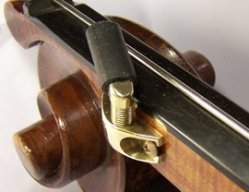
I was asked this recently. "Do you need to adjust the C-nut on the extension when changing to a different string?" Over the last fifteen years or so, I've used Eudoxa, Helicore orchestra, and Obligatos. A small sample, but a big variety of string types. After each change, I did move the nut so that the C would match the closed E, but on my bass the change was like 1.5mm at most. I've heard reports that some basses needed a much greater adjustment, and see some extension builders going really hog-wild creating an adjustable extension nut with a wide adjustability range. IME this is unnecessary. I just add a bit of spacer material or file down the end of the extension fingerboard to set the nut at the proper position.

I can imagine that the stiffness of the neck could come into play when changing to a string set with a vastly different tension, but this seems like an outlier. Can anyone chime in with their experiences?
 
I'll chime in if nobody else will. It seems like a range of adjustment of 1.5 mm both up and down might work although depending on where your starting point is that could limit you with a range that narrow. 4.5 mm total is less than 3/16" - 1/4 or 3/8" seems more like it unless you're totally sure of your compensated starting point and the bridge position remains the same. My experience has been that the ext. nut position definitely needs some compensation and that simply taking 1/4 of the vibrating string length of the E string would make you short by 2 or 3 millimeters. And like with guitars, stiffer strings require more compensation.
 
I'll chime in if nobody else will. It seems like a range of adjustment of 1.5 mm both up and down might work although depending on where your starting point is that could limit you with a range that narrow. 4.5 mm total is less than 3/16" - 1/4 or 3/8" seems more like it unless you're totally sure of your compensated starting point and the bridge position remains the same. My experience has been that the ext. nut position definitely needs some compensation and that simply taking 1/4 of the vibrating string length of the E string would make you short by 2 or 3 millimeters. And like with guitars, stiffer strings require more compensation.

Amen, Brother!
1/4 of the E string is NOT correct for calculating the correct/in tune C-ext. length and subsequent overall "E/C" string length.
There is a previous Thread here exploring this subject. (robobass and I arrived at a similar result, using different methods, for tuning and calculating the string/extension length).
Thanks,
don kasper
 
Last edited:
I'll chime in if nobody else will. It seems like a range of adjustment of 1.5 mm both up and down might work although depending on where your starting point is that could limit you with a range that narrow. 4.5 mm total is less than 3/16" - 1/4 or 3/8" seems more like it unless you're totally sure of your compensated starting point and the bridge position remains the same. My experience has been that the ext. nut position definitely needs some compensation and that simply taking 1/4 of the vibrating string length of the E string would make you short by 2 or 3 millimeters. And like with guitars, stiffer strings require more compensation.

vejesse - here is that prior discussion regarding C-ext./E string length calculation:

robobass-
I just did "your" Math on my C extension:
My numbers:
E string length - 42.250"
C string length - 53.375"
C extension length - 11.125"

I then ran your "126.3%" formula:
42.250 x 26.3% = 11.111"( C extension length).
42.250 + 11.111 = 53.361"( this is the C string length calculation, based upon your "126.3%" formula).

So, your "126.3%" calculation yields a C extension length of 11.111"(!)

I arrived at a C extension length of "11.125", and a resulting C string length of 53.375", using first, a Fret Calculator,(Stew Mac website), and then Tuner, Trial and Error /Earror.
I realize that 53.375 does not EQUAL 53.361, but it is fairly close(!).
(.014" = less than 1/64").

Thanks for your time and interest.
Thanks,
don kasper
 
robobass,

I see.
I only have experience between very similar string types, (Spiro Weich, Spiro Mittel), and so I haven't seen a lot of variation in tuning the extension between those strings. I suspect that there might be a need for more range of adjustment if, for instance, a synthetic/Velvet/Gut/Eudoxa type string were installed. I'm fortunate that the luthier who made my extension had over-engineered the nut area to accommodate a more accurate (longer) tuning length. (It was originally placed at the "1/4 of the E string" point).
Thanks for your interest (and products).
don kasper
 
robobass,
...
(It was originally placed at the "1/4 of the E string" point).
...
don kasper

Yes, I've had two extensions where the original nut was placed quite short. On my Pfretzschner I've got the nut sitting close to 3/8" beyond the original position. On this bass the extension length is 126.3% of the string length, over a half inch longer than simple "25%"!
As I said, I've found the adjustment needed from going between steel, synthetic, and gut was quite small.
 
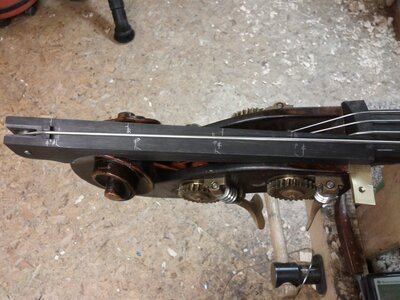
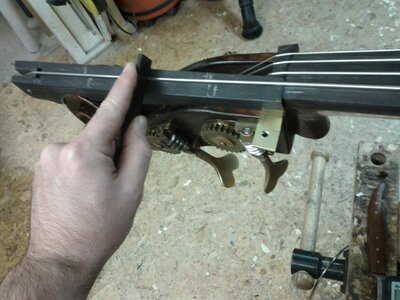
I have found great variation in tuning extensions from brands of strings and even within the same brand. In general, I find that the added string length of C extension equals 1/4 the instruments natural string lenght plus about 3-5 mm. I suspect it has mostly to do with the stiffness of a string making the intonation point a bit fuzzy (as you get closer to the nut, the stiffness of the string resist the free motion more and more). This idea seems to correlate with the observation that more string length is needed for the C and the E to intonate together, never less. An argument could be made for different temperament being an added confusion. In the shop we avoid this trouble by doing exactly what the customer will do, reach for a tuner. I've added a photo example and highlighted the pencil marks of an extension in progress at the shop. The blue lines indicate the intonation of a used string (I think it was a belcanto) we used during construction and initial set up of the extension. The red lines indicate the intonation points of the customers string choice (some Pirastro product judging by the silks).
 

Attachments

  • ExtTuneVarRaw.jpg
    ExtTuneVarRaw.jpg
    333.1 KB · Views: 151
  • ExtTuneVar.jpg
    ExtTuneVar.jpg
    321.3 KB · Views: 151
  • ExtFin.jpg
    ExtFin.jpg
    152 KB · Views: 156
  • Like
Reactions: JoeyNaeger
I have found great variation in tuning extensions from brands of strings and even within the same brand. In general, I find that the added string length of C extension equals 1/4 the instruments natural string lenght plus about 3-5 mm. I suspect it has mostly to do with the stiffness of a string making the intonation point a bit fuzzy (as you get closer to the nut, the stiffness of the string resist the free motion more and more). This idea seems to correlate with the observation that more string length is needed for the C and the E to intonate together, never less. An argument could be made for different temperament being an added confusion. In the shop we avoid this trouble by doing exactly what the customer will do, reach for a tuner. I've added a photo example and highlighted the pencil marks of an extension in progress at the shop. The blue lines indicate the intonation of a used string (I think it was a belcanto) we used during construction and initial set up of the extension. The red lines indicate the intonation points of the customers string choice (some Pirastro product judging by the silks).

keiranohara,

Those blue and red lines seem to be defying the laws of Physics! How were the chromatic notes between C and E calculated/arrived at?
Regarding the RED lines, for example :The distance of C - Db should be greater than the distance of Db to D. In the photo, it appears as though the distance from C-Db is LESS than the distance from Db-D.
Maybe the camera angle is distorting the relationship and position of those lines?
Regarding the BLUE lines : it appears that the distances between C-Db-D-Eb are equidistant from one another! You would expect to see a decreasing distance between those chromatic notes, starting with the C-Db, Db-D, etc.
Am I the victim of "Optical Confusion"?
Also, would you be able to provide the E string mensure and subsequent C-extension length of the instrument in the photos?
Thanks for your time, interest and expertise...(and beautiful craftsmanship).
don kasper
 
I think the reason why the extension needs to be a few mm longer than by tempered length ratio is that any pitch except the open string needs to press the string down which will stretch the string, raise the tension and so the pitch. The few mm more will bring the pitch down a bit, specially for the E which should be at the same position as the nut for the other strings.
Since steel, synthetic and gut cores stretch differently (which also depends on the diameter of the core), there might be some pitch variation for mechanically stopped strings, but the E is important for any kind of extension, so the extension length difference might be used to tune the E on the extension string. But lower capos might get a more bad intonation for a different string type if the total length of the extension is changed.
 
Sadly, I can not tell you those measurements, took those pics a few months ago and the bass has run off with the customer. Yes, those markings do show counterintuitive intonation. I will be doing another soon and will try an intentional demonstration (methods and a variety of strings). I believe this is an example of where the real world has far more variables than a classical physics three.
 
  • Like
Reactions: Greg Clinkingbeard
Here is the Math and Physics behind my thinking:

For a mensure of 42.00in., the "1/4 of the E string" calculation results in a C string of 52.50in., (42.00 x 1.25 = 52.50in.),
and a C-ext. length of 10.50in. (42.00 + 10.50 = 52.50in).


Using a Fret Calculator, (see Stewart-MacDonald website), which is based on the constant "17.817"(Google it), ("Pythanks, Pythagoras!"), and much trial and error, we finally look at a C string length of 53.00in. and calculate the first 4 "fret" locations.
This is:

fret / from nut / fret to fret
1 - 2.975" - 2.975" (nut-Db)
2 - 5.782" - 2.808" (Db-D)
3 - 8.432" - 2.650" (D-Eb)
4 - 10.934" - 2.501" (Eb-E)

We then subtract the total C-ext. length of 10.934 from the C string length:
53.00 - 10.934 = 42.06in.
So, the C-ext. length is 10.934in., which leaves an E string length of 42.06". Or, to put it another way - a mensure of 42.00in. requires a C-extension length of 10.934in.
Another way of thinking about this is to understand that a C string that is 53.00in. long, "contains" an E string that is 42.06in. long.
You must find a C string length that contains the length/mensure of the E string.
I believe this is a kind of "Reverse Engineering"?!
(A nice feature of the Fret Calculator is that it provides the locations of the chromatic notes in between the C and E).

The "1/4 of the E string" calculation is short by .50in. or approx. 12.5mm.
Even if "3 -5mm" is added to the length of that 52.50in. C string, it is still short by 6.5 - 9.5mm, or short by roughly 1/4in. to 3/8in.


My initial frustration, (over 20yrs. ago), was the result of attempting to reconcile the tuning of the open C string with the closed E string, and vice versa - either one could be "in tune", but never both at the same time. Most bassists I spoke with also expressed their frustration with this discrepancy. You could hear it in the Section.
I also found that, as recently as 2007, two very well respected luthiers that I had spoken with, were still using the "1/4 of the E string" formula.
Another problem is the difficulty of electronic tuners (even very expensive ones) to accurately "read" low pitches. I've verified the abstract/mathematical calculations using electronic tuners, harmonics- esp. the 1st, 2nd and 3rd partials, and my ears to confirm the conclusions above.
I'm not saying it's perfect, but I'm convinced that, as a starting point, it is much closer to "intuneness" than the archaic "1/4....." formula.
Thanks.
don kasper
 
Last edited:
The problem with the 1/4 calculation. Is that is really a 5:4 ratio (4/4+1/4=5/4) and this means you get a pure major third which is a much smaller interval than the tempered major third (by about 14 cent). It might be compensated a bit by the raised pitch of pressed down string, but probably only partly, since 14 cents is much (the tempered and the pure fifth differ only by 1.4 cents).
The main problem is not science, but that we often forget something important to consider in our calculations, so the model doesn't mirror the reality.
 
Sadly, I can not tell you those measurements, took those pics a few months ago and the bass has run off with the customer. Yes, those markings do show counterintuitive intonation. I will be doing another soon and will try an intentional demonstration (methods and a variety of strings). I believe this is an example of where the real world has far more variables than a classical physics three.

Is there an update on this demo?
Thanks.
don kasper
 
Yes there is. Sorry for my tartines, moving shop space and all other things have fallen by the wayside (so much stuff to pack so as to unpack).

With the four ext strings I could put my hands on, there were a shotgun of results. The hardest thing was consistency. Weight of the bowing varied the intonation a lot, upwards to 15 cents. With the bass on its back on the bench and with just the weight of my arm at the same point in the string. A ebony stick with nut sized grove along with a tuner is used to determine the intonating points.
ExtKS.jpg ExtTuneVar2.jpg IMG_20141016_183619.jpg IMG_20141016_183641.jpg IMG_20141016_183648.jpg IMG_20141016_183712.jpg
 
  • Like
Reactions: JoeyNaeger
Hi keiranohara,
Thanks for your quick reply.
1. Can you provide the natural mensure of the E string, and the overall length(s) of the extension from E to C, (or the final total mensure(s) of the C string)?.
2. I'm not clear as to what the 4 (and 4.x) digit numbers are referring to in the notebook photos.
Talk to me like I'm stoopid. Please.
Thanks.
don kasper
 
Thanks, keiranohara,

The calculation below shows that a C string whose length is 1338mm "contains" an E string whose length is 1061.98mm (1062mm, your E string mensure), and a resulting extension length of 276.02mm. Based on this calculation for an E string of 1062mm in length, it looks to me like the extension is (theoretically) short by anywhere from 9.5mm (for the Perm string), to 3.5mm (for the Evah).
This calculation also generates the position of each chromatic note in between the C nut and E stop- see "fret to fret", below. For example - Your locations for the chromatic notes for the "Flex Stark" vary wildly - (starting at "C-C#": 69mm,81.5mm,55mm,64.5mm), as do the locations on the Bel - do you think that pitch inconsistencies due to the bow weight, (which you alluded to), and/or tuner sensitivity and tracking, may have led to inaccurate readings? If the string is obeying the laws of Physics, these distances should begin to diminish in length, after the measurement of the first interval (i.e., the distance from C-C# should be longer than C#-D, etc.).
(Your placement of the chromatic notes for the Evah and Perm DO follow the anticipated pattern of diminishing lengths, by the way).

Fret position calculator


1338.000mm fret scale
1.gif

fret
1.gif
from nut
1.gif
fret to fret
1
1.gif
75.096mm
1.gif
75.096mm (nut-1)
2
1.gif
145.978mm
1.gif
70.881mm (1-2)
3
1.gif
212.881mm
1.gif
66.903mm (2-3)
4
1.gif
276.029mm
1.gif
63.148mm (3-4)

1338mm - 276.02mm = 1061.98mm

I definitely have an ongoing, (some would say unhealthy?), fascination with this topic...
Thanks for your time, interest, expertise and civility.

don kasper
 
Last edited:
  • Like
Reactions: Higure420