• TalkBass has been independent since 1998. Add your voice.
    Create a free account to reply to discussions, view embedded media, and browse with fewer display ads.
    Join freeLog in
    Want zero display ads or expanded classifieds tools? Compare plans.

Experiences with rechargeable 9V batteries?

now fishman does make an onboard lithium 9V supply that recharges via mini-USB; that lasts plenty long, but i don't love the idea that if you forget and let it die you can't throw in a new battery and you're just stuck with no instrument
Same. Easier to just buy a whole bunch of nine volts at Costco or online or whatever and keep a spare in your gig bag. My bass dying like my phone? That's a bad joke. Also another reason to always have a passive mode if feasible.
 
  • Like
Reactions: walterw
Not sure on the 9 volt lithium rechargeables but the AA's internally are charged to a high voltage and then regulated to 1.5 volts so the power / voltage output remains constant until at the point it dies. Some newer equipment has a menu selection for the battery type that scales the battery metering.

I bought a few Lithium AA's as a test in my wireless mics, they did not work well at all, randomly would shut off or sometimes would last for a few hours!
Panasonic AA's is all I use now.
how long ago did you try the AA lithiums? which brand? these seem pretty new and there are so many sketchy-sounding brands, i have to think the tech will mature pretty quickly

i've had good luck with the "amptorrent" brand in my wireless for a few years now, a fresh pair lasted all night. i managed to lose a few at a show a few months back and discovered that brand is already gone so i replaced the whole system with new Xtar batteries and charger; these are also doing just fine, a pair lasting all night in my relay G75 digital wireless

they do indeed have 3.6V internal that gets regulated down to 1.5V, so they stay at a full 1.5V right up until they die

 
As an Amazon Associate, TalkBass may receive commissions from qualifying purchases made via links on this site.
how long ago did you try the AA lithiums? which brand? these seem pretty new and there are so many sketchy-sounding brands, i have to think the tech will mature pretty quickly

i've had good luck with the "amptorrent" brand in my wireless for a few years now, a fresh pair lasted all night. i managed to lose a few at a show a few months back and discovered that brand is already gone so i replaced the whole system with new Xtar batteries and charger; these are also doing just fine, a pair lasting all night in my relay G75 digital wireless

they do indeed have 3.6V internal that gets regulated down to 1.5V, so they stay at a full 1.5V right up until they die

Actually they were the Amptorrent brand, it's been three or four years ago that I got them. I still use the few I got in my point and shoot digital camera, they seen to work well in that. I did try them in flash for my DSLR and at most I got two flash re charge cycles out of them.
 
As an Amazon Associate, TalkBass may receive commissions from qualifying purchases made via links on this site.
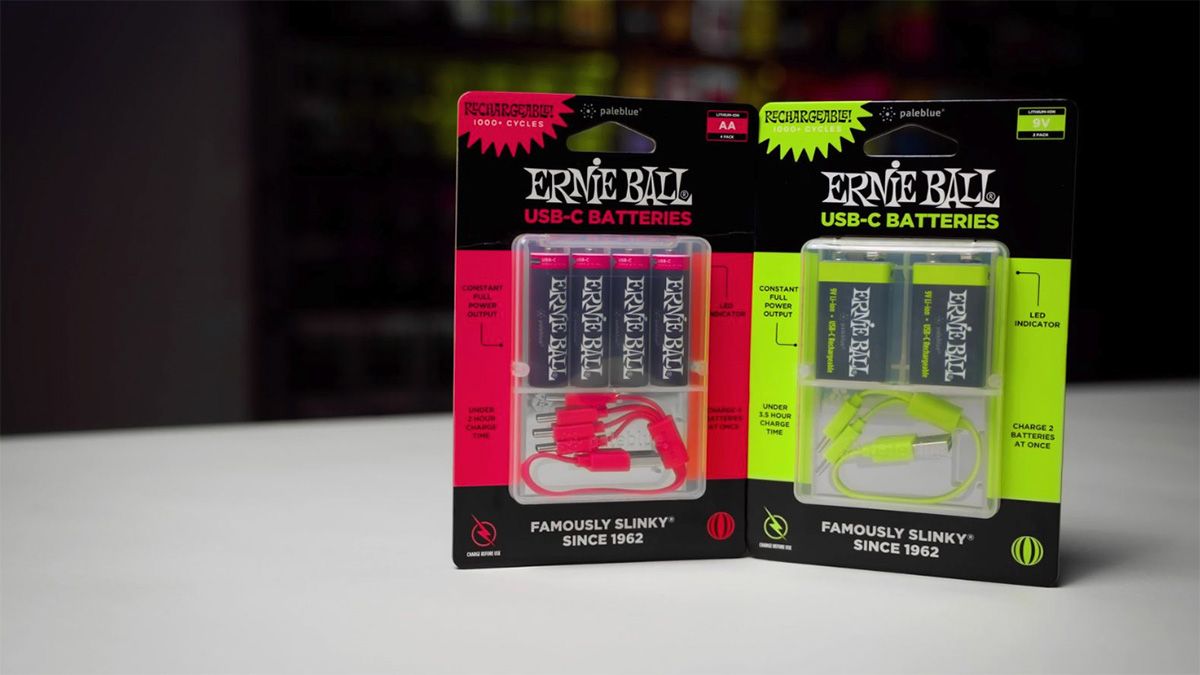
So, yesterday, I see an ad for these new Ernie Ball rechargeable batteries. Guitar World ran an article that seems like little more than a reprinted press release.


Absurd statements being made here. Who knows, though? Maybe they'll be decent. $30 on amazon isn't too bad. Gonna have to wait and see what the general verdict is when the reviews start rolling in.
 
  • Like
Reactions: v-12
Traditional non-rechargeable 9V batteries consist of 6 1.5V cels in series internally, and usually have slightly over 9V when fresh. The individual cels of rechargeables are usually only around 1.2V capacity or sometimes even less, so even when fully charged the voltage can measure below 8V sometimes (I've measured a handful with varying voltages from under 8V to around 8 and a half V). There are some rechargeable that will fit an extra cel in (for 7 total) so they are more in line with a regular battery when at full charge, but these are a bit larger and won't fit in many typical 9V quick-release type cavities and might need to be jammed into other tight cavities. In either case, as others have said, the way they discharge over time tends to make them unreliable for a vital application where you don't want drop-outs unless you recharge before every gig (which will quickly limit their lifetime, and again can lead to unpredictable drop-outs!).

I have used a Fishman Universal rechargeable unit in basses successfully, but as someone mentioned these are not 9V shaped and so best used in an application where you could quickly swap out for a regular 9V in a pinch. They are also super expensive for a rechargeable 9V battery option.
 
  • Like
Reactions: fig
Tried many rechargeable batteries in wireless systems, active basses, pedals. For me they are a royal PITA. Far more trouble to maintain and stay organized than simply using alkalines or corded depending on the item. If i gigged far less, rechargeables may be useful to me, but I usually return from gigs in the wee hours and all I want to do is bring my basses in and hit the sack. The next day is often another show, so remembering to charge and replace is frequently a problem.
 
  • Like
Reactions: calimariguy
Traditional non-rechargeable 9V batteries consist of 6 1.5V cels in series internally, and usually have slightly over 9V when fresh. The individual cels of rechargeables are usually only around 1.2V capacity or sometimes even less, so even when fully charged the voltage can measure below 8V sometimes (I've measured a handful with varying voltages from under 8V to around 8 and a half V).

Li-Ion or LiPo cells have 3.7-4.2V, one or two might be inside a 9V rechargeable, but the voltage might be regulated to 9V with an internal circuit. However, likely, different models may give different voltage. If you find the right one, self-discharge is very low and capacity may be higher than traditional ones.
 
Li-Ion or LiPo cells have 3.7-4.2V, one or two might be inside a 9V rechargeable, but the voltage might be regulated to 9V with an internal circuit. However, likely, different models may give different voltage. If you find the right one, self-discharge is very low and capacity may be higher than traditional ones.
I see you are right- I think my info must have been about earlier rechargeable that used 1.2V cels (the kind you had to recharge in a wall pack rather than with a USB cable). In any case, some of the ones I tried (and still have a few of somewhere in a box) were plug-in Li-ion and measured well under 9V when fully charged. That worked fine with some preamps, but can have low headroom or potentially no function at all with other preamps IME. The worst part was the unpredictable nature of the discharge over time though, as they could measure fine one day and completely die the next. I tried a couple of these in smoke alarms when I gave up on them in instruments and had similar frustrations where they would die unpredictably and sometimes permanently. Maybe the tech has improved, but it'd be hard to convince myself to make the investment again. One plus of the Fishman unit is the I could replace the actual battery cels relatively cheaply as long as the voltage regulator/charger part keeps working.
 
Last edited: