• TalkBass has been independent since 1998. Add your voice.
    Create a free account to reply to discussions, view embedded media, and browse with fewer display ads.
    Join freeLog in
    Want zero display ads or expanded classifieds tools? Compare plans.

Double Bass Extending the endpin all the way out

I have double bass with a steel endpin that has notches along it and a screw to hold it at the notches. The last notch makes the bass just a little shorter than I'd like it to be, so I go beyond it a little and the screw still seems to hold fine without the notches.

My question is that if I extend it more than it is intended so the end of the steel rod is outside of the bottom of the body but inside the housing of the endpin, would I break something or cause any problems?

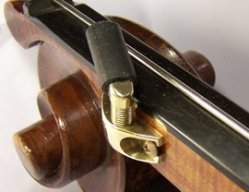
I illustrated it below (last notch on the left, all the way out on the right):
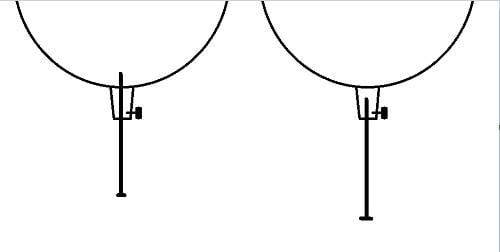

endpin.jpg
 
What kind of bass is it? If it's a Kay or Engelhardt, they now make a long endpin to replace the stock one, for folks like you. If it's something else, perhaps you could go to a local machine shop and get a longer, custom-cut steel rod (and even get them to turn a few notches on the lathe) for not too much money...
 
I had the same problem when I cut the endpin too short. With the end inside the housing, there is only one point of contact and the bass would wobble around. Plus the added stress would exert pressure on the screw causing it to loosen and eventually fail. I got a new endpin.
 
YES!!! Do not extend so far that the top of the pin is significantly below the top of the socket. Another thing to consider is the pin diameter. If you have a crappy 5/16ths pin (like on many older student basses), and extend it way out then it will bounce when you are playing. Bad for technical precision even if you don't break the socket. If you need your endpin to extend more than 8" or so, then at least use a 3/8" steel pin, and consider investing in a high quality socket/pin if you don't have one.
 
I got an extra-long endpin.

The longer it sticks out, the more leverage it has. You'll end up with either a bent endpin, or worse damage on the bass.

Get a longer endpin.

I'd only add that a longer pin won't prevent bending. Only a stiffer pin will. That usually means thicker. Also, if you need to extend that far, then an angled pin like the LaBorie seems especially worth exploring. Angle your pin back, and you reduce the bending moment. Angle it too far, though, and you just reverse its direction!
 
Last edited:
Yeah, to clarify, I wasn't saying a longer endpin won't prevent bending, quite the opposite! Just warning that a long endpin needs a little extra care. Bent my Shen's endpin just enough that extending it for play or retracting it for travel... well it sticks a little.

An angled endpin never appealed to me before, now it kinda makes sense.
 
I have double bass with a steel endpin that has notches along it and a screw to hold it at the notches. The last notch makes the bass just a little shorter than I'd like it to be, so I go beyond it a little and the screw still seems to hold fine without the notches.

My question is that if I extend it more than it is intended so the end of the steel rod is outside of the bottom of the body but inside the housing of the endpin, would I break something or cause any problems?

I illustrated it below (last notch on the left, all the way out on the right):


View attachment 512681
Short question and perhaps I should have created a new post for this. But I'm a pretty tall player (193 cm, or 6' 3" I believe). When I extend my endpin fully it automatically stops and the rod will not exit the inside of the bass. I believe there are like 3 small welded blubs on the top of the pin to prevent it from going out beyond that point. Is it okay to use the endpin in this fully extended state? There is no notch in that part of the endpin. But like this post also mentioned, it holds just fine without it.
 
Why would it not be ok?

Chet, are you responding to the OP? If yes, I think the problem is that it's a huge lever with little counterbalance on the other end (ie., inside the bass). Usually there is just as much endpin inside the bass as outside, and that helps to distribute any shock or leverage. Not so in this case.

When I think about an endpin being practically out of the bass, and fixed in that position, it seems similar to putting a crowbar at the collar/block join. I think that any sudden force is going to work 100% at damaging the block.
 
Actually replying to the previous post (dnp41), but everything you said applies:
Agreed, but if that is the height he needs, then regardless of what is inside the corpus, the distance from the fulcrum (end block) to the point of force (floor) would be the same, thus the leverage will be the same.

Is there a better solution, other than buying a taller bass? Play sitting? Cellists play with about 2’ of endpin out, but of course the instrument is much lighter….)

(I’m not attempting humor, just trying to understand the options.)
 
Last edited:
  • Like
Reactions: AGCurry
I have once seen a cellist playing standing with an extremely long endpin.
One should be aware of a long endpin putting more stress on the lower block, but as long as the endpin is completely in the endpin holder and the bass is not angled much when played it should be safe.
A new dent at the needed position might help to avoid a slipping endpin which can damage the bass.