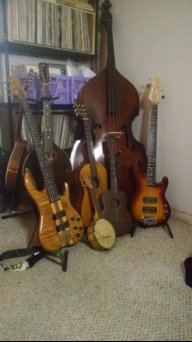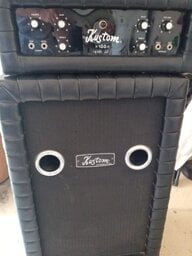
So Anyway, you know the TB drill. Pictures or it didn't happen.I got mine, at a reasonable price I might ad, off an adult toy website.


TalkBass has been independent since 1998. Add your voice.
Create a free account to reply to discussions, view embedded media, and browse with fewer display ads.
Join free Log in
Want zero display ads or expanded classifieds tools? Compare plans.
So Anyway, you know the TB drill. Pictures or it didn't happen.I got mine, at a reasonable price I might ad, off an adult toy website.
This needs more likes that was hilarious. Read it at work, waited til I got home to likeI got mine, at a reasonable price I might ad, off an adult toy website.
That depends on what you mean by “problem”. When I was a stoned and crazy teenager, I only had to turn the volume on my Bassman to about three o’clock to get endlessly sustaining Hendrix tones from my Coronado II (standing directly in front of, and facing the stack). I’ve never experienced this with another bass, and while any hollow body bass can feed back, Coronados are in a league of their own. Might have something to do with no center block, a metal bridge, and pickups you could announce a hockey game through. Having thrown mine in the trash forty years ago, I’m surprised that anyone buys them for any reason EXCEPT to get endless, Hendrix type feedback from them.How common is this? How loud is it for this to be a problem?
It seems to me that the idea or possibility of playing "unplugged" for practice is not only quite incidental to the the use of a semi-hollow or hollow-body electric bass guitar with F holes, but at best, quite unideal and unsuited for it in fact terms of physics and design, relative to using the instrument plugged-in. I know this from having played one in a jam/casual strummy acoustic front porch thing while there were two acoustics and a singer or two, the semi-hollow/hollow-body really had to be plugged in the be heard at all without beating it to death with super heavy plectrum picking just to be heard by everyone on solely an acoustic basis.Seems like a set of pickups that isn't microphonic would do the same, wouldn't it? Kinda defeats the purpose of a hollow body, which is really just the possibility of some unplugged volume for practice. Never even knew those existed.
I started out in the early 70's with a Hofner Beatle Bass and a Fender Bassman. They were a great match, except when placed into the hands of an inexperienced idiot.That depends on what you mean by “problem”. When I was a stoned and crazy teenager, I only had to turn the volume on my Bassman to about three o’clock to get endlessly sustaining Hendrix tones from my Coronado II (standing directly in front of, and facing the stack). I’ve never experienced this with another bass, and while any hollow body bass can feed back, Coronados are in a league of their own. Might have something to do with no center block, a metal bridge, and pickups you could announce a hockey game through. Having thrown mine in the trash forty years ago, I’m surprised that anyone buys them for any reason EXCEPT to get endless, Hendrix type feedback from them.



Kinda defeats the purpose of a hollow body, which is really just the possibility of some unplugged volume for practice.
I have an SA-70 too (with the F Hole plastic) and a later SA-75 which didn’t come with the plastic. They sound really different, but I don’t think it’s down to the plastic I have no issue with feedback on either, the 75 it just has a lot more growl and much hotter pick ups…My Yamaha SA-70 from the early 70’s has form-fitted plastic liners in both f-holes. They’re not removable but I do think they’re useful.
View attachment 7243019
Does the 75 have a centre block or is it fully hollow as well? Looks hollow with a floating bridge in the photo.I have an SA-70 too (with the F Hole plastic) and a later SA-75 which didn’t come with the plastic. They sound really different, but I don’t think it’s down to the plastic I have no issue with feedback on either, the 75 it just has a lot more growl and much hotter pick ups…

Ha! Thanks for asking… I had assumed they were the same construction but I just checked, poked a pipe cleaner in the f hole and it does indeed have a centre blockDoes the 75 have a centre block or is it fully hollow as well? Looks hollow with a floating bridge in the photo.
 (also gave it a tap and it sounds solid too)… that explains a lot, much more sustain than the SA-70. The bridge looks the same as the SA-70, but may be fixed down, I have changed the strings but it didn’t move so I left it where it was.
I suspected as much given what you’ve heard—and now begins my hunt for an SA-75! When I got my SA-70 it had the mute assembly but the foaam was DOA so I replaced that. I also extracted the tone control through the opening for the large jack plate on the side of the instrument and replaced the old 250k audio pot with a new 250k linear pot and upped the capacitor to 100 pF (from 47). The result is a really useable tone control, not what I experienced on delivery. BTW, I’ve had no feedback issues with the fully hollow body, but then I’m not playing at stadium volume.Ha! Thanks for asking… I had assumed they were the same construction but I just checked, poked a pipe cleaner in the f hole and it does indeed have a centre block
I now have flats on the SA-70 and rounds on the 75 I really like them both and between them there’s a lot of tones available.

I took the SA-70 to a luthier when I got it, he reckoned the tone pot should’ve had a much larger range than it does, so changing that makes sense. I have it set to zero 90% of the time for that dead plonky Hofner kind of sound so it didn’t really bother me especially once I got the 75 which covers more ground, although, thinking about it, it’d probably benefit from an upgrade there tooI suspected as much given what you’ve heard—and now begins my hunt for an SA-75! When I got my SA-70 it had the mute assembly but the foaam was DOA so I replaced that. I also extracted the tone control through the opening for the large jack plate on the side of the instrument and replaced the old 250k audio pot with a new 250k linear pot and upped the capacitor to 100 pF (from 47). The result is a really useable tone control, not what I experienced on delivery. BTW, I’ve had no feedback issues with the fully hollow body, but then I’m not playing at stadium volume.