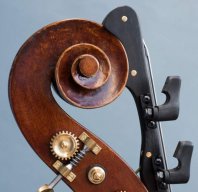
Oh, really now. It needs far more than just the neck attached. It has a name and number carved into it. The scroll is a mess. Sure, that could all likely be rahabilitated but it does not bode well for the condition of the rest of the instrument nor for how it has been cared. In addition, it has cracks and chips.
Yes, indeed, my judgment has a great deal to do with the fact that it is plwood! The point is that after the work is done to restore it, the time money and effort will only yield-- well, a plywood bass! In the case of a carved bass, you might end up with something that sounds great and that even is worth substantial $$$. It's like anything else. Whether it is worth restoring and whether the price is fair depends on what you will have in the end. It could be a car, a boat, a plane, a house, or a toaster.
This has nothing to do with intolerance of players or basses. Laminate basses have their places. I played one for years! This is a matter of common sense, practicality, and economics. In my opinion (and one that is apparently shared widely), paying nearly $500 (or even $300) for that abused and broken plywood bass makes no sense at all.
We here do a service to others who are less informed by steering them away from such "deals." It's not intolerance, it's sound advice.
Once again, for the record, I do not fault the seller who, except for the use of the word "fair" in describing the condition, is quite forthcoming about what he is selling.














 !!! - so I had to have his old bass. Despite hoping for my "gifted an old Italian bass" story, it turned out to be a pretty fair blond Selmer. I tried using it myself, but there's just no point. It's now a happy slappin' backup bass strung with weedwhackers for a mainstream/trad friend of mine.I think this kind of illustrates Ken's point.