• TalkBass has been independent since 1998. Add your voice.
    Create a free account to reply to discussions, view embedded media, and browse with fewer display ads.
    Join freeLog in
    Want zero display ads or expanded classifieds tools? Compare plans.

Fakes, copies, and tributes...

From what I have read here, the only consistent discriminator seems to be country of origin. If it is a US brand, e.g. Sadowsky, then it is accepted as 'improvement on a great idea'. Irrespective of quality, if it is of international origin then it is frowned upon. Unless you recognise the Lakland oval bridge, from a distance a Lakland P looks just like any other P-bass. Without a Fender logo it is clearly not a fake, but is it a copy or a tribute? Either way it is neither Fender nor original. What would be the collective's view on the same instrument with a Chinese maker's mark?
You are dead right, but few are going to admit to this, they have to admit to their biases and to being hypocrites
 
  • Like
Reactions: wcriley and SteveCS
To me a fake is something that isn't what it says it is--so if it says "Fender", for example, on the headstock, but it isn't a Fender--then it's a fake.
If it's their own brand name--then it's not a fake.
If it looks like a Fender & says "Ibanez" and is--it's a copy, if it isn't an Ibanez--it's still a fake.
 
  • Like
Reactions: Watchootognbout
Sometimes it gets into grey areas pretty quickly. I remember when the big discussion was were Squier instruments counterfeit even though they were licensed and sold by Fender? Same with the modern Epiphone line. (Wasn't this discussion on one of the rec.music groups in the days of old?) Under these criteria is my Epiphone EB-0 a counterfeit, or a knock-off, or a tribute? It's a brand owned by Gibson, but not made by them at the factory in Nashville. Yet made to look like the bass of old with a few differences that I consider to be major but some folks would consider insignificant (different bridge, different neck attachment).
 
Actually that's exactly what a logo is....an assurance, or guarantee, from a manufacturer that a certain standard of quality will be met, and that standard can be expected by the consumer. Generally speaking, the genuine article can always be expected to be of better quality than the cheap faux knockoff. That applies to all consumer goods.....clothing, wristwatches, tools, whatever.

But my point was that 'traditional' brands do not have a monopoly on top quality. And assurance is no guarantee.
 
Either way once you put a logo branding it as something it is not you've crossed the line.

:)

hC26E265E_zpsg2lytmw2.gif
 
  • Like
Reactions: Nomogram
Sometimes it gets into grey areas pretty quickly. I remember when the big discussion was were Squier instruments counterfeit even though they were licensed and sold by Fender? Same with the modern Epiphone line. (Wasn't this discussion on one of the rec.music groups in the days of old?) Under these criteria is my Epiphone EB-0 a counterfeit, or a knock-off, or a tribute? It's a brand owned by Gibson, but not made by them at the factory in Nashville. Yet made to look like the bass of old with a few differences that I consider to be major but some folks would consider insignificant (different bridge, different neck attachment).

Given that in both cases the manufacturer owns the rights to the design it is just another makers marque. A bit like GM in the US, Opel in Europe and Vauxhall in the UK.
 
BITD, when I was younger and could (kinda...) afford to do fun stuff, I was way into hot-rods, etc. I was a truck dude, but I digress. Anyhoo, a buddy of mine had a "General Lee" clone. Nobody thought it was the actual TV car, we just thought it was cool. Another buddy had a "Bandit" themed Firebird. A couple more dudes with more money had fiberglass T-Buckets, and a little more scratch could get you a fiberglass Shelby Cobra clone. Why? No way in hell any normal person could afford, or even have access to, the originals. It's all about intent, I suppose.

So today.... Jaco's bass of doom? Dusty Hill Custom Shop P? Jamerson's Funk Machine? No farkin' way LOL. Modded $100 Squiers as aesthetic "stage props?" Yeah, highly do-able for most of us Weekend Warriors. Intent, respect, and perspective...
 
I'm a professor of ceramics and here is a story I tell my students when this subject comes up.

Shoji Hamada (iconic mid 20th century ceramics artist) had a competitor who was making counterfeit pieces of his work. Hamada was asked why he didn't take legal action against the counterfeiter and his reply was: "In 50 years when we are both gone, all of his best pieces will be attributed to me and all of my worst pieces will be attributed to him."

I like this way of looking at it. If someone is making counterfeits, but are of subpar craftsmanship, than players and collectors will know it is fake. If it is poor quality, it will not stand the test of time.
 
...

I like this way of looking at it. If someone is making counterfeits, but are of subpar craftsmanship, than players and collectors will know it is fake. If it is poor quality, it will not stand the test of time.

And if it is good it will, in time, stand on it's own merit, like some of the better 'law-suit' basses everyone is fawning over these days.
 
It's really quite simple, putting someone else's name on the headstock is BS. Sure, it won't fool people with a bit of knowledge, but it screws the people who don't know any better. You can make the argument that someone who believes he's buying a $1,500 Ric, for example, from one of these disreputable sellers for $500 should know better, but what happens when someone resells one for more than $500 to another naive buyer?
I can't count how many times I've heard someone ask where they can find a Ric copy and then someone asks them: "Do you want the Ric sound or do you want a bass that looks like a Ric?" Nine out of ten times they answer that they want a bass that looks like a Ric. Sure, to each his own, but the wanting fakes is half the problem.
As for Squires, Epiphones, Sterlings etc, they shouldn't even be a part of this conversation. Companies like Retrovibe who manage to skirt the copyright issues (they're not copies trying to fool anyone) is another subject entirely.
Regardless, I wouldn't be happy with any fake or "tribute" bass, I'd rather play a Squier, Epiphone or Sterling than even the most convincing fake Fender, Gibson or Musicman bass.
As for fake Rics or Ric copies, again, I prefer the genuine article. I want my bass to be every bit as real as my playing.
 
Last edited:
  • Like
Reactions: SteveCS
But my point was that 'traditional' brands do not have a monopoly on top quality. And assurance is no guarantee.

Traditional brands (sic) do have a monopoly on their standard of quality. It rests on brand name recognition by consumers. That brand name is a "guarantee" of continuation of established quality standards. Consumers are "assured" of this standard by a written "warranty". There is no such reliable assurance from the flim-flam knockoff artists who would have unwary consumers believe otherwise.
 
Anyway, what the hell is a "tribute" bass?

This is what I consider a tribute, I'm taking a Rondo Hadean solid body bass ukulele and modifying it to look like the first solid body electric bass by Paul Tutmarc of Audio Vox in the 1930s/40s.
Rondo 24 Tutmark both 800.jpg


This is a P-bass style mini bass copy (or can it be called a tribute) that I bought recently and had painted, imported from China by SmallGuitars.com.
Small P-bass 700.jpg
 
Traditional brands (sic) do have a monopoly on their standard of quality. It rests on brand name recognition by consumers. That brand name is a "guarantee" of continuation of established quality standards. Consumers are "assured" of this standard by a written "warranty". There is no such reliable assurance from the flim-flam knockoff artists who would have unwary consumers believe otherwise.

In theory yes, but in reality, sadly not, especially in large corporations where 'affordability' is the latest buzzword and quality standards are the first things to go - largely as victims of their own success.

But the point I was trying to make is that top quality does exist beyond the leading mass-market brands and can be found in all parts of the world. Not everything non-US or non-Fender is 'flim-flam'.
 
I have noticed that there is good advice and bad on here about the idea of buying a bass that looks like something else. I would love to sort out the differences between them.

So the first catagory is fakes.
Fake basses are exact copies of real basses. They use parts and logos that look real. These are for people trying to scam or impress others. They can be well made or firewood quality. The people that knowingly buy or sell these should be shunned. You are hurting others buy having these on the market.

The other is a copy. This is similar to a fake, but is marked with a different brand. Licensed or not, a copy can be total garbage or a beautiful gem. A Lotus is a good example of this. As is a Sadowsky. Both are at different ends of the quality. But neither try to be exactly the same as a Fender.

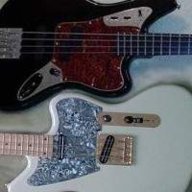
The last is a tribute. This is where some Chinese basses fall. Especially the Rickenbacker basses that are out there. Now before you dismiss this as a fake hear me out. All that I have seen are Ric like, but not an exact copy. The diffences can be more or less frets, different scale, etc. This can be a good substitute for a bass that is out of your price range or just not available. Or if you like the look, but not the feel or sound of the real one. Again they can be trash or beautiful. But they shouldn't fool anyone trying to buy it. It should be obvious that it isn't the real thing at first glance.
If you want a copy or a tribute, go for it. Nothing wrong with either as long as you understand what you are getting. Good or bad, it should be obvious that it isn't the original.

Fakes should be avoided and so should people that sell them. They create confusion on the market and can hurt people financially. Either by being scammed or by driving down the prices of real ones.

I own copies and tributes. I would never own a fake.

whatever helps you sleep at night.
 
I guess my point is that Steve Jobs didn't invent the computer; he created his own version of it. Kinda like Roger Sadowsky. He didn't invent the electric bass; he created his own version of it.
Regarding the computer. Xerox pretty much started it all. Not only that but they also thought up the graphical interface and the mouse. Steve and Bill grabbed anything and everything that wasn't copyrighted from Xerox, IBM and each other.
 
  • Like
Reactions: kohanmike
Yep, Xerox PARC (Palo Alto Research Center) engineers and designers brought their computer to their bosses of Xerox in New York, who asked what that has to do with copy machines and told the engineers to dump it. They did an open house in Palo Alto and invited their local computer companies to see what they had done. Steve Jobs was known to have regretted not licensing the part that became Adobe. (Sorry to add to the hijacking.)