This is the Horace Silver video with Gene Taylor I was speaking of, there are several good shots of him playing and of his bass

Enjoy the benefits of a premium membership!
Upgrade Account
-
TalkBass has been independent since 1998. Add your voice.
Create a free account to reply to discussions, view embedded media, and browse with fewer display ads.
Join free Log in
Want zero display ads or expanded classifieds tools? Compare plans.
You are using an out of date browser. It may not display this or other websites correctly.
You should upgrade or use an alternative browser.
You should upgrade or use an alternative browser.
Double Bass Famous Jazz Bassists and their instruments
- Thread starter jazzizded
- Start date
More options
Who Replied?
That’s very kind, thank you. I’m headed home from Brazil tonight (weather permitting, ugh), in the 10 days we’ve been here a couple of basses nearly killed meFlattery will get you everywhere . And let me say this......you kill on any bass, seriously.
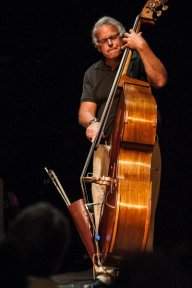
Jed is a true master. He was able to make my bass a completely different instrument. After 12 years of playing it I still can't get over how much he improved it. I'm glad that Juzek is working out well for you. Maybe you've seen on one of the lower bouts someone carved their name and street address if that bout hasn't been replaced. I bought it from a bassist in the Dallas Symphony around 1995 who was happy to sell it to raise money to buy another bass. He didn't use it with the symphony, I think he used it for jazz gigs. I don't think he realized its value as a jazz instrument. Before it was restored it sounded really open and big, afterwards the sound changed. I'm sure that Jed was able to bring that sound back. I'll be watching Small's feed in hopes of hearing you and that bass soon!
Thanks for the back story, it’s great to know that about the bass. And I have seen the name, just part of the charm of a workhorse bass. To be honest, if I had know more about carved basses when I bought it I may not have bought it. It definitely sounded closed up when I got it, but there were things about the sound that I couldn’t pass up, especially in my price range. As I played it it opened up but the first big step was Jeff Bollbach resetting the neck, that made a massive difference. After that there were times it felt and sounded good, but they just never seemed to last. Arnold and Kieran had the top off in late 2016 and as you would expect they did a tremendous job, new bass bar, cleaned up a lot of old repairs, and for awhile it felt fantastic. But Jed had been on my mind since he worked for Arnold, and Ben Street in particular had telling me to get up there. So I finally did last fall and he just turned that bass completely around, everyone who had any familiarity with my playing and sound noticed the difference immediately. If you go to the Smalls archive, all the gigs I’m on since last September are post-Jed
Last edited:
Oh, yeah, I saw that one (I think) but that was a different bass. The one I'm thinking of had a dark varnish, beautiful curly maple back & sides, violin corners, a C-extension, and was a Bass World centerfold about 25 years ago...anybody else know the one I'm talking about? Maybe I just need my medication adjusted again....I want to say that I saw it for sale on Arnold’s old website and it was listed as “high end German”
I'm on it. All of those guys are great. Jed has something unique, though. Its great when you get your bass back from the shop and it sounds as good or better than you hoped it would. Safe travels home!
What did Pops Foster, Wellman Braud, Slow Drag Pavageau, and Montudie Garland use?
I'm not sure about these bassists, but most pictures of Walter Page show him with a Tyrolian "block-less wonder" flatback. Jimmy Blanton played a German factory bass and one article I read said it was a Juzek. That's one bass I'd love to play.
- Steve

We are talking about jazz bassists we adore and what basses they use (and how it doesn't matter anyways because we are mere mortals), and nobody mentioned any modern players like Avishai Cohen or Dan Berglund or Nick Blacka. I must be too young to be hanging out on here or none of y'all listen to anything that was recorded after 1980.
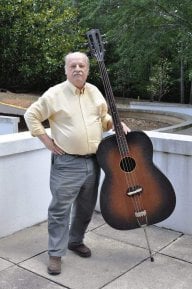
George Duvivier played three DBs over the course of his career and revealed the brand names of none of them. Details can be found here
Bassically Speaking
Bassically Speaking

We are talking about jazz bassists we adore and what basses they use (and how it doesn't matter anyways because we are mere mortals), and nobody mentioned any modern players like Avishai Cohen or Dan Berglund or Nick Blacka. I must be too young to be hanging out on here or none of y'all listen to anything that was recorded after 1980.
I'm pretty sure that Avishai Cohen plays a Juzek. I'm gonna guess it's a 50's era instrument, but it's only a guess.
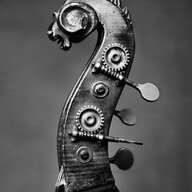
I thought this excerpt was interesting where Duvivier describes getting his "the one" bass, so in case you don't want to read thru the whole thing (but the whole thing is surely worth reading):George Duvivier played three DBs over the course of his career and revealed the brand names of none of them. Details can be found here
Bassically Speaking
It was while working with Coleman Hawkins in that winter of 1939 that I found the bass that I'm still playing today. Actually, it found me. In those days, all of the dealers used to bring their instruments around to the jobs. They would get the musicians to sample them hoping to palm them off by offering discounts. They were pushing the American basses then: Epiphone, Kay, Guild, King, and Gibson. Most were plywood instruments made by the guitar companies. It was a motley group; some were pink or green! American Standard even made a metal bass; instead of getting your bass cracked you could get it bent! I would usually look at this collection and wave the salesmen off. I had a pretty good instrument and intended to get a better one as soon as I saved some more money. I was in no position to do it then. But one night Eddie Bell of New York Band showed up with this bass. It was around eleven, and we were into our second set. When I spotted him I said, “Oh no, not another one!” After the set, Eddie asked me if I’d like to try it. I said, “What is it, another plywood?” He said it wasn’t, so I took a closer look and pulled the strings a little. I took it up on the stand with me and started the next set with it. After the first two notes the whole band turned around and looked at me and said, “What’s that?” That was it! I told Eddie, ‘‘You’re not getting this instrument back. Here’s my old bass as a down-payment. We’ll discuss terms later.” I paid it off weekly as I worked.
It’s just one of those rare instruments. I wish I could tell you the pedigree, but it has no name. It was built by an Italian, who was then an octogenarian. He made it as a labor of love. He built two of them; I got one, and later Artie Bernstein got the other. I did meet the old man once when I took the bass into his shop for an adjustment less than a year after I got it. He was pleased that I’d bought it and was so happy with it. He died shortly afterward, and no one seems to remember his name. So it’s a bass with no name. It is a most unusual instrument. It’s three-quarter size, which means it’s not too bulky to carry around. And it does everything I want it to, from jazz to orchestral work. It bows well and has no “woof point,” as we in the bass department call it. That means that there is no place where the note will choke down on the string; you can play the full length of each string and get a clear sound all the way. Since 1939, that bass has covered many millions of miles with me!


I'm pretty sure that Avishai Cohen plays a Juzek. I'm gonna guess it's a 50's era instrument, but it's only a guess.
Avishai plays a Pfretzschner built on the early 1900's. Chris Wood's is also a Pfretzschner.


And just for the record I like Charlie best on that lions head Pollmann he had, though he sounded just like himself on every bass I ever heard him play
Yes, I heard and loved him in the 70's with that bass. Possibly why I've always wanted to own a lions head bass... Never found the right one at the right price!
Some contemporary players:
Rufus Reid plays a Joseph Reiger bass.
Steve Rodby plays a Wilfer that he got from Marc Johnson.
Mike Arnopol plays a Golia.
Larry Gray plays a big German imported by back in the day by Chicago company Lyon & Healy.
Paul Warburton played a 5 string by Chicago instrument manufacturer Joseph Bohmann.
Robert Hurst also plays a Bohmann.
John Patitucci has played many basses professionally including Pollman, Villaume, and Thomas Martin.
I've heard Ben Alison with an old blockless looking bass, possibly a Prescott.
Marlene Rosenberg plays a Pollman.
Rufus Reid plays a Joseph Reiger bass.
Steve Rodby plays a Wilfer that he got from Marc Johnson.
Mike Arnopol plays a Golia.
Larry Gray plays a big German imported by back in the day by Chicago company Lyon & Healy.
Paul Warburton played a 5 string by Chicago instrument manufacturer Joseph Bohmann.
Robert Hurst also plays a Bohmann.
John Patitucci has played many basses professionally including Pollman, Villaume, and Thomas Martin.
I've heard Ben Alison with an old blockless looking bass, possibly a Prescott.
Marlene Rosenberg plays a Pollman.
how about henry grimes and that green bass he played for a while. I think I read William Parker gave it to him when he started playing again...so rad.

Henry Grimes! One of the most humble, nice, and talented guys I've met. A largely unsung bass hero.how about henry grimes and that green bass he played for a while. I think I read William Parker gave it to him when he started playing again...so rad.
View attachment 2951408


