okay, so to get this back on topic, does anybody here play fanned fretless and regular fretless, and if so, how much of an adjustment is it to make? Somehow I get a feeling that fretless might actually be easier to adjust to than fretted, and I'm not really sure why.

Enjoy the benefits of a premium membership!
Upgrade Account
-
TalkBass has been independent since 1998. Add your voice.
Create a free account to reply to discussions, view embedded media, and browse with fewer display ads.
Join free Log in
Want zero display ads or expanded classifieds tools? Compare plans.
You are using an out of date browser. It may not display this or other websites correctly.
You should upgrade or use an alternative browser.
You should upgrade or use an alternative browser.
"Fanned" fretless?
- Thread starter Warpticon
- Start date
More options
Who Replied?
I found fanned fretted very easy to adapt to - literally 30 seconds.
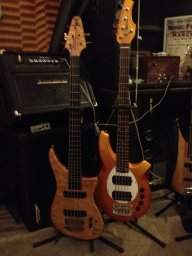
I have not played fanned fretless, but as position of your fretting hand is critical to the intonation and, say on a four string, you will have four reference points to get used to for the intonation of each string, this is going to take a bit of learning. In saying that nothing is impossible and check out this beauty!
[Invalid or Expired Link Removed]
I have not played fanned fretless, but as position of your fretting hand is critical to the intonation and, say on a four string, you will have four reference points to get used to for the intonation of each string, this is going to take a bit of learning. In saying that nothing is impossible and check out this beauty!
[Invalid or Expired Link Removed]
I usually don't like the long upper horns at all, but that looks great to me. Also, that looks like some fairly modest fanning--not nearly as extreme as a lot of other examples I've seen. Maybe it's just the scale length.
Me too: definite case of relearning your technique and forgetting what you have learned. I suspect though that if your new to fretless then the learning curve would not be so steep.
There's a Dingwall fretless 5 on Bassgear.com for $1600
Bump
There's really
no relearning on fanned frets.
There's a slight adjustment when chording up high. Some chords are actually easier, but how much chording can you do if you're working.
no relearning on fanned frets.
There's a slight adjustment when chording up high. Some chords are actually easier, but how much chording can you do if you're working.
There's really
no relearning on fanned frets.
There's a slight adjustment when chording up high. Some chords are actually easier, but how much chording can you do if you're working.
I'm pretty sure that's what I said!

Question is (as per my last post) what about fanned fretless?!

Another point/clarification. Although a longer B IS one major benefit of longer scale fanned fingerboards, the other benefits can be had with shorter scale lengths. The most significant of these is more even tension across all strings. I play both 32-35 and 34-37 scale fanned basses, preferring the shorter scale for chordal stuff or when I use the B rarely. I occasionally play a fretless that's "regular". IME switching to the fan is a breeze 

1" fan if I remember (34-35); Dingwall goes up to 3" (32-35), I think.
Dingwalls go 34" to 37" in their 5str.
Having played many basses (40+ I own right now) with different scales, ranging from 34" to 36" (conventional) and the Dingwalls, IMHO the fanned fret concept provides the most benefits if the B is 36(+)''. The other benefit is the even-ness of string tension and tone across the strings and across the board. I have no problem to go from "conventional" to fanned to "conventional fretless. At the end of September, I will have a fretless Dingwall to comment on the specific comparison ("conventional" to fanned fretless)

I 'thunk' wrong re the Dingwall - thanks for the correction.
I'll be keen to get the feedback on the 'fanned fretless'!
I agree no problems to go parallel fretted to fanned fretted to parallel fretless.
I'll be keen to get the feedback on the 'fanned fretless'!
I agree no problems to go parallel fretted to fanned fretted to parallel fretless.
they are the 4str version of the traditional J-vibe. The G is sweeter than the Jazz and the E is tighter (equal tension and tone balance across the string and board). I am sure you can find the Super J review and see what some other players say

JAUQO III-X
Inactive
You know what I'd like to see? An unlined fanned fretless...
I was hoping that my Conklin fanned fretless was unlined but when I recieved it,it was then that I saw that it was not.
I can only speak from my experience playing a fanned fretless.
The lines would be an incredible help(and I really hate lines)it really does give you an indication where you are at on a multi scaled instrument.With out the lines it really is an all out open vast land on the fingerboard because with the fanned finger board naturally it becomes multi scaled so technically you would be playing at least two different scale fretless basses at one time(depending on how many strings your bass may have)
Jauqo is an incredible player both in terms of technique (from ERB to fretted and fretless) as well as groove. He really nailed it.
One of my fretless basses was unlined and even though the tone was huge and fat, I had a harder time to enjoy jamming with it. I needed to concentrate harder to play in tune compared with my other lined fretless
One of my fretless basses was unlined and even though the tone was huge and fat, I had a harder time to enjoy jamming with it. I needed to concentrate harder to play in tune compared with my other lined fretless

Of course you can make a fretless with fanned lines and even one with a parallel bridge and nut. No one said you had to pay attention to the lines when playing.
Scott
Scott
You know what I'd like to see? An unlined fanned fretless...
I basically have one in medium light. The combo of maple fretlines and hazy epoxy make the lines very subtle.
Latest posts
-
-

-
Post a funnier picture than the one above - Parallel Universe Edition
- Latest: BassicJazzy
-
-

