
Enjoy the benefits of a premium membership!
Upgrade Account
-
TalkBass has been independent since 1998. Add your voice.
Create a free account to reply to discussions, view embedded media, and browse with fewer display ads.
Join free Log in
Want zero display ads or expanded classifieds tools? Compare plans.
You are using an out of date browser. It may not display this or other websites correctly.
You should upgrade or use an alternative browser.
You should upgrade or use an alternative browser.
Fatten up D and G string notes?
- Thread starter Halvorsen
- Start date
More options
Who Replied?
I have often said I could just play a two-string bass, just the E and A strings. I understand your dilemma. I have found that flats help, especially if they are beefier. But, they don't really solve the whole problem. Something I have tried to train myself to do is to pluck more on the side of my finger on the D and G strings, especially the G string. The extra meat helps make them sound fuller. Hard to implement sometimes, though, depending on the line.
Some amps have a Contour function. This does seem to fatten up notes and goes well with a compressor. And just as a side note, short scale basses seem to have fatter notes on the D and G strings.

My recommendation would be a combination of:
(1) Making sure the volume is relatively even across all strings, and raising the pickups on the D-G side if they are too quiet;
(2) Slightly heavier strings;
(3) Playing softer and more even; and
(4) Using compressor that has at least some "fattening" effect.
The compressor may actually be the most important part of this equation, with most of the other points making it more effective. I rarely use more than minimal compression because I don't want fat-sounding D-G strings. Every time I've tried to use a pedal compressor I find that it beefs up the D-G strings too much and loses the "stringy-ness" that I prefer for playing chords and upper register parts. A cheap (used) and easily available option would be the Boss LMB-3, which I specifically found to have this feature/problem.
(1) Making sure the volume is relatively even across all strings, and raising the pickups on the D-G side if they are too quiet;
(2) Slightly heavier strings;
(3) Playing softer and more even; and
(4) Using compressor that has at least some "fattening" effect.
The compressor may actually be the most important part of this equation, with most of the other points making it more effective. I rarely use more than minimal compression because I don't want fat-sounding D-G strings. Every time I've tried to use a pedal compressor I find that it beefs up the D-G strings too much and loses the "stringy-ness" that I prefer for playing chords and upper register parts. A cheap (used) and easily available option would be the Boss LMB-3, which I specifically found to have this feature/problem.

And one, specific reason why I use the Boss LMB-3. Honestly, I get more from EQ'ing though.My recommendation would be a...compressor [it] may actually be the most important part of this equation...Every time I've tried to use a pedal compressor I find that it beefs up the D-G strings too much and loses the "stringy-ness" that I prefer for playing chords and upper register parts. A cheap (used) and easily available option would be the Boss LMB-3, which I specifically found to have this feature/problem.
As an eBay Associate, TalkBass may earn a commission from qualifying purchases.

This is why I use tube Ampeg amps and a REDDI. You can get a fatter sound if you add a touch of overdrive and do a little EQ magic, but with tube amps, you don't need to.
I have two things to say on the subject.I've come to a crossroads in my playing style and I need some advice.
For years, I've been playing my bass lines using the E and A strings for the root notes of a song, moving around and changing hand position as needed. I use the D and G strings mostly when I do fills, walks, or when adding melodics.
I do this not because I am unaware of how to play using all four strings in one position, but because I prefer the Fatter, rounder tone I get out of the two lower strings as compared to the Brighter thinner sound out of the D and G strings.
Lately, I've been experimenting with moving all the notes of a song to one hand position and using all 4 strings, like I'm sure most of you already do.
While I really would like to use this arguably better technique, I am having trouble accepting the loss of the round tone I get from playing mostly on the E and A strings when holding down a simple root note bass line.
My question is this: Is there anyway to Fatten up the notes on the D and G?
I've considered flats, thicker gauge strings, and maybe a 5 string so I could gain the extra positioning higher up on the neck, but I'd like to hear some opinions and advice.
Anyone else struggled with this?
1. a hollow or semi hollow body bass (and many of the older ones are shorter scale too) will be much fatter on the high strings.
2. here's my new idea but i haven't tried it yet. slant the next pickup so it favores the high strings a little bit and slant the bridge pickup the opposite direction so it favores the low strings and then mix the two pickups to taste. Anybody tried this?

Not a concern of mine, however, yes to flats and or thicker gauge and the 5 string with a low B seems like the way to go IMO......I've considered flats, thicker gauge strings, and maybe a 5 string so I could gain the extra positioning higher up on the neck, but I'd like to hear some opinions and advice. Anyone else struggled with this?
Here's what I did. (It's also what Lee Sklar did on one of his Ps). Leave the E/A pup where it is and mount the D/G pup on the fretboard side. That's known as a 'half-reverse P'. Hide the mod with a custom pickguard from Pickguardian.
Weak D and G strings were one of the reasons I grew to dislike rounds; that and the sometimes overly zingy overtones. I briefly tried various rounds but always went back to flats. About a month ago I put GHS Balanced Nickels on my jazz bass. Wow! The sales pitch is not just hype - the D and G REALLY hold their own, even on the upper frets. The strings are very warm for rounds and the growl is lower in the mids than other rounds I have tried. I LOVE these strings, and they're only a little over $20 for a four string set. Definitely worth a try!

I also like the fat deep sound of the E and A. And depending on the song, the fatter E and A fit better to hold the bass line. I do the same also, and go out of my way sometimes to use the E or A, which requires more speed and precision in the hand and arm than playing in the box or an open string. Nevertheless, there are songs that have a lot of walking type lines that fit well with using all the strings.
So I suppose it's best to use both depending on what you feel the song requires.
So I suppose it's best to use both depending on what you feel the song requires.

All good advice. For me it's about hearing my D and G strings in a loud band. Pickup height adjustments seem most effective. Also, make sure your mids aren't scooped and bass isn't boosted. Surgical fully parametric boost in the 100-200 range can help.
I'm not convinced strings make a big difference for me but thicker D and G strings do help. I'd like to find some rounds at about 50-65-80-100.
Sealed cabs help a lot with their damped lows. "flat" cabs with their enormous lows seem to exacerbate the problem.
P basses tend to be more even than J basses in this regard.
I'm not convinced strings make a big difference for me but thicker D and G strings do help. I'd like to find some rounds at about 50-65-80-100.
Sealed cabs help a lot with their damped lows. "flat" cabs with their enormous lows seem to exacerbate the problem.
P basses tend to be more even than J basses in this regard.
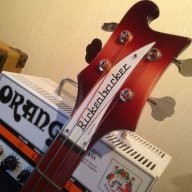
I tried a set of those GHS balanced nickels on my rick. definitely more even string to string. i quite like them.
I'd try those GHS balanced nickels but my main band right now is tuning down to E flat and I need a high tension string. I don't think a 0.044 G would do it.

- Feb 8, 2005
- 3,636
- 1,053
- Disclosures
- Endorsing Artist: Bag End - Dean Markley - Thunderfunk
Years ago, I had a very long conversation with the late Bill Lawrence. We talked about many things and at one point we got into this very topic. It's something that has bugged me pretty much always and fairly ubiquitousl.
Based on our talk, his assertion is that the core problem at work here is that (for the most part, this also pertains typically to round wound strings) the G string in a set of electric bass strings isn't really a bass string....it's a guitar string.
At gauges of .045", 040" (i.e. the gauges most in use) a G will typically consist of a core and a single wrap. All the heavier strings have more than one wrap and this difference is a major (and he maintained THE) reason why the fundamental timbre of the G differs from the other strings....it tends to sound thinner and twangier.
There's work-arounds and things one can do the help reduce the effect but nothing really can offset the fact of differing construction. There are a few companies (Thomastik comes to mind) that use more and/or silk wraps internally, and sometimes heavier G strings will have a very small thin inner wrap under the main, but this is rare.
Of course, cost is the culprit since the inner wrap needed would be very thin, something like a .005" wire and this would be harder to work with, more expensive to make, etc. so it's not generally done.
BTW I'd love to know if anyone knows of a .045" round wound G with more than 1 wrap.
Based on our talk, his assertion is that the core problem at work here is that (for the most part, this also pertains typically to round wound strings) the G string in a set of electric bass strings isn't really a bass string....it's a guitar string.
At gauges of .045", 040" (i.e. the gauges most in use) a G will typically consist of a core and a single wrap. All the heavier strings have more than one wrap and this difference is a major (and he maintained THE) reason why the fundamental timbre of the G differs from the other strings....it tends to sound thinner and twangier.
There's work-arounds and things one can do the help reduce the effect but nothing really can offset the fact of differing construction. There are a few companies (Thomastik comes to mind) that use more and/or silk wraps internally, and sometimes heavier G strings will have a very small thin inner wrap under the main, but this is rare.
Of course, cost is the culprit since the inner wrap needed would be very thin, something like a .005" wire and this would be harder to work with, more expensive to make, etc. so it's not generally done.
BTW I'd love to know if anyone knows of a .045" round wound G with more than 1 wrap.
"Balanced Nickels have the same number of wraps from string to string."
Products - BALANCED NICKELS - GHS
I have not tried them. But they seem to have addressed Bill's (and your) concern.
Products - BALANCED NICKELS - GHS
I have not tried them. But they seem to have addressed Bill's (and your) concern.


