• TalkBass has been independent since 1998. Add your voice.
    Create a free account to reply to discussions, view embedded media, and browse with fewer display ads.
    Join freeLog in
    Want zero display ads or expanded classifieds tools? Compare plans.

Double Bass Fdeck and GB Shuttle 3.0

As an amplification neophyte I have an HPF question. The background is that I'll soon get my hands on a GB Shuttle 3.0 combo (for DB with Realist copper p/u). From what I can tell, an HPF like the Fdeck is commonly used by folks for this set-up. Impedance for the amp is 500 K-Ohm I think.

My questions are:
- do I have this right so far (about the fdeck rec)?
- if so, should the HPF plug in before the amp input or as an "effects loop?" (see pic), or does it not matter?

Feel free to educate me on anything else I might be missing here...
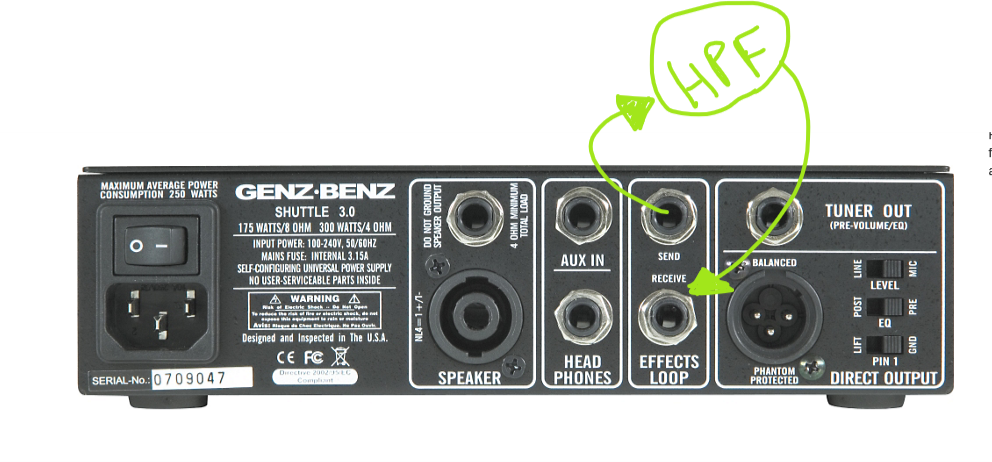
GB shuttle .png
 
If you don't plug the FDeck into the front end of the amplifier, so that it's Pickup>FDeck>and Genz Benz. You will not get the 10 Meg Ohm load that the FDeck HPF/Buffer Preamp provides. 500 K is to low for piezo pickups.

So, you will only get the 500K that the preamp section of the Genz Benz provides. You will still be able to use it as a Hight Pass Filter and Phase Reverse. You could plug into the HPF in the effects loop you'll likely be past

the EQ section.
 
As an amplification neophyte I have an HPF question. The background is that I'll soon get my hands on a GB Shuttle 3.0 combo (for DB with Realist copper p/u). From what I can tell, an HPF like the Fdeck is commonly used by folks for this set-up. Impedance for the amp is 500 K-Ohm I think.

My questions are:
- do I have this right so far (about the fdeck rec)?
- if so, should the HPF plug in before the amp input or as an "effects loop?" (see pic), or does it not matter?

Feel free to educate me on anything else I might be missing here...

View attachment 3666008
easiest way to do it (and most effective in my experience) is plug your bass into the fdeck, than the fedeck into the amp. You can just sit it on top of the amp if you like, and use a short cable to connect it to the amp. Easiest way is to use 9v batteries, unless you have a 9v power adapter and don't mind having something else to plug into.
 
Don't be afraid to try the FDeck in the effects loop though... when I had a GB Shuttle 6, one of my piezo pickups (APTflex) sounded best straight into the amp with the FDeck in the effects loop. FWIW, all of the bridge wing style pickups wanted the FDeck in line before the amp.
The final proof is if it sounds how YOU want it to.
 
To followup on Jeff's comment: Piezo pickups are affected by the load impedance and the difference between say 500K, 1M, 5M and 10M can be quite audible with most pickups. Usually the higher the input impedance the more lows and less highs. Depending on the bass, the pickup and your personal taste, the ideal impedance for you might be different than for someone else.

Just the other day I was using a borrowed Demeter amp with 1M input impedance at a rehearsal. I tried it with and without my fDeck (10M), just to hear the difference. At first, I thought straight into the amp sounded really good (all tube preamp, nice)...then I plugged the fDeck in and the heft increased dramatically, not something that could be compensated for with the amp EQ. However it wasn't that the Demeter by itself sounded bad. I've also had this experience with GK amps...1M input impedance plus a high mid EQ band that sits right where you want it to control the nasal aspect of most pickups makes them very DB friendly, but adding the fDeck still gives more heft to the sound.

There are a few boxes out there that allow the user to dial in the input impedance to your taste if you're anal enough about your sound. My personal experience is that anything between 1M and 10M works well for me,
 
  • Like
Reactions: Zbysek and Ric Vice
The field effect transistor has a very high input impedance (the impedance is so high that a resistor is needed to lower it to the useful value for a certain application) so very few electrons need to go in and out which is good for piezos. It is mainly a current amplifier (same voltage but more electrons can be delivered to the next stage.

Bipolar transistors have a lot lower input impedance and won’t work well directly connected to a piezo.

There are also OpAmps with a FET input stage like the one in the HPFpre version 3. They are also commonly used in mixing consoles.

Also an FET is more similar to a tube than to a bipolar transistor.

The highest input impedances have MOS-FETs. But they are very sensitive to static electricity and can be damaged just by touching the gate connector (more modern ones have some safety built-in).