
Enjoy the benefits of a premium membership!
Upgrade Account
-
TalkBass has been independent since 1998. Add your voice.
Create a free account to reply to discussions, view embedded media, and browse with fewer display ads.
Join free Log in
Want zero display ads or expanded classifieds tools? Compare plans.
You are using an out of date browser. It may not display this or other websites correctly.
You should upgrade or use an alternative browser.
You should upgrade or use an alternative browser.
fEARful part nine (9)
- Thread starter greenboy
- Start date
- Status
- Not open for further replies.
More options
Who Replied?
So leave the gains on the amp the same, just reduce the output for the mid at the crossover by -3db? Sounds simple enough. I also have a few other related questions.
In the typical CBG 15/6 crossover, roughly how much power is wasted to heat? 2%? 10%?
What are the recommended hi/lo pass freqs/slopes for a 15/6?
Thanks guys.
Mike
In the typical CBG 15/6 crossover, roughly how much power is wasted to heat? 2%? 10%?
What are the recommended hi/lo pass freqs/slopes for a 15/6?
Thanks guys.
Mike
Yeup. That's a good starting point anyway. From what I recall I think people use a lot of different padding values; GB was using down around 1.5db or something for a while I think, and I want to say 4Mal uses as much as 4db of padding with his Alpha in the 12/6 (which would normally call for no padding).
Definitely a place in which you can experiment if you're responsible
Definitely a place in which you can experiment if you're responsible

- Dec 18, 2000
- 13,201
- 340
- Disclosures
- greenboy designs: fEARful, bassic, dually, crazy88 etc
If you have to ask, maybe you should step away. It can get expensive, not understanding. OK. Disclaimer served.
Better live sound engineers look at sensitivity figures of the various components, and passbands they are safe and good in. That determines a range of crosspoint possibilities and likley pad-back values.
Here, I'll say that for 15/6 there's a mid driver pad-back range of about -1.5 to -4.5 dB (centered on a nominal - 3dB value). Anything less than that it's hard to get the lower-pitched strings to sound balanced with the D and G and C strings no matter what brand of barbecue sauce you soak them in. Any more than that, you should be looking at EQ instead, because you are painting with too broad a brush. It's better to have fine grained control.
For active crossover type in such a case as fEARfuls it should ALWAYS whenever possible be Linkwitz-Riley, 4th order or higher. This gives better performance off-axis vertically for one, and steeper slopes that minimize the crosspoint transition, which is good up close. It offers more protection and it's very easy to tune.
Crosspoint range for LR24: 500 Hz to 800 Hz. Anything higher makes a mess because of the huge peak the 3015LF has above 1K Hz, anything lower is making the 6ND410 resonant bump too obvious and the driver handle perhaps more power than good, and also scoops out the mid-midrange slightly. You want the enclosure voice to be relatively flat there and take care of any scooping you think you want via EQ. I consider 710 Hz pretty fine myself.
But then, I have a DSP crossover, where I can perform slight over- or under-laps if desired. A straight analog electronic crossover will not allow separate lowpass and highpass values. Rightfully so: you can mess things up if you have more things to mess with ; }
* * *
Best highpass filter if any is a Butterworth, at least 3rd order, 4th or 5th order is optimal. You can call those BW18, BW24, BW30. But forget passive in-enclosure highpass filters. They are not effective for most applications.
Realize that with all this talk of a capacitor on the woofer that you are talking one of the mightiest MI woofers ever with a 9.6 xmax and a 17 xlim, tuned sufficiently low that it won't easily unload. It's all those other pathetic woofers out there that you need to worry about! ; }
Better live sound engineers look at sensitivity figures of the various components, and passbands they are safe and good in. That determines a range of crosspoint possibilities and likley pad-back values.
Here, I'll say that for 15/6 there's a mid driver pad-back range of about -1.5 to -4.5 dB (centered on a nominal - 3dB value). Anything less than that it's hard to get the lower-pitched strings to sound balanced with the D and G and C strings no matter what brand of barbecue sauce you soak them in. Any more than that, you should be looking at EQ instead, because you are painting with too broad a brush. It's better to have fine grained control.
For active crossover type in such a case as fEARfuls it should ALWAYS whenever possible be Linkwitz-Riley, 4th order or higher. This gives better performance off-axis vertically for one, and steeper slopes that minimize the crosspoint transition, which is good up close. It offers more protection and it's very easy to tune.
Crosspoint range for LR24: 500 Hz to 800 Hz. Anything higher makes a mess because of the huge peak the 3015LF has above 1K Hz, anything lower is making the 6ND410 resonant bump too obvious and the driver handle perhaps more power than good, and also scoops out the mid-midrange slightly. You want the enclosure voice to be relatively flat there and take care of any scooping you think you want via EQ. I consider 710 Hz pretty fine myself.
But then, I have a DSP crossover, where I can perform slight over- or under-laps if desired. A straight analog electronic crossover will not allow separate lowpass and highpass values. Rightfully so: you can mess things up if you have more things to mess with ; }
* * *
Best highpass filter if any is a Butterworth, at least 3rd order, 4th or 5th order is optimal. You can call those BW18, BW24, BW30. But forget passive in-enclosure highpass filters. They are not effective for most applications.
Realize that with all this talk of a capacitor on the woofer that you are talking one of the mightiest MI woofers ever with a 9.6 xmax and a 17 xlim, tuned sufficiently low that it won't easily unload. It's all those other pathetic woofers out there that you need to worry about! ; }
I'm looking at the Peavey Max Bass preamp with built in crossover, spec'd at 18db per octave. My Rane crossover is 24db per octave. For biamping a 15/6, will the Peavey's crossover slope be adequate?
Side note: My Rane AC22 in mono runs as a three way x-over with a Lo-Mid-Hi output. I could overlap if I wanted, set Lo at 600hz, the Hi at 575hz while hooking up the mid driver to the Hi out on my Rane.
Side note: My Rane AC22 in mono runs as a three way x-over with a Lo-Mid-Hi output. I could overlap if I wanted, set Lo at 600hz, the Hi at 575hz while hooking up the mid driver to the Hi out on my Rane.
- Dec 18, 2000
- 13,201
- 340
- Disclosures
- greenboy designs: fEARful, bassic, dually, crazy88 etc
I'm looking at the Peavey Max Bass preamp with built in crossover, spec'd at 18db per octave. My Rane crossover is 24db per octave. For biamping a 15/6, will the Peavey's crossover slope be adequate?
In general the fEARfuls can sound great with that BW18 crossover that's on the Max (which I use sometimes). It's mainly off-axis on the vertical (where you might be standing close, with the cab on the floor not tilted upward, that it can be "different". You can cross fairly low because BW summing is 3dB hot on axis at the crosspoint. This will juice up the 6ND410 dropoff at say 500 to 630 Hz. This all depends on how padded back one runs the mid driver, too. If not very padded back at all, 700-800 Hz might be a safer bet when doing an especially powerful amp.
Experiences and ears gives one the confidence to answer all their own questions during the actual using, so it's important to spend time with this stuff, and maybe use a particular setting for quite a while as long as you don't hear the mid driver protesting. That allows your ears to really accomodate new territory, and some time to check it out thoroughly at various distances and angles. I'll often spend a week with a new setting before blowing it off or committing to it, with maybe an occasional comparison to a favored approach just to keep things honest.
Side note: My Rane AC22 in mono runs as a three way x-over with a Lo-Mid-Hi output. I could overlap if I wanted, set Lo at 600hz, the Hi at 575hz while hooking up the mid driver to the Hi out on my Rane.
Just more to confuse yourself with. Forget overlap until you've really gotten a grasp mentally and aurally. I've done SR for ages, so I can tell myself I know what I'm doing - as long as nobody can hear something bad enough to call me on it ; }
Thanks for all the tips, GB. If I go active xover it will be a digital one, so I'll have the ability to over/underlap if necessary. Thanks again.
Thanks greenboy. Do you or anyone else know if the pre-amp in the Peavey T Max Bass head is the same pre as the Max Bass Pre?
- Dec 18, 2000
- 13,201
- 340
- Disclosures
- greenboy designs: fEARful, bassic, dually, crazy88 etc
As mentioned and pictured on the [Invalid or Expired Link Removed] page, has anybody yet place one or two of these in the handle cutouts of a 12/6 or 12/6cube?
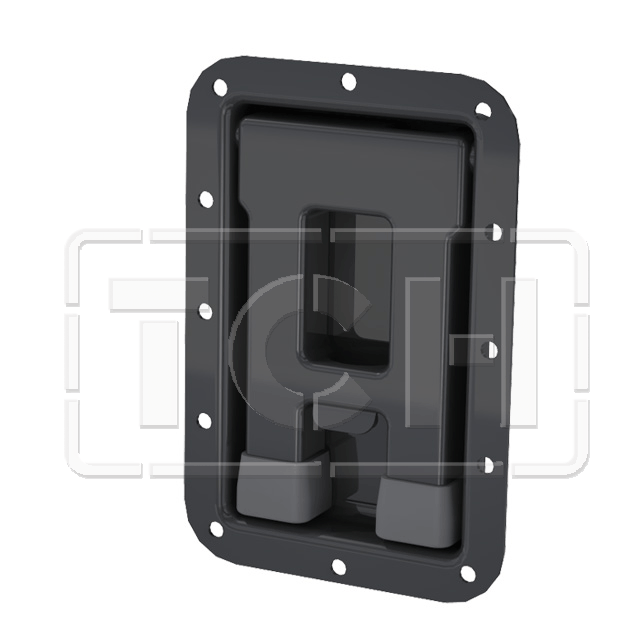
Incidentally, TCH's page for this item is good. It not only gives a clean picture but also links to exact measurements drawings in pdf and dwg formats. Like many of these types of items, probably Penn/Elcom as is the detailed info.
I'm-a gonna get around to placing one of those on my 12/6cube instead of the rack handle.
Incidentally, TCH's page for this item is good. It not only gives a clean picture but also links to exact measurements drawings in pdf and dwg formats. Like many of these types of items, probably Penn/Elcom as is the detailed info.
I'm-a gonna get around to placing one of those on my 12/6cube instead of the rack handle.
I still have some work to do on them. Rounding over the edges and mounting the corners may happen in the near future, but covering it is going to have to wait 4ish months at least until the garage is warm enough to work in and paint properly.
I am still trying to figure out how to EQ these things.
One fun thing I have done already though is driven them thru the PA rig as the lows with my DBX driverack pa+. I have been using some Klipsch monitors for the high end just to listen to live music in a concertish setting
 Compared to the Klipsch 15 sub (which I crossed over at 40/170 before), the fearful's sound is gigantic down low.
Also on the bi-amping subject, the previously mentioned DBX pa+ makes it fool-proof. It cost me $379 dollars, but with an RTA microphone you just plug it in and push a button, and presto.
The processor allows for LW 6/12 and BW6/12/18 selectable, crossover paths with huge ranges (I don't know the max, but just messing with it and the fearful I dialed the "low" channel up over 2k. The Rane crossover I was using before this went up to 250hz for the subs.), and the automatic EQ is really awesome.
Invalid Link Removed
Man, I wanna rig exactly like this. It's a shame I have no talent with wood/speaker&cab construction.

BurningSkies
CRAZY BALDHEAD
- Feb 20, 2005
- 27,956
- 20,348
- Disclosures
- Endorsing artist: Dingwall Guitars
Man, I wanna rig exactly like this. It's a shame I have no talent with wood/speaker&cab construction.
When it comes to the cab, neither did I.
I had the woodwork for both cabs done by other builders, and then worked my way through doing the rest of the stuff myself. Trust me, that if I could do it, SO CAN YOU. 
When it comes to the bass, that learning curve will be a little steeper.
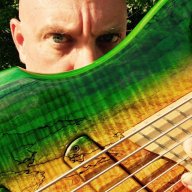
 But I can't take credit for it myself. I do know that this bass is a limited edition of one...so you're probably not going to find another.
Hey, is there a chance one of you guys could explain crest factor in the context of bass guitar and amplifiers? Or point out some resources?
I think I kind of have an idea of what it means, I just don't know exactly how it relates to bass amplification (e.g. how much crest factor there is in bass reproduction and how that relates to wattage and excursion).
I think I kind of have an idea of what it means, I just don't know exactly how it relates to bass amplification (e.g. how much crest factor there is in bass reproduction and how that relates to wattage and excursion).
- Dec 18, 2000
- 13,201
- 340
- Disclosures
- greenboy designs: fEARful, bassic, dually, crazy88 etc
Hey Nightraider, that's pretty non-optimum stacking for 15/6 if you are using the midrange drivers. It's fine for 12/6 or 15/6tube because the mid drivers will be a lot closer together on those cabs. Just thought I'd mention it.
[Invalid or Expired Link Removed]
- Dec 18, 2000
- 13,201
- 340
- Disclosures
- greenboy designs: fEARful, bassic, dually, crazy88 etc
Hey, is there a chance one of you guys could explain crest factor in the context of bass guitar and amplifiers? Or point out some resources?
I think I kind of have an idea of what it means, I just don't know exactly how it relates to bass amplification (e.g. how much crest factor there is in bass reproduction and how that relates to wattage and excursion).
Check out Alex's site. But basically it's easiest to think of it as the difference between average - or quiet sustain/decay signal levels - and the top-peak transients when someone is really hittin' it ... depending on who you ask.
Peak to average ratio is how it gets thought of in radio and TV transmission.
The funny part is it was only a bit of a concern during the analog days, and got to be a bigger deal when we transitioned to digital! There's no tape head compression to save your bacon when you hit all ones.
When you go dig in; there are two places I'll send you; [Invalid or Expired Link Removed]
and hunt around for some of the white papers done years ago by the BBC on peak audio measurement.
I can drag one home and measure samples this weekend if would be worthwhile to you.
Jim
The funny part is it was only a bit of a concern during the analog days, and got to be a bigger deal when we transitioned to digital! There's no tape head compression to save your bacon when you hit all ones.
When you go dig in; there are two places I'll send you; [Invalid or Expired Link Removed]
and hunt around for some of the white papers done years ago by the BBC on peak audio measurement.
I can drag one home and measure samples this weekend if would be worthwhile to you.
Jim
- Dec 18, 2000
- 13,201
- 340
- Disclosures
- greenboy designs: fEARful, bassic, dually, crazy88 etc
Funny though, now that people have got the hang of it in digital, they have a very good idea how much long per peak they can run at top value. Unfortunately another part of the LOUDNESS WARS going on in the recording industry, often at the mastering stage for digital media and not always done just by tubes either. A lot of mp3 get converted with floating point values well above 1.1500000 too. Amazing that they think they need to do that.
EDIT: It's likely I have sub-millisecond peaks in clipping quite frequently when playing through a V-Bass too. As long as I don't push it up to the point where I can hear it in critical listening, it's not a problem though, right? : }
EDIT: It's likely I have sub-millisecond peaks in clipping quite frequently when playing through a V-Bass too. As long as I don't push it up to the point where I can hear it in critical listening, it's not a problem though, right? : }
Sure, I'll whack away. Crest factor, peak-to-average ratio. In my previous encounters it was applied to a noise signal. A white noise voltage can be theoretically, well, large. It mattered when trying to set the IF level in a receiver for example. Also for making certain measurements where its effect needed to be accounted for.Hey, is there a chance one of you guys could explain crest factor in the context of bass guitar and amplifiers? Or point out some resources?
In the context of bass guitar I'd say it was just that - peak-to-average ratio. The ratio of the initial string excursion to its sort of averaged level at the onset of the decay phase. If you like to dig in, use a pick, maybe rounds instead of flats (?), then you might get a very large initial spike from the first pluck or slap or pop, what-have-you before the string settles down to decay. It would be a good thing if your amplifier/speaker chain could handle it.
Actually, that brings an interesting point to the design of SS amplifiers. Tube amps need not apply here - they just let the peaks blast through and the tube-alation takes care of the instantaneous peakage.
SS amps often have a compressor of sorts. We've seen them. My LM2 has some compressor thing going on in there. If it is a peak compressor then then the compression on the instantaneous peak will depress the average level resulting in an amp that will get no louder, though the input signal gets larger. But it will be clean. If it is an averaging compressor then the peaks may exceed the dynamic range capability of the amp. In this case something other than clipping should be used to manage signals that exceed the input dynamic range, else aural nastiness will occur, resulting in bad reps on net discussion forums and lost sales. (Actually, I guess that can occur with both approaches.) BTW, there are all manner of compressor dynamics, these are just rudimentary examples.
Personally, I'm of the high-gain light-touch school, so an amp that handles a high crest factor isn't so important for me.
If you really must dig in then:
- get a tube amp
- get a high wattage SS amp and cab
- get a SS amp and a nice compressor
GB, why is the Butterworth transfer function best for this application?Best highpass filter if any is a Butterworth, at least 3rd order, 4th or 5th order is optimal.
- Dec 18, 2000
- 13,201
- 340
- Disclosures
- greenboy designs: fEARful, bassic, dually, crazy88 etc
GB, why is the Butterworth transfer function best for this application?
Hey Codger, long time.
In the sense that BW is stated by -3dB instead of -6dB like LR, it's easier to predict what to choose for a Hz value if you halfways know the box/driver. And because BW is higher Q it carves a little less at usable content than LR set to an approximately equivalent value. All this strictly on the assumption we are talking about maximum output in the usable range while protecting from unloading. As opposed to making value judgments about tone. Beyond 5th order I really can't tell the difference and it probably has greater potential for unplanned artifacts as well.
Yeah, there's a lot of funky compression stuff that can go on with the minis/micros, no doubt. Part of distinguishing oneself in this early immature market seems to be nailing some non-linearities in a way that pleases various bassists (and suits the cabs they have). A little different than having a pro power amp and a preamp you know well. I'm pretty big on low ratio compression/limiting at a mid threshold and mid-slow attack (and some makeup gain) for my live use. With the strings and tonal choices I make that still gives me incredible dynamics while giving me maybe 3 or more dB average levels, and no problems with crazy hits further downstream. With a lot of "heads" this is superfluous stuff 'cause they have their own saggy non-dynamic influences already there anyway.
With my gear and approach short and extreme peaks are no big deal, fersure.
- Status
- Not open for further replies.


