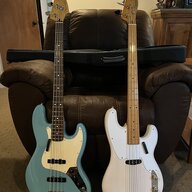
I just put a set of light gauge Flats on my American Standard P bass and strung them through the body without giving a though but now a friend commented on the break angle and how flats could break should I have gone through the bridge?

Enjoy the benefits of a premium membership!
Upgrade Account
-
TalkBass has been independent since 1998. Add your voice.
Create a free account to reply to discussions, view embedded media, and browse with fewer display ads.
Join free Log in
Want zero display ads or expanded classifieds tools? Compare plans.
You are using an out of date browser. It may not display this or other websites correctly.
You should upgrade or use an alternative browser.
You should upgrade or use an alternative browser.
Fender bass guys with flats, string through the body or bridge?
- Thread starter MrRiff
- Start date
More options
Who Replied?

Depends upon which ones you used as to whether they're prone to breaking. Now since you've already done it, and it didn't break. Theres nothing to talk about really. Play em. I've had em break on me an it happens as you're tightening or setting the angle over the saddle. Those that didn't break I'm playin
I guess if I restrung them it might do more harm than good?

I just put a set of light gauge Flats on my American Standard P bass and strung them through the body without giving a though but now a friend commented on the break angle and how flats could break should I have gone through the bridge?
Most flats can be strung thru-body without breaking as long as you're careful when installing them. La Bella is the only company who explicitly warns against thru-body method for their regular flats.
For me personally, I've never liked the idea of putting any flats thru-body as I don't like the sharper break angle created at the saddle that can cause problems for the outer flat ribbon wire. Just my preference.
Thanks,Most flats can be strung thru-body without breaking as long as you're careful when installing them. La Bella is the only company who explicitly warns against thru-body method for their regular flats.
For me personally, I've never liked the idea of putting any flats thru-body as I don't like the sharper break angle created at the saddle that can cause problems for the outer flat ribbon wire. Just my preference.
Last edited:
Thanks, can I restring them?
Once they're installed, you should leave them alone as long as they're not causing any issues. An attempt to restring them can make it even worse.
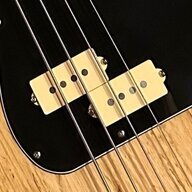
I have Labella thru-body on one of my P's. I never really pondered it until now, but what is different in the construction of them? I thought it was just the length. It's not like they're exposed core or something. The wrapping looks intact where they go over the saddles--no separation of note.
Last edited:
TI Jazz Flats on my American Standard Precision, strung though with no problems at all. Remember, the original 1951 Precision was string though only, and you had to use flats back then.

I only use string through when there's no other option; '51 reissues & my Tele bass. (IOW: 2 saddles)
Which flats?
La'Bellas are the only ones where this could be an issue, and it should be pretty evident to anyone that attempts it. They are the only company I know of that specifically makes a "string-through" version.
Which flats?
La'Bellas are the only ones where this could be an issue, and it should be pretty evident to anyone that attempts it. They are the only company I know of that specifically makes a "string-through" version.

That's the TB vulgate, but actually not true until the Mastersound flats appeared in the 1959 catalogue.Remember, the original 1951 Precision was string though only, and you had to use flats back then.
The sole set in the Fender catalogues up to that point, the no. 90, was not flatwound but polished/groundwound at most (and, continuosly produced in the following decades, was described as simply roundwound come the '70s).

Round core flats are said to be risky to bend 90° can unwind, not only break. Nothing yet happened to me though. I use flats exclusively, different brands often and through body mostly.
Last edited:
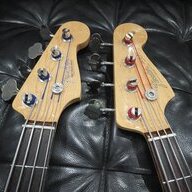
The initial, silk-covered segment is more flexible, in order to prevent breakage. I'm assuming - just a WAG of mine - that at that point the string under the silk is just core and spaced-out coils of flat ribbon, not yet tightened, and no underwindings yet.I have Labella thru-body on one of my P's. I never really pondered it until now, but what is different in the construction of them? I thought it was just the length. It's not like they're exposed core or something. The wrapping looks intact where they go over the saddles--no separation of note.
Shows you how observant I am. I have regular ones top-loaded on another bass to compare, and, yes indeed upon inspection the TB's have that silk section after the ball-end. Doh!The initial, silk-covered segment is more flexible, in order to prevent breakage. I'm assuming - just a WAG of mine - that at that point the string under the silk is just core and spaced-out coils of flat ribbon, not yet tightened, and no underwindings yet.

I have a set of balanced light Chromes strung through the body of my ‘08 American Standard P with no issue.
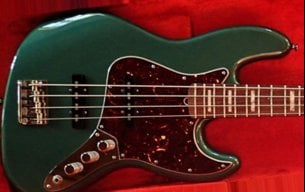
Just get the correct set . I do bridge thru . Depends what brand you like .
Invalid Link Removed
Invalid Link Removed


I have used Rotosound Jazz Bass 77 flats on a bridge thru Jazz bass then took that set and put them on a string thru P MM style bass and played it for a year with no issues. Going back again to bridge thru still works but the strings have a kink in them. They haven’t broken and I can’t tell a large difference to be honest.
I would say go for it. Also I think string thru better suites flats because the additional sustain you get, unless you like a really dead thumpy sound. Also bridge thru tends to add bass to my ear. And I think string thru gives a little bit more focus.
There is a video on YouTube floating around of a blind test of a Lakland bass string thru vs bridge thru if you are curious.
I would say go for it. Also I think string thru better suites flats because the additional sustain you get, unless you like a really dead thumpy sound. Also bridge thru tends to add bass to my ear. And I think string thru gives a little bit more focus.
There is a video on YouTube floating around of a blind test of a Lakland bass string thru vs bridge thru if you are curious.

