• TalkBass has been independent since 1998. Add your voice.
    Create a free account to reply to discussions, view embedded media, and browse with fewer display ads.
    Join freeLog in
    Want zero display ads or expanded classifieds tools? Compare plans.

Fender HMV bridge - top loading issue

Jul 19, 2009
5,221
6,079
41
Croatia
I prefer to top load my bass because the strings feel more pliable and comfortable to me that way, tested it both ways, so don't wanna get into that can of worms.

Anyways, there's a glaring issue to me with the HMV bridge when you top load it. It forces you to pull the string so that the ball end is in the exact position that can fit through the bridge all the way. There's no wiggle room there at all! This is a glaring issue as you can easily twist the string when stringing the bass and tuning it up.

Here's what my ball ends look like as otherwise they wouldn't fit there:
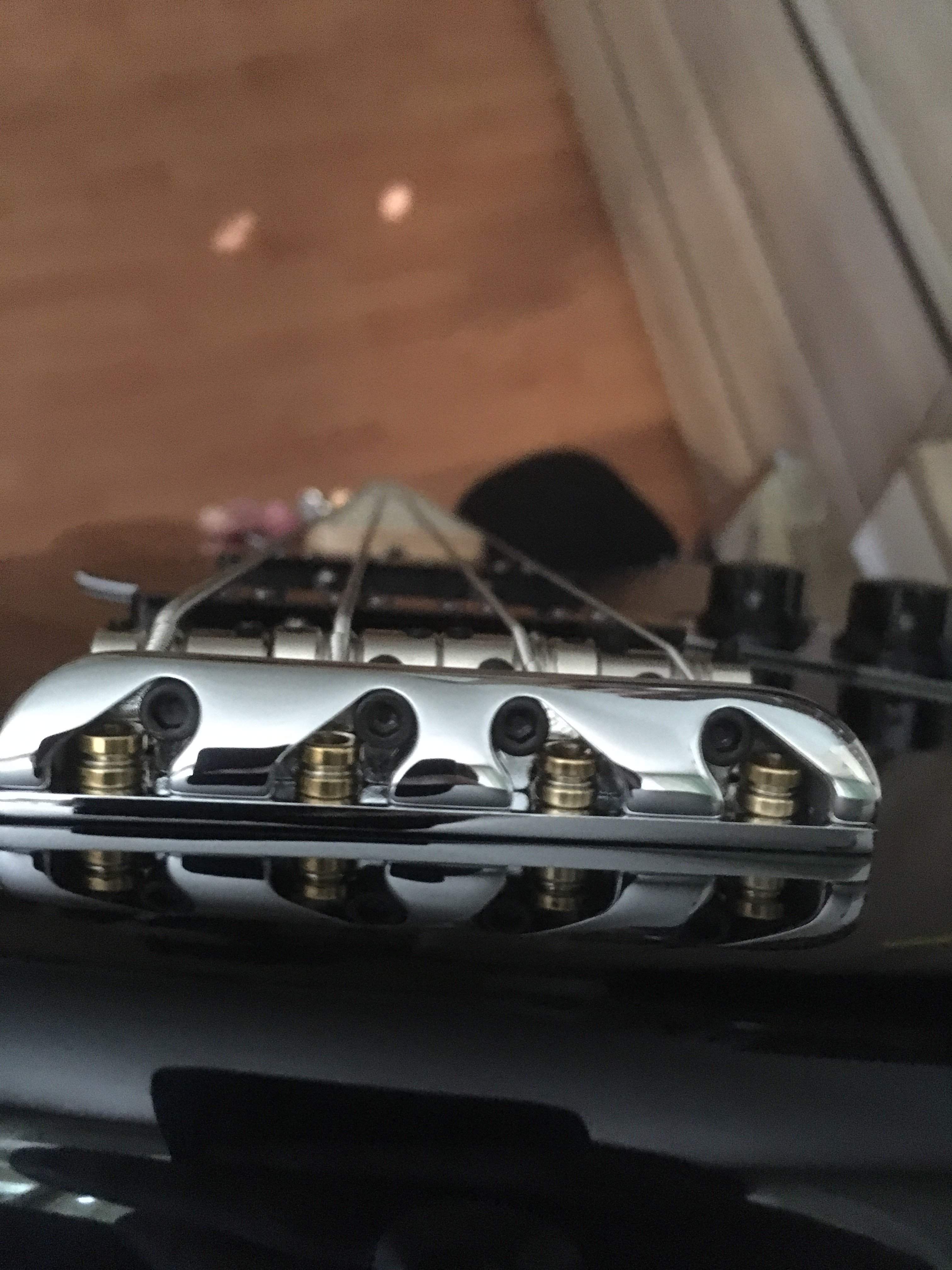
IMG_3019.JPG


They're all sort of resting horizontally, the intonation screws and the interior are in the way otherwise. What the hell Fender? This issue just keeps going on for 10 years?

How are you supposed to string the bass with the HMV bridge correctly when top loading? Any advice? The strings are fine now, but I don't know if there are any twists. I guess I'll know if any of them break.

Just got this bass and I'm already thinking of replacing the bridge -.- The American Deluxe version looks like it would work fine. I just can't get over the design on this thing, the top loading looks like such an afterthought, it boggles my mind. A very pretty looking bridge, but the top loading functionality is absolute crap fest.
 
Yep.

Forces you to wind the entire string onto the post using the key and being very careful. A PIA for sure; no pre-wrapping which is really what causes big twists.

It seems you’ll need to be very careful laying out your pre-bend at the tuner end. Get the ball in place, srt your length, get the pre-bend STRAIGHT DOWN, then cut. Align your tuner slot parallel with the string, Insert your bend in the tuner hole, tighten.

A slight twist such as a quarter turn isn’t that big of a deal. A full turn begins to be a problem.

This could all be fixed if Fender would have a committee of actual bass player employees ratify new designs. It always seems as if guitarists have designed basses.
 
It's also a good idea to leave the ball-end hanging out beyond the anchor as long as possible when tuning up. I grab the string at the 3rd fret and pull tautly against the tuner post leaving the balance of the string fairly slack.

Riis

Yes, but the issue with that is that you can't pull the ball end all the way through if it doesn't get in the exact position that fits. I always tuned that way as to avoid twisting the strings, but you can't do that on this bridge. The ball ends won't fit. I tried that with the E string, and if you look closely in the photo, I ended up scratching the intonation screw a bit. So I was forced to pull it all the way through the only way that it would fit, and do the same with other 3 strings.
 
  • Like
Reactions: Zooberwerx
A slight twist such as a quarter turn isn’t that big of a deal. A full turn begins to be a problem.

Yes, but the issue with that is that you can't pull the ball end all the way through if it doesn't get in the exact position that fits. I always tuned that way as to avoid twisting the strings, but you can't do that on this bridge. The ball ends won't fit. I tried that with the E string, and if you look closely in the photo, I ended up scratching the intonation screw a bit. So I was forced to pull it all the way through the only way that it would fit, and do the same with other 3 strings.

I honestly don't know how much of a twist is tolerable without resulting in chorusing, wonky intonation / tuning, etc.

Given the design limitation, here's another compensatory measure that may help: Once the string(s) is tuned to pitch with the ballends aligned in the initial pic, de-tune / loosen the string just to the point you can pull the wrap coil (intact) from the tuner post. The coil will probably spin in an attempt to assume its natural orientation. With any normal bridge, you would simply manipulate the ballend so the coil is re-aligned with the tuner post. Given the description, we're pretty much stuck with two options with a 180 deg variance. JOOC, what happens if the ballends are inserted at a 45 deg "slant"?

Riis
 
I honestly don't know how much of a twist is tolerable without resulting in chorusing, wonky intonation / tuning, etc.

Given the design limitation, here's another compensatory measure that may help: Once the string(s) is tuned to pitch with the ballends aligned in the initial pic, de-tune / loosen the string just to the point you can pull the wrap coil (intact) from the tuner post. The coil will probably spin in an attempt to assume its natural orientation. With any normal bridge, you would simply manipulate the ballend so the coil is re-aligned with the tuner post. Given the description, we're pretty much stuck with two options with a 180 deg variance. JOOC, what happens if the ballends are inserted at a 45 deg "slant"?

Riis

They might fit in a 45 degree and possibly 90, but the easiest I found was the way I put them in the photo. Still doesn’t give a lot of wiggle room.
 
  • Like
Reactions: Zooberwerx
Worthy of experimentation. My bigger concern is whether the intonation screws remain accessible. Easiest route is not always the best option in any number of arenas.

Riis

Yeah that's the problem, the ball ends either fit all the way through, or get stuck on the intonation screws. Which
both scratches the screws and makes them unusable (you can't fit the hex key because of the ball ends).
 
  • Like
Reactions: Zooberwerx
I like the design the way it is. The ball end lies nice and flat and doesn’t get in the way of the intanation screw. Tidy. Put the string into the bridge, seat the ball end. At the tuner end bend the string down at 90 degrees, cut to length, insert into the tuner post and wrap by winding the key. That will not introduce any twist into the string. It will result in a good clean twist-free installation.
 
I like the design the way it is. The ball end lies nice and flat and doesn’t get in the way of the intanation screw. Tidy. Put the string into the bridge, seat the ball end. At the tuner end bend the string down at 90 degrees, cut to length, insert into the tuner post and wrap by winding the key. That will not introduce any twist into the string. It will result in a good clean twist-free installation.

When I bend the string at 90 degrees, how long is the bent part? At which part of the string do you recommend I bend it? I usually cut the needed length (2 tuning posts length) before bending the string.
 
When I bend the string at 90 degrees, how long is the bent part? At which part of the string do you recommend I bend it? I usually cut the needed length (2 tuning posts length) before bending the string.
I usually make the bent portion about 1/2 inch (10 mm) long, but as long as the bent portion doesn't bottom out so it sticks up past the bottom of the slot it is fine.
 
  • Like
Reactions: mouthmw
When I bend the string at 90 degrees, how long is the bent part? At which part of the string do you recommend I bend it? I usually cut the needed length (2 tuning posts length) before bending the string.
I recommend three wraps on the post. Bend the string at that point and cut about 1/2” past the bend. The bend point past the post depends on the diameter of the post.
 
  • Like
Reactions: mouthmw