I know I might be able to find some info on these on other threads, but I just couldn't find all the answers I was looking for, for starters how is the quality control? Do they use nitro cel on the necks in japan or just the high gloss? Is it worth the couple extra from the mim? How are the electronics? Lastly how can you tell if one is real(I don't see a serial number on the back of the headstock)? Thanks

Enjoy the benefits of a premium membership!
Upgrade Account
-
TalkBass has been independent since 1998. Add your voice.
Create a free account to reply to discussions, view embedded media, and browse with fewer display ads.
Join free Log in
Want zero display ads or expanded classifieds tools? Compare plans.
You are using an out of date browser. It may not display this or other websites correctly.
You should upgrade or use an alternative browser.
You should upgrade or use an alternative browser.
Fender Japan Info
- Thread starter bassmastan
- Start date
More options
Who Replied?And any other info is apreciated, like location of the factory,type and quality of the woods, hardware, if it passes american standards/american hands in the factory, if they include extra work. I'm not looking to buy one, I just wanted to know more about them.
Quality control on Japanese Fenders is usually very good. Qualitywise they are up to their american relatives.
Not 100% but dont think the gloss on the necks is nitro as the one I have is about 20 years old and the gloss is intact.
Serial number is usually located at the heel of the neck, together with a Made in Japan or Crafted in Japan legend.
Not 100% but dont think the gloss on the necks is nitro as the one I have is about 20 years old and the gloss is intact.
Serial number is usually located at the heel of the neck, together with a Made in Japan or Crafted in Japan legend.
Setebos said:Quality control on Japanese Fenders is usually very good. Qualitywise they are up to their american relatives.
Not 100% but dont think the gloss on the necks is nitro as the one I have is about 20 years old and the gloss is intact.
Serial number is usually located at the heel of the neck, together with a Made in Japan or Crafted in Japan legend.
Thanks any more info?

Fit & finish is as good or better then a USA. Some of the hardware (tuners, bridge) is not as good as USA as with the electronics.
No Nitro from Japan.
No Nitro from Japan.
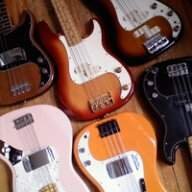
Fender Japan quality is excellent. I have never had any trouble with any of the basses I have bought from over there. The only thing that makes them in any way inferior to the US ones is the hardware. Sometimes the hardware is not top notch, but it is all easily swapped out.... but definitely still usable even if you do not.
**edit** hdracer beat me to it on the hardware.
**edit** hdracer beat me to it on the hardware.

Very interesting thread for me as I'm looking at a 70's Precision and I discovered through a thread in FS that they're made in Japan (pic of serial number showed MIJ stamped on the heel). Fender's own page says nothing about the country of origin. Invalid Link Removed
I've been wondering about the diff too since price-wise it goes MIM-->MIJ-->MIA with the MIJ essentially splitting the difference. I know that older MIJ instruments are famous for their quality and hi-line models like the Ibanez Prestige line are all MIJ with stunning results.
I've been wondering about the diff too since price-wise it goes MIM-->MIJ-->MIA with the MIJ essentially splitting the difference. I know that older MIJ instruments are famous for their quality and hi-line models like the Ibanez Prestige line are all MIJ with stunning results.


70's reissue? Not a 70's MIJ Fender. IIRC, Fender started a plant around 82 in Japan. Over the years, they've become great instruments. Never had any issues and personally, I favor them over others for their value. They usually are not as expensive as the MIA's, but have the same quality and usually a few different variations in colors - but those can only be obtained overseas. I've had a few MIJ's and CIJ's over the years. Still have a few. Love em. But as for particulars, couldn't tell you.
@whoapower: This thread shows differently. Look at the 4th pic. Seller states "Ordered bass last month". http://www.talkbass.com/forum/f126/new-fender-70s-p-bass-olympic-white-blocks-binding-830536/
I'm seriously thinking about buying one new, but I really want to know if they are MIJ. I'm not paying $800 for a MIM bass no matter how nice it looks or plays. Resale value just isn't worth it.
I'm seriously thinking about buying one new, but I really want to know if they are MIJ. I'm not paying $800 for a MIM bass no matter how nice it looks or plays. Resale value just isn't worth it.
I didn't articulate clearly. There were no Japanese Fenders in the 70's but a 70's reissue... yes. So, that thread you linked to... great example! Looks fantastic especially for the dollar! Japanese Fenders - prob the only way you'll see a P bass with blocks.
Yepper: P-Bass with blocks has me all tingly!  Thanks for clarifying. Probably buying one very soon.
Thanks for clarifying. Probably buying one very soon.
I concur with the others here:
Excellent QC at Fender Japan. Build quality equal to or better than any MIA Fender, IME.
Hardware and electronics has varied over the years and over different models. Some great, some just so-so.
The necks, especially, are really top-notch.
Excellent QC at Fender Japan. Build quality equal to or better than any MIA Fender, IME.
Hardware and electronics has varied over the years and over different models. Some great, some just so-so.
The necks, especially, are really top-notch.

The Fender model 70s Precision bass I believe is what the poster was referring to where they have the blocked and bound neck and a quite stunning. I have been long at pulling the trigger on one myself. The serials indicate they are MIJ, but oddly the serials I have been able to see on the 70s Jazz Bass model have been MIM. Sweetwater has some nice shots in their bass gallery of these with clear serials.
Fit & finish is as good or better then a USA. Some of the hardware (tuners, bridge) is not as good as USA as with the electronics.
No Nitro from Japan.
I think with any current models the hardware is going to be fine. With older MIJ models the hardware and electronics can be lower quality than MIA offerings. I have an '82-83 JV serial # bass that I believe is nitro, it certainly is not the thick, durable poly usually seen on MIJ/CIJ models.

The MIJ line is a little difficult to work out. Not only do they have top, bottom, and middle level instruments, they also have lines that are export and non-export. Generally speaking - their bottom of the line basses are basswood, the better ones are alder and top of the range have "American Vintage" pickups.... which is marketing speak for god knows what.
There are some rules of thumb when shopping for used MIJ - the larger plated tuners are the usually the alder instruments, smaller ones (similar to that of the HWY 1) are basswood..... but there are exceptions to this, particularly in the 90s.
Fender was pretty much blown away by copies coming out of Japan in the late 70's and in 80/81 contracted FugiGen to start putting Fender stickers on what were previously Fernandes/Tokai/etc... Early 80's Fender in the US was a strange time. They were making outstanding reissues of their 60's instruments (Fullerton RI's), but the 'Standard' line was an excercise in cost cutting - quality nowhere near what was coming out of the Japanese factories... (IMO)
IMO a great way to judge the quality of a bass is by looking at the at the maple woodgrain in the neck. The higher graded wood reflects on the standards employed by the company at the time of manufacture. Good quality maple has a fine grain texture to it that sometimes goes flame or birdseye. Have a close look at a Musicman neck compared to a Fender MIM and you'll see what I mean. 80's MIJ instruments are sought after but IMO early 90's basses seem even better.
There are some rules of thumb when shopping for used MIJ - the larger plated tuners are the usually the alder instruments, smaller ones (similar to that of the HWY 1) are basswood..... but there are exceptions to this, particularly in the 90s.
Fender was pretty much blown away by copies coming out of Japan in the late 70's and in 80/81 contracted FugiGen to start putting Fender stickers on what were previously Fernandes/Tokai/etc... Early 80's Fender in the US was a strange time. They were making outstanding reissues of their 60's instruments (Fullerton RI's), but the 'Standard' line was an excercise in cost cutting - quality nowhere near what was coming out of the Japanese factories... (IMO)
IMO a great way to judge the quality of a bass is by looking at the at the maple woodgrain in the neck. The higher graded wood reflects on the standards employed by the company at the time of manufacture. Good quality maple has a fine grain texture to it that sometimes goes flame or birdseye. Have a close look at a Musicman neck compared to a Fender MIM and you'll see what I mean. 80's MIJ instruments are sought after but IMO early 90's basses seem even better.

I played, and now YEARN for a MIJ 75RI Jazz. One of the best basses I've played regarding comfort. The neck was right up there with my AVRI 62 P neck as far as ease and comfort to play. And it was very fast. The one I tried had the "American" pickups, and it sounded solid, like a vintage style Jazz should. One day.......one day it will be mine............

I have a Fender Jaguar Bass and the only issue that I have is grounding. After completely shielding the bass, it is now dead quiet. The neck is absolutely perfect for my feel and I can set the action really low. I think overall, MIJ's, qualitywise are just as good or even better than MIA's.
It is very important issue with the the mij bass and that's because many of these bass are the same price as the American standard. So everyone of us wonder whether it is worth to buy a Japanese. I hear many on this forum to say - ...I bought a Japanese bass and after changing the bridge and pickups ...sounds fine... Personally, if I buy a bass worth 1000 - 1200 Euros, I do not intend to change anything in it! I will have the requirement to fully satisfy instantly!! If it is to buy a bass and start making changes, I get a vintage modified and will change them ALL !! But my questions remain. the Americans have better electronics, have better quality, have better woods than the Japanese in the same price ?
But my questions remain. the Americans have better electronics, have better quality, have better woods than the Japanese in the same price ?Latest posts
-
 Adding J pup to P bass, should I go 60’s or 70’s spacing?
- Latest: Gianni "Orlandez" Orlati
-
-

-
