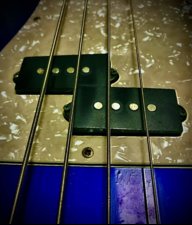
I use both pickups wide open, tone cut about halfway and run through a compressor. I poke through and sit in our mix just fine.

TalkBass has been independent since 1998. Add your voice.
Create a free account to reply to discussions, view embedded media, and browse with fewer display ads.
Join free Log in
Want zero display ads or expanded classifieds tools? Compare plans.

Hi guys,
Whenever I take my American Jazz to a gig it seems like I'm having difficulty to find my place in the mix, no matter what tweaking I do on the amp or pickups. The same seems to be the case for two other bassists who regularly play there on J-style basses in that venue. I 'feel' the bass lines, but don't really notice them.
When I have my P, it cuts through. Another guy's Warwick cuts through... so I figured out it's not the amp.
When I'm jamming my J along to music on the computer, plugged into Amplitube, I encounter the same problem. It kind of drowns. So I'm assuming it's not the venue.
Is there a magic setting or anything of that sort to make a J jump out a bit more? I'm sure the stock pickups on an American J should be good enough, right?
What do you guys think?



Compressor. High pass filter. Cut bass, boost low mid.
I just start with a precision.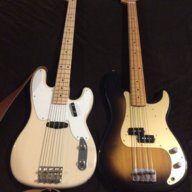

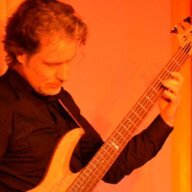
This is what Jaco did (favor the bridge PU) and he was in front of every mix.First thing to do is not run both pups equally.
Amusing typo.having jazz with 70' pickup spacing helps also.
Oh yeah. For me, I just love the simplicity and efficiency of my P!That sounds like trying to turn a jazz into a precision.

Neck pickup only!
cut through properly

Hi guys,
Whenever I take my American Jazz to a gig it seems like I'm having difficulty to find my place in the mix, no matter what tweaking I do on the amp or pickups. The same seems to be the case for two other bassists who regularly play there on J-style basses in that venue. I 'feel' the bass lines, but don't really notice them.
When I have my P, it cuts through. Another guy's Warwick cuts through... so I figured out it's not the amp.
When I'm jamming my J along to music on the computer, plugged into Amplitube, I encounter the same problem. It kind of drowns. So I'm assuming it's not the venue.
Is there a magic setting or anything of that sort to make a J jump out a bit more? I'm sure the stock pickups on an American J should be good enough, right?
What do you guys think?

Hi guys,
Whenever I take my American Jazz to a gig it seems like I'm having difficulty to find my place in the mix, no matter what tweaking I do on the amp or pickups. The same seems to be the case for two other bassists who regularly play there on J-style basses in that venue. I 'feel' the bass lines, but don't really notice them.
When I have my P, it cuts through. Another guy's Warwick cuts through... so I figured out it's not the amp.
When I'm jamming my J along to music on the computer, plugged into Amplitube, I encounter the same problem. It kind of drowns. So I'm assuming it's not the venue.
Is there a magic setting or anything of that sort to make a J jump out a bit more? I'm sure the stock pickups on an American J should be good enough, right?
What do you guys think?


Having a Jazz with 70's pickup spacing works really well until the weather changes, which warps the coils and requires a truss rod adjustment, which will lower the strings and cause the magnetic pull to interfere with the inherent resonance of the strings, depending on whether they are reverse wrapped or forward wrapped and whether the month they were wrapped in had thirty or thirty-one days, and if it was February whether it was a leap year. This of course interacts with the tilt of the Earth's axis and the time of year, which determines how much solar energy was present when they created the core wire, which influences the degree of angularity of the hex core wire, or the purity of the circle of circular core wire. This of course has a direct correlation on whether the output frequency of the pickups reacts with the tone capacitor, along with the length of the cable you're using and also the guage of the extension cord your amp uses to plug into the wall, along with whether you're using oxygen-free speaker cable and/or if you are plugging the directional cable in in the right direction. Ultimately you may require a slight tweak at 600 hz or 800 hz, depending on whether your bass has an ash body or an alder body. If it has a sunburst finish you may find that it needs a further tweak at around 2.5K, unless it was sprayed with nitro in which case the degree of flecking will determine whether you need +3db at 2.5k or +2.5db at 2.8k.
All this of course may be rendered moot by the room you're playing in and the overall mix, which may change at random depending on the dimension of the room, relative humidity, and the whims of the other people in the band.