
I'll second Greywoulf - the Squier Mustang is super easy to play and lightweight and with LaBella's gives some serious old school thump. I have been wanting to try a JMJ just for kicks but I'm told the necks are chunky which is turn off form me but I love the road worn feel on P and J basses and Telecaster guitars so you might be suprised that the Road Worn thing is a feel as much as a look. YMMV

Enjoy the benefits of a premium membership!
Upgrade Account
-
TalkBass has been independent since 1998. Add your voice.
Create a free account to reply to discussions, view embedded media, and browse with fewer display ads.
Join free Log in
Want zero display ads or expanded classifieds tools? Compare plans.
You are using an out of date browser. It may not display this or other websites correctly.
You should upgrade or use an alternative browser.
You should upgrade or use an alternative browser.
Fender Mustang Club
- Thread starter FlyingPigSound
- Start date
More options
Who Replied?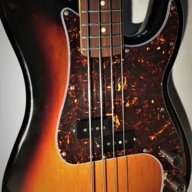
Having just sold my coveted Mustang PJ, I guess I might be an honorary member here?
I have found my tone and comfort in my other basses so, the funds from my sale will help my investments in a home recording studio.
I have found my tone and comfort in my other basses so, the funds from my sale will help my investments in a home recording studio.

So in terms of the jmj neck can some of you comment specifically why you like it or don’t like it chunky? What advantage does a chunky neck provide specifically and what disadvantage. I have short fingers for a dude, but I’m not sure that rules out the chunky neck, it’s possible the chunkiness provides more leverage for the thumb? Just wondering. My main guitar is 1990 era strat plus, whatever that neck is.
I think its my playing style - I like for my hand to wrap around the full neck which makes it harder to reach the E string with your index finger - some people use the thumb over the top or the thumb as a pivot point on the back of the neck so it might not bother them. you could play a jazz bass at any guitar shop to se ewhat a small neck feels like. I have my favorite '54 style P bass on consigement locally because the neck is too chunky and uncomfortable for me. It did not bother me at first but after gigging it and playing it a lot it became bothersome.

So in terms of the jmj neck can some of you comment specifically why you like it or don’t like it chunky? What advantage does a chunky neck provide specifically and what disadvantage. I have short fingers for a dude, but I’m not sure that rules out the chunky neck, it’s possible the chunkiness provides more leverage for the thumb? Just wondering. My main guitar is 1990 era strat plus, whatever that neck is.
When I play a chunky neck I get hand cramps - obviously some people really like chunky necks so I think its mainly a comfort thing.
It's a feel thing. I don't have particularly large hands and it just feels more comfortable. It is definitely not so thick that someone with below average hand size couldn't play it. The short 30" reach probably helps it not be as unwieldy as it might be on a 34".
The only time I have had left hand cramps is on much skinnier jazz type necks. I don't know if there are any advantages to the thick neck except preferred feel, but I suppose a skinnier neck is better for shredding etc, if that's the way you play.
1.75" nut width like old P basses is what I consider wide. 1 5/8 is kinda normal fora P bass and 1.5 is narrow like a jazz bass. My Squier Mustang is a 1.5 - I think the JMJ is a 1 5/8

The JMJ neck is a wonderful thing. I have small hands and often edge towards J necks rather than Ps, but there is something about the combination of the thicker neck and short scale that makes it feel so good ... you really get the sense that you are playing a vintage Mustang. Added to that, the pickups are incredible.

I've had 2 jmj's and ended up selling both due to thick neck. I've had every version of mustangs, and i just didn't bond with it. I too have small hands and like to wrap my hand around neck more that pivoting with thumb. I've landed with a squier mustang and the neck is crazy awesome, very similar to the MIJ/CIJ mustangs...
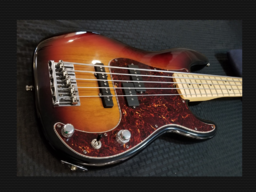
I have a JMJ neck on my Mustang. I go back and forth between this and my American Standard precision without a thought. I do play with my thumb on the back of the neck, as opposed to wrapped, and I'm not the world's most sensitive guy, but I don't feel a lot of difference.
That being said, I don't care much for most 4 string Jazz necks, but I also don't like 50's baseball bat necks.
The "C" precision profile/thickness (and nut width) feels like home to me.
That being said, I don't care much for most 4 string Jazz necks, but I also don't like 50's baseball bat necks.
The "C" precision profile/thickness (and nut width) feels like home to me.
Last edited:
1.75" nut width like old P basses is what I consider wide. 1 5/8 is kinda normal fora P bass and 1.5 is narrow like a jazz bass. My Squier Mustang is a 1.5 - I think the JMJ is a 1 5/8
Yes, yes, and yes.


Generally speaking most folks with smaller hands prefer skinnier necks because there's less wood on the neck to interfere with your fretting. Plus a wider or thicker neck can make you hafta stretch your hand and fingers farther, and this can be uncomfortable. But this is not always so... 
You're gonna hafta discover your neck preferences for yourself, and a good way to start is to do some research at music stores that carry a variety of bass guitars. Pick them up, play them, see how their necks feel in your hand. Period.
This having been said, I myself (with small hands) have found the neck on the CV60 Squier Mustang an absolute delight to play, with it's rounder, skinnier, more pole-like 9.5" radius and 1.5" nut. ~Best in the bass world for me, could even be the absolute worst for you...
Do some personal research. Questions will only get you as many different opinions as there are bassists.........
You're gonna hafta discover your neck preferences for yourself, and a good way to start is to do some research at music stores that carry a variety of bass guitars. Pick them up, play them, see how their necks feel in your hand. Period.
This having been said, I myself (with small hands) have found the neck on the CV60 Squier Mustang an absolute delight to play, with it's rounder, skinnier, more pole-like 9.5" radius and 1.5" nut. ~Best in the bass world for me, could even be the absolute worst for you...
Do some personal research. Questions will only get you as many different opinions as there are bassists.........
The Am performer will obviously be more versatile due to the extra pickup.
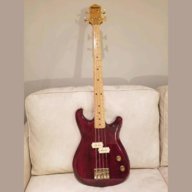
I have a JMJ and absolutely love it, but it's not for everyone. It's kind of a one trick pony, but it's a hell of a trick. The pickup is amazing and I like to describe is as more of a P bass than a P bass. It has that extra thump and really does the vintage thing well. I use TI Flats, but have strung it with Nickel rounds and it sounds really good with those. A lot more versatile, but I prefer the flats for what I do.
The neck on the JMJ isn't for everyone either. It's really chunky, quite a bit more than my PBass. I haven't played anything this fat and I love it. The Am Performer has the same nut width but has a more modern profile.
I wasn't crazy about going with the road worn at first, but where else can you get a nitro finish at this price point? It's nice not having a quarter inch of poly and worrying about finger prints, especially on the black one. Also, when you inevitably knock the bass into something, or it falls over, I find I don't panic looking for a mark like I do on my non road worn basses.
~Either bass is a winner, but just beware that the JMJ has some quirks that the Am Performer doesn't.
The Am Performer has quirks of its own, along with its higher price tag.
Due to the design of the small split pickup on it and most or all US built and MIM Mustangs, they had to rewire the two halves of the pickup to be in phase with each other in order for it to get along with the added J pup [a situation which has been covered in more detail, upthread].
THIS MEANS HUM, in any situation where a Jazz bass would have hum.
Anyone who is considering these two basses should also take a look at the Vintera 60s Mustang.
I have.
Same wider nut, no fake relicing, and just the split Mustang pickup with no hum, for the same or a bit less cash than the JMJ costs.
I'm not sure of the profile [chunkiness] and radius numbers of the neck.
Also there is the Fallout series from G&L, similar in a lot of ways to a Mustang.
~
Last edited:
~
The Am Performer has quirks of its own, along with its higher price tag.
Due to the design of the small split pickup on it and most or all US built and MIM Mustangs, they had to rewire the two halves of the pickup to be in phase with each other in order for it to get along with the added J pup [a situation which has been covered in more detail, upthread].
THIS MEANS HUM, in any situation where a Jazz bass would have hum.
If you are considering these two basses, then also take a look at the Vintera 60s Mustang.
Same wider nut, no fake relicing, and just the split Mustang pickup with no hum, for the same or a bit less than the JMJ costs.
I'm not sure of the profile and radius numbers of the neck.
~
Yes, you're quite right! And the CV Squier Mustang also has the two split sections of the older style Mustang small pickup w/o any J and so has no hum whatsoever..
Question tho: What about the newer Fender PJ Mustangs (that I'm becoming interested in)? Since they also have a split P pickup (full P size tho) over a J one, wouldn't that mean they also suffer from HUM??? ~And taking this a bit further, wouldn't all PJ basses also have hum then too??
~Yes, you're quite right! And the CV Squier Mustang also has the two split sections of the older style Mustang small pickup w/o any J and so has no hum whatsoever..
Question tho: What about the newer Fender PJ Mustangs (that I'm becoming interested in)? Since they also have a split P pickup (full P size tho) over a J one, wouldn't that mean they also suffer from HUM??? ~And taking this a bit further, wouldn't all PJ basses also have hum then too??
Those are valid questions, all of them.
I thought that we covered this upthread, but it might have been in another thread.
Anyway, the original USA design is different for the two sizes of split pickup.
The Mustang split pickup, though it came later than the Precision pickup, is of a simpler design.
We have two identical halves, wired out of phase externally to cancel hum, and since each string only activates one or the other half of the pickup, the phase does not of the signal matter.
But if we try to add another pickup, half of the split pickup will be out of phase with it, so for the Am Performer, Fender lazily solved this by wiring everything in phase, so there became hum from the split pickup.
The design of the Precision pickup tackled the situation in a more complex manner.
Each half of the split pickup is NOT constructed the same as the other, and you need one of each half to make a whole pickup.
In the two halves, the wire is wrapped in the opposite direction on one half, and the magnets are facing the opposite direction, but the pickup halves are wired externally in phase.
This results in hum cancellation, but the signal from each half remains IN phase with the other, so if we add an extra pickup as in a typical PJ bass, the signals are all in phase.
However, since a standard J pickup is a single coil, it will notice hum when soloed, if there is any in the room, regardless of what other pickups are on the instrument.
I should add, that info has been posted on TB, that on Japanese Fender Mustang basses, and on Squiers, if there is a small Mustang split pickup, it seems to have been designed like a P pickup, instead of the Mustang way.
Not sure about the JMJ in this regard.
~
Last edited:
IMO. Most PJ people, I believe, run the P pickup, wired conventionally, solo most of the time. They expect to have some hum when running the single coil Jazz pickup solo and use it sparingly; not really intending to replace a true Jazz.
I personally always use a split J hum-cancelling pickup on my PJs. Solos better, blends better, but doesn't ever quite catch that "Jazz bass" sound.
EDIT! I got a lot of this wrong, or at least "tangled up". More research is needed!
EDIT 2! I deleted the part I think I screwed up. I misunderstood what the AmPerf pickup design was.
I think.
I personally always use a split J hum-cancelling pickup on my PJs. Solos better, blends better, but doesn't ever quite catch that "Jazz bass" sound.
EDIT! I got a lot of this wrong, or at least "tangled up". More research is needed!
EDIT 2! I deleted the part I think I screwed up. I misunderstood what the AmPerf pickup design was.
I think.
Last edited:
~So What you're saying about the Fender Mustang PJ with it's 3-way toggle switch is, if I got it right, is:~
Those are valid questions, all of them.
I thought that we covered this upthread, but it might have been in another thread.
Anyway, the original USA design is different for the two sizes of split pickup.
The Mustang split pickup, though it came later than the Precision pickup, is of a simpler design.
We have two identical halves, wired out of phase externally to cancel hum, and since each string only activates one or the other half of the pickup, the phase does not of the signal matter.
But if we try to add another pickup, half of the split pickup will be out of phase with it, so for the Am Performer, Fender lazily solved this by wiring everything in phase, so there became hum from the split pickup.
The design of the Precision pickup tackled the situation in a more complex manner.
Each half of the split pickup is NOT constructed the same as the other, and you need one of each half to make a whole pickup.
In the two halves, the wire is wrapped in the opposite direction on one half, and the magnets are facing the opposite direction, but the pickup halves are wired externally in phase.
This results in hum cancellation, but the signal from each half remains IN phase with the other, so if we add an extra pickup as in a typical PJ bass, the signals are all in phase.
However, since a standard J pickup is a single coil, it will notice hum when soloed, if there is any in the room, regardless of what other pickups are on the instrument.
I should add, that info has been posted on TB, that on Japanese Fender Mustang basses, and on Squiers, if there is a small Mustang split pickup, it seems to have been designed like a P pickup, instead of the Mustang way.
Not sure about the JMJ in this regard.
~
1}Both pups toggled on = no hum.
2}Neck P pup toggled alone also = no hum.
3}But bridge pup toggled alone = HUM!
Thanks for the mind-clearing explanation!

And it seems to me that on the PJ Mustang it would be ever so much better to have a blend knob in place of that selective toggle switch, cause if you could keep the opposite pup on just a little bit you would eliminate hum w/o much effecting your sound....
Last edited:


