• TalkBass has been independent since 1998. Add your voice.
    Create a free account to reply to discussions, view embedded media, and browse with fewer display ads.
    Join freeLog in
    Want zero display ads or expanded classifieds tools? Compare plans.

Fender no longer using rosewood ?

Well, as with everything, it all comes down to personal preference. I have had a couple Pau Ferro boarded basses, as well as a Sadowsky Metro with Morado. Absolutely nothing wrong with them.

However... Strictly my personal preference, but I much prefer the APPEARANCE of a dark rosewood over the lighter Pau Ferro or Morado. IMO, the darker rosewood gives a more aesthetically appealing, and dare I say "richer" appearance. :D So there is no right or wrong in this case. Only opinions, which almost always clash. ;)

All that said, most of my basses have maple boards. :D
 
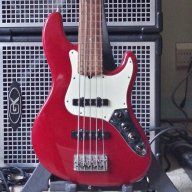
Pau Ferro, yup.

IMG_0008.JPG
 
  • Like
Reactions: fender68 and ale29
The decision to put all Dalbergia's on the CITES list is not really totally fair but I can see why they did it. They know that tree poachers would cut down "the real thing" and label it as one of the species not on the list. Apparently they've added Bubinga onto the list even though it's not a Dalbergia. I guess we're all going to have to get a lot more comfortable with maple boards as Pau Ferro and X,Y and Z following it will get logged out too. This could actually be a real boon to the used market.

That's what I thought at first, but then I started to wonder if they can't tell one dalbergia species from another (which can be difficult), how are they going to tell various dalgergia from other non-dalgergia exotics, some of which look more like indian rosewood than other true rosewood do?
 
Sorry if this has been posted before, the search turned up nothing.

According to the Andertons website: Link Removed
Fender will be discontinuing the use of rosewood and will be switching to Pau Ferro for the Mexican and Ebony for the American Elite models due to the CITES regulations on rosewood.

This will take effect somewhere in June / July of this year.

:wideyed:
What about the American Professional series? Will the American Professional P Basses and Jazz Basses be made with ebony boards?
 
And the bitching about streaky ebony fretboards will be endless :bag:
Honestly, I think guitar makers need to seriously think about wood alternatives, switching to another wood species will just delay the problem. For the exotic woods at least, I don't think we'll run out of maple or spruce anytime soon.

But especially when it is a fretboard, whose influence on the sound of an instrument is rather small, I think other materials could be used. Such as Richlite fretboard on Martins or Gibsons.

C_Becker: I agree with what you say about fretboard materials. I have a Richlite fingerboard on my Martin (finally found a guitar with my name on it :)) D-16 and it looks and feels great to play. I would say the affect on the sound is close to zero(strings and picks would have a much bigger effect) ... and definately zero on an electric bass. Also, ebony is too valuable to be using on the huge number of electric instruments that are made around the world.

For many years Stelling used Ebanol fingerboards on their banjo's and I never heard any of even the most finicky players complaining about it. Stellings now have ebony fingerboards but I have read comments by Geoff saying the ebanol fingerboards have been very stable and many are still in use after 25 years with no signs of wear. I would prefer ebony but the stability of the Richlite material on a neck is a good thing.
 
I think they should just go ahead and ban the use of a separate wood for the neck & fretboard.
Mahogany neck, Mahogany fretboard
Maple neck, Maple fretboard

keep it simple


Pau Ferro... I though he plays for the San Antonio Spurs

I actually know a guy named Paul Fierro & I think of him every time Pau Ferro gets mentioned :roflmao:
 
I, for one, would like to see the bigger companies start playing with more and more alternative materials for their electric instruments. I see what Aristides is doing and I like it a lot, but they're instruments are definitely of a futuristic aesthetic that's doesn't appeal to everyone...but I wonder what somebody like Fender, Warwick, Spector, etc could do. It'd be very interesting to see some of them start showing up to NAMM and the like with full composite material instruments, if not just to start shifting public opinion a little bit.
 
  • Like
Reactions: lousybassist
Pau Ferro is a very popular fretboard wood. Hardly new for Fender. My '92 jazz bass plus 5 had a Pau Ferro fretboard. Zero issues. All my Peavey G-V basses use it as the fretboard wood. They are from about the same time.

ALL my Peavey G-V basses?:wideyed: How many you got? No wonder I can't find one! :mad::D

PS. Had one. One of the few basses I bought new. Now I think if I has swapped out the aluminum bridge, I could have made it work for me.
Ah well. My AM DLX Fender has a Pao Ferro board, I prefer it to Rosewood and it DON'T LOOK CHEAP:spit:!!!.
Dadgum rassa frassa call my bass cheap lookin' why I oughta that's what you are, you grumble grumble fuss swear complain....

:bag::rolleyes::laugh:
 
Last edited:
Honestly, I think guitar makers need to seriously think about wood alternatives, switching to another wood species will just delay the problem. For the exotic woods at least, I don't think we'll run out of maple or spruce anytime soon.

Looks like it's gonna be "ebonol for days"! :whistle:
(…which, given my one experience with it, wouldn't bug me at all. :thumbsup:)

The rosewood on my Jazz is lighter than most of the pau ferro examples shown here. The rosewood on my Aerodyne is almost certainly dyed since its almost ebony in color. It's all good.

They most certainly are stained, and yeah…they are all so very good. drool

In another thread, someone informed me that Ishibashi is no longer willing/able to sell instruments that contain rosewood internationally. Invalid Link Removed :crying:

UPDATE: I saw this information on a Reverb ad posted by Ishibashi. Apparently, it would be difficult, but not impossible to get an instrument shipped out-country from them.

Note for instruments containing Rosewood or African Blackwood:
You may have noticed we have started listing instruments made from Rosewood and African Blackwood again. Due to the new 2017 CITES regulations however, trade in these woods has become heavily regulated. Purchases of these instruments will incur an additional waiting period of approximately 2-4 weeks while we apply for individual trading permits for each instrument. Please note that this additional time frame is counted from the date you purchase the instrument as we can not apply for the permit until then. Despite this, there is still a possibility the application will be declined by the Japanese government. In this case we will of course offer a full refund.
 
Last edited:
  • Like
Reactions: 4StringTheorist