

The Fender Performer Bass
From Fender:
"Performer Bass (1986-1987). Distinctively pointy shapes continued in the mid-1980s with the Performer guitar and bass models, which were second only to the Katana models in non-traditional Fender design. 1986’s angular Performer Bass boasted a slim two-octave neck, unusually deep cutaways and dual single-coil pickups. It was available in two versions—the less expensive ($499) Japanese-made Standard Performer Bass, which had a rosewood fingerboard and white pickguard, and the more expensive ($949) U.S.-made Elite Performer Bass, which had an ebony fingerboard and no pickguard. Fender Custom Shop founder John Page, the creator of the Performer instruments, designed a five-string version of the bass in 1987 that never made it past the prototype stage. Although it didn’t catch on with players and it too suffered from Fender’s post-CBS instability of the mid-1980s, the Performer Bass nonetheless had notable strengths and was a well-conceived attempt at a modern direction for Fender basses quite apart from the long-established Precision/Jazz tradition. It was discontinued after only a year. Performer basses are regarded today as a something of a curiosity, albeit interesting and well-built ones, and they command high prices in the infrequent instances when they show up for sale."
And a post from John Page from fender.com:
"Yes the Performer was one of my designs. Believe it or not, the Performer bass (designed before the guitar) was designed to be the Elite version of the Jazz Bass.. yes that's right... it was going to be the top version of the Jazz Bass... scary huh? The shape of the instrument is derivative of the back of the Strat Look at the waist cut on the back of the Strat and you'll see where the basic horn/body shape started. At the time (1982-3ish?) I was designing this, Fender was considered a pretty conservative instrument Kramer, Jackson & BC Rich were building these radically styled instruments, so we wanted to get into that market. In my original design, it used a Strat-style peg-head and the pickups were a double Strat hum-bucking setup. I also designed the Fender Logo On The Performer I can't say that that a good thing, but it was kinda cool to design a new Fender logo. We got some comments that it looked like the Peavey logo, which really pissed me off. The guitar that was produced was different than the original that I designed. I initially designed it to be made in the US, but it ended up being made in Japan. When that transition happened, things were changed. The peg-head went from the Strat to the Swinger, for example, so I don't remember what pickup they actually went with. I angled the pickups to thicken up the top end a bit... and it looked cool. Well, at least to me, I like "off-line aesthetics". Why weren't they successful? Look, I was a designer in Fender R&D for years before I started the CS. I was always trying to design something new and different. When we started the CS, I tried to do the same. Reality is, the public wants Strats, Teles, P & J basses from Fender. So it's really tough to get them to accept any "new & different" designs in any great quantities. I'm afraid I have no idea how many were actually produced.
I designed the five string version when I first came back to start the CS in '87. To the best of my knowledge there was only one prototype made by Fuji Gen Gakki It was kind of a pinkish color and had the same basic features of the 4 string Japanese model. When I initially designed both basses, they were modified Mustang coils, wound beefier and wired to be hum-bucking. When the four string version was released it used a single coil p/u under each cover. The original also was designed with a angular/massive/fine-tuning bridge, and a "lightning bolt" styled string tree. Both were prototyped but never released. I never heard of any instruments being destroyed for any legal issues... maybe another one of those "legends"? The idea behind the neck was simple, at the time a lot of bass players were guitar player converts. Bass playing style started to have more of a "lead guitar" approach, so the idea of a narrower neck was to help along those lines. The original proto went on the summer before it was released with the then "hottest" bands, Billy Idol (I don't remember his bass player's name) and The CARS bass player, Ben Orr."
OK, so many of you know me as one of the "resident" medium scalers around here and if you paid attention, even casually - you know that I have been gassing for a LONG time for a Fender Performer in medium scale.
The truth is - in the grand scheme of custom bass building - this will be a pretty simple and straight forward "replica" type build. Nothing revolutionary, nothing groundbreaking - the creativity will reside in the more subtle areas and the devil will be in the details:

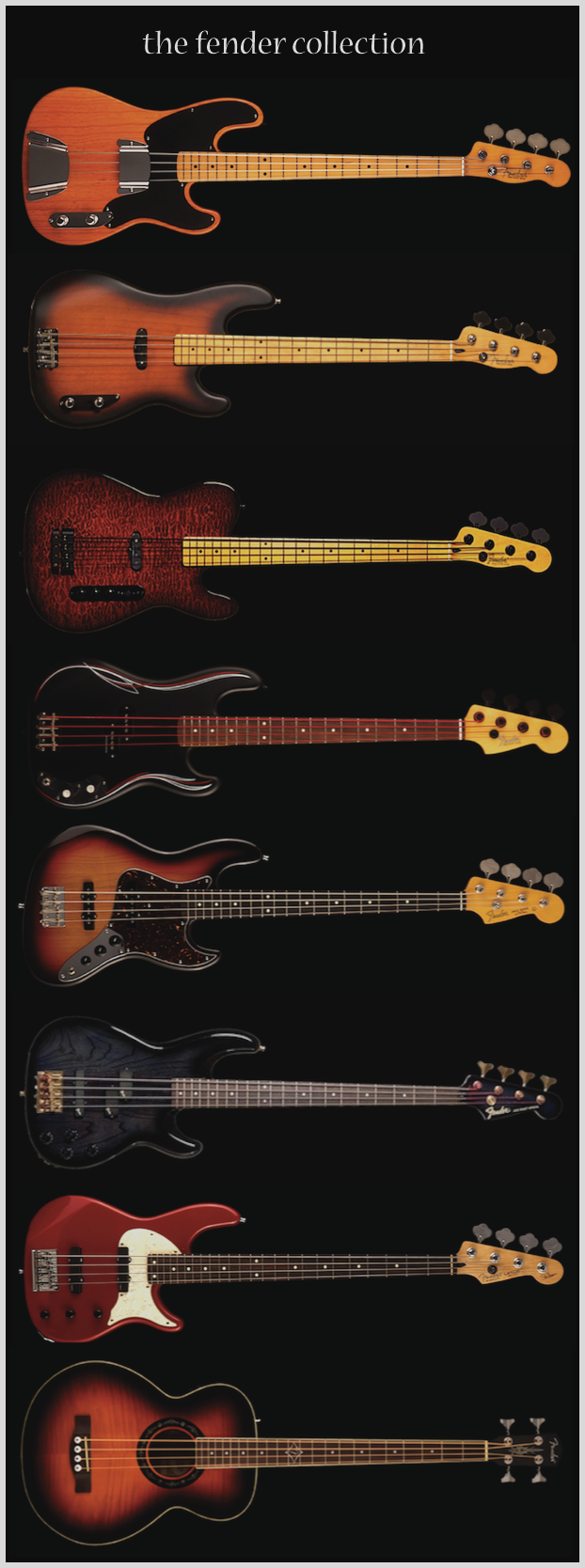
You can call this bass #17, or #9 in the Fender Collection.
As I have been doing the planning and the designing around this project - I have had the good fortune to be inspired by a number of good folks on this board.
I like to give credit where credit is due so I want to take a moment to thank those who have been influential and even inspirational in my approach to this project.
The first shout out goes to JIO whose Performer "Supersonic" build was not only remarkable but incredibly inspirational. To be honest, his headstock smokes the original Performer headstock and he - IMHO - made a number of improvements over the original design. If you are even vaguely a Performer fan and you haven't seen this build for yourself, you should proceed here, without further ado and check out his work:
http://www.talkbass.com/threads/custom-performer-supersonic-bass.904968/
I would also like to give a shout out to mapleglo, who also made her version of a Fender Performer, once again remarkably cool and incredibly inspirational. While you are at it, check out all of their builds. They are both wonderful builders. The thread on her Performer build is here, with a big heartfelt "thanks" to both of you.:
http://www.talkbass.com/threads/first-build-performer-copy.1013458/
The next shout out goes to the man himself John Page - who was a founder of the Fender Custom Shop in the mid-eighties - and was the original creator of both the Fender Performer Bass AND the original Stu Hamm Urge I medium scale bass. I have been in touch with John and gave John Page Guitars every opportunity to actually build this bass for me as a tribute to his work while he was in the Fender Custom Shop. I gently prodded him from time to time and he never said no, but always told me to check back with him. Very recently he told me it would be quite a while due to the number of new designs he was in the middle of - and if I found someone to help with the build I should move ahead. He DID express a genuine desire to help with the process which I greatly appreciated and asked that I send photos. Unfortunately, time was not on my side when it came to John and his busy schedule but I am delighted and amazed that in his own way he gave the project his "blessing".
An additional shout out needs to go out to the Fender Squier Katana bass. I was convinced that I could find one of these rare medium scale birds at a decent price - to rob the neck off of. I also realized that if I could find the neck on the cheap, this bass could be built for a very reasonable price. Unfortunately or fortunately, however you want to look at it - I was unable to find a Fender or Squier Katana bass at a reasonable price. I was hoping to find one with a trashed body so that I could save a few bucks and abandon the body with little or no guilt. The Katana headstock seems like a medium scale replica of the full scale Fender Performer headstock:

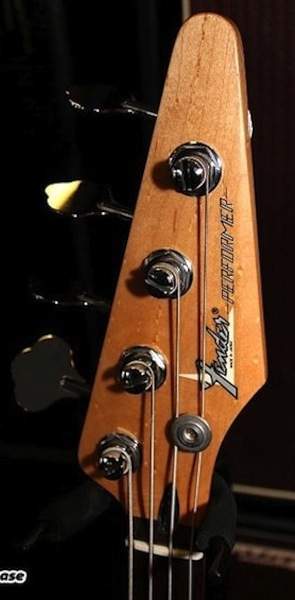
The Katana only had 21 frets while the Performer has a full two-octave neck at 24 frets. In the end, I couldn't live with this discrepancy and mostly as a tribute to John Page I decided to really try and nail this one in his honor with a full two-octave neck.
The last shout out goes out to Bruce Johnson who as far as I can tell - builds custom neck/truss rod systems and neck blanks for a number of builders, including at times for my friend Pat Wilkins. Bruce noticed a posting I had on here, and recommended a talented luthier in Los Angeles named Keith Horne. Keith does custom work for a number of folks and was very receptive and excited about doing a Fender Performer replica in medium scale.
I can't really post this in the "Luthier's Corner" as I am not technically the builder. I suppose Keith as the builder could post as we go, but I didn't want to bother or burden him with this - but he has agreed to send photos as things progress. So, I hope it is alright with the mods and you good TBer's that I continue to post progress right here in this thread in the "Bass" section.
The first issue that Keith and I spoke about was the issue of the neck. Although JIO and mapleglo improved dramatically on the headstock in my opinion, I decided that I wanted to stay in keeping with the tribute to John Page and keep the original headstock shape. It's a weird headstock and hard to love, not nearly as George Jetson as JIO's - but I have become more and more enamored with it as we go.
Also as a tribute to John, we decided to use my Stu Hamm prototype medium scale neck design as our basic guide for the neck. As far as I know, it is the ONLY Fender medium scale production neck ever made with two full octaves.
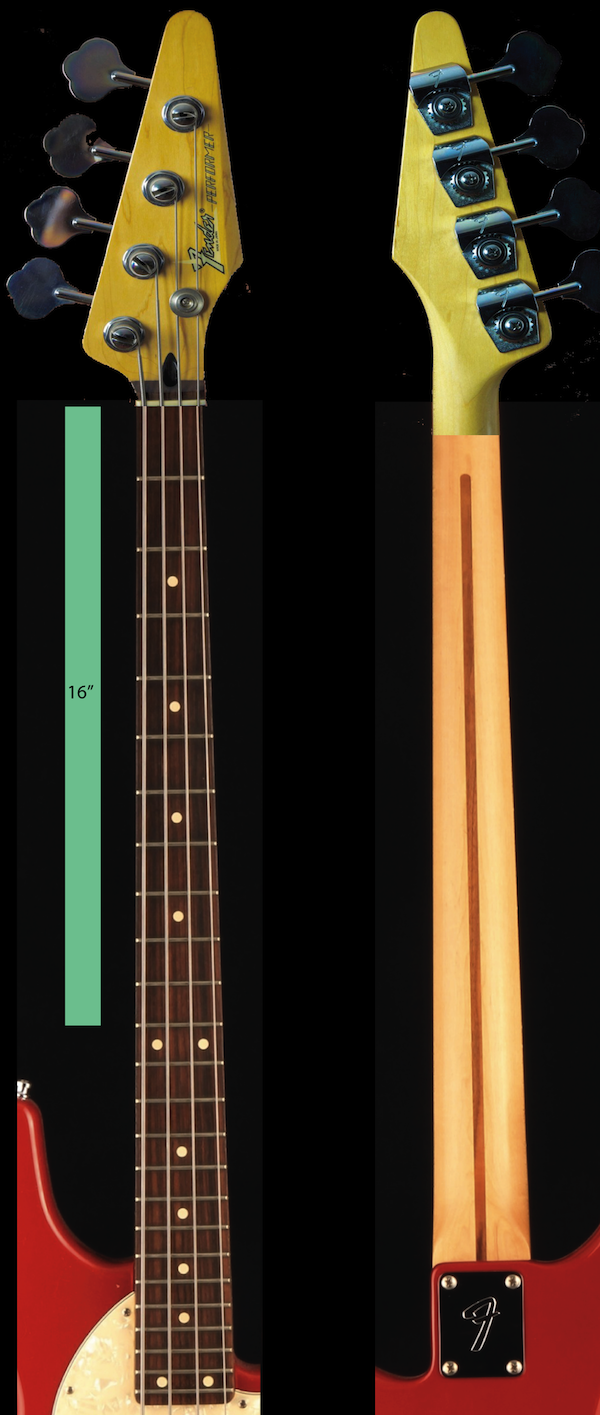
Keith asked me to measure the neck and I provided all of the measurements that he asked for. I work with Illustrator a lot and find it extremely accurate when making things actual size. Here is the template that i provided for Keith, basically the Stu Hamm neck with a reduced version of the Performer headstock. Of course, we have to round off the end of the fingerboard end at the body - instead of leaving it straight as this one appears:
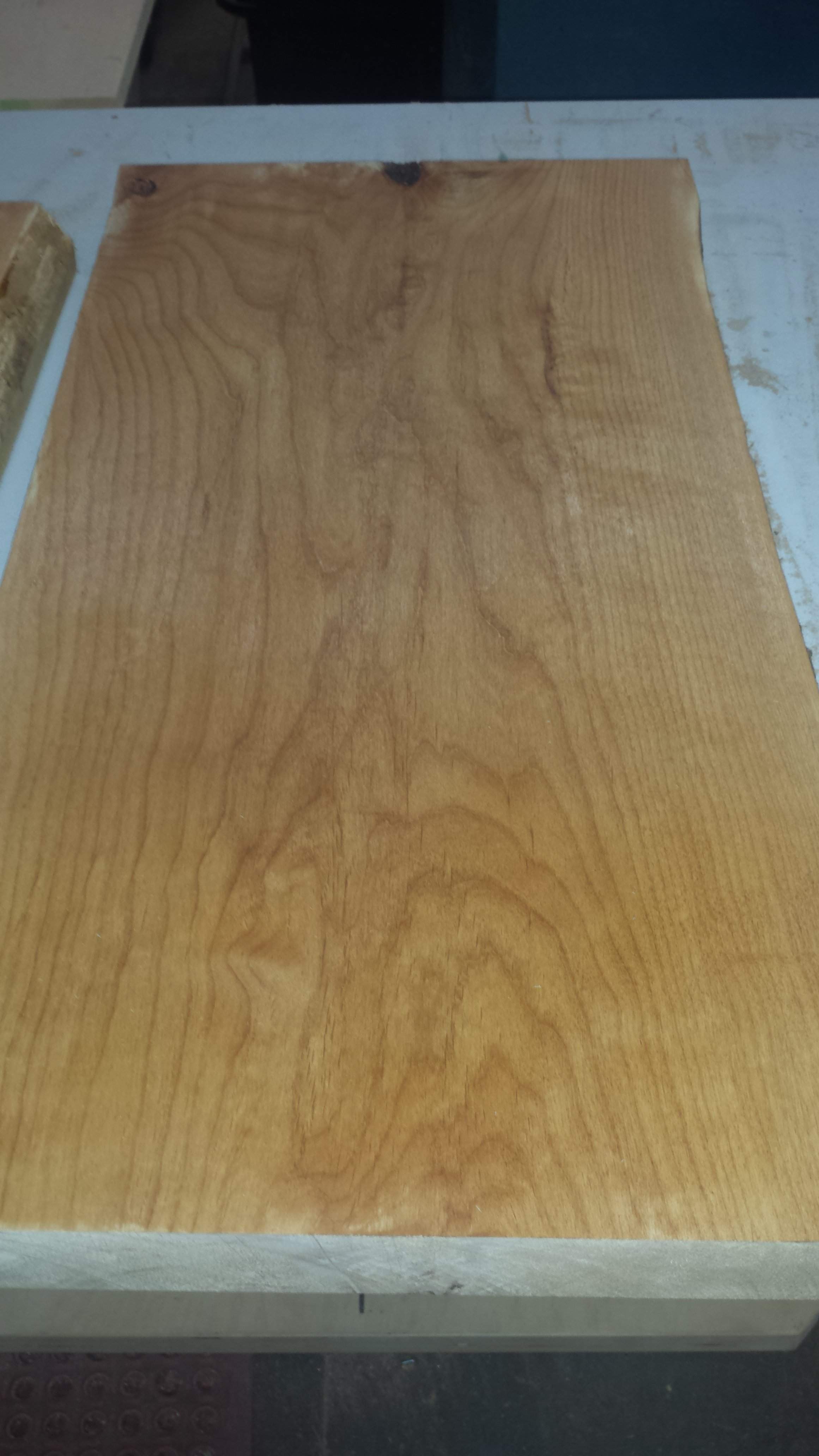
We are not downsizing the body, but are going with the full size Performer body in one piece alder. Keith sent me shots of two different pieces of alder he found and purchased today and I picked this one:
I have decided on rear rout and no pickguard, more like the elusive Performer Elite - which we ALL wish we could have seen photos of. Rather than 3 pickups like the elite, I will stay with two.
And here is the maple for the neck:
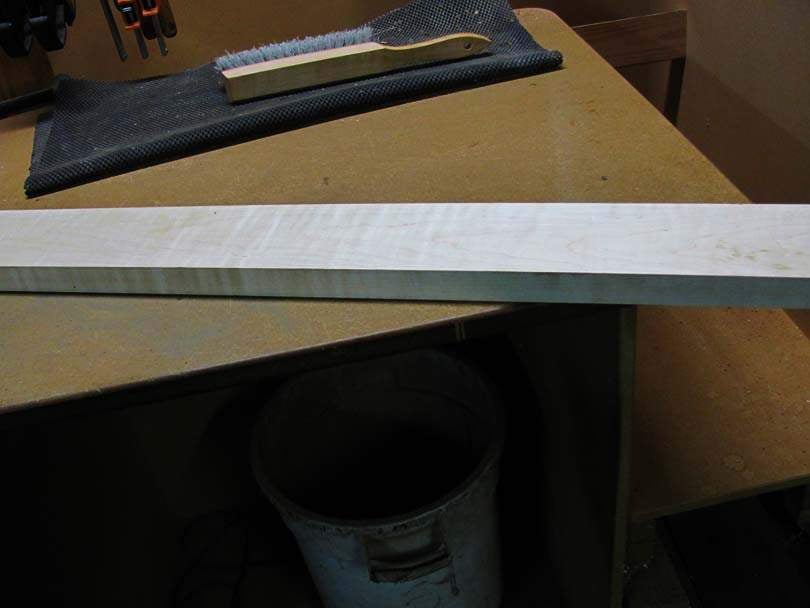
Some figure and some flame, not too much, just right for the period, I think....
I managed to find the same tuners which are ultra-lights:
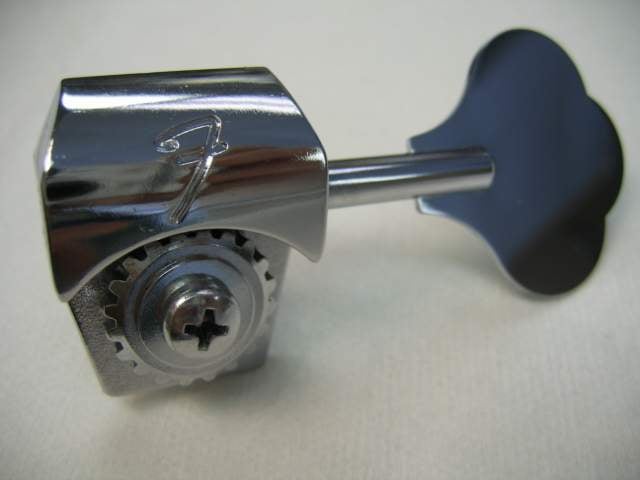
And I always like the Fender Vintage bridge on the medium scalers in case you have to play around slightly with the string spacing:

I also sent Keith a neck plate, strap buttons and a string tree. I am going with all chrome hardware but all black screws, including the neck plate and bridge screws, even the screws for the bridge barrels are black, and black screws for the chrome strap buttons. I think it will dress it up a little and hopefully make it stand out a bit.
As we all know, with trying to replicate the original Performers the great challenges and the magic lies in the pickups, the pickup covers, the decal and the control knobs. Still trying to decide if we should use a micro tilt kit on the neck like the original. Stay tuned.
BassHappy
www.innertainment.net
From Fender:
"Performer Bass (1986-1987). Distinctively pointy shapes continued in the mid-1980s with the Performer guitar and bass models, which were second only to the Katana models in non-traditional Fender design. 1986’s angular Performer Bass boasted a slim two-octave neck, unusually deep cutaways and dual single-coil pickups. It was available in two versions—the less expensive ($499) Japanese-made Standard Performer Bass, which had a rosewood fingerboard and white pickguard, and the more expensive ($949) U.S.-made Elite Performer Bass, which had an ebony fingerboard and no pickguard. Fender Custom Shop founder John Page, the creator of the Performer instruments, designed a five-string version of the bass in 1987 that never made it past the prototype stage. Although it didn’t catch on with players and it too suffered from Fender’s post-CBS instability of the mid-1980s, the Performer Bass nonetheless had notable strengths and was a well-conceived attempt at a modern direction for Fender basses quite apart from the long-established Precision/Jazz tradition. It was discontinued after only a year. Performer basses are regarded today as a something of a curiosity, albeit interesting and well-built ones, and they command high prices in the infrequent instances when they show up for sale."
And a post from John Page from fender.com:
"Yes the Performer was one of my designs. Believe it or not, the Performer bass (designed before the guitar) was designed to be the Elite version of the Jazz Bass.. yes that's right... it was going to be the top version of the Jazz Bass... scary huh? The shape of the instrument is derivative of the back of the Strat Look at the waist cut on the back of the Strat and you'll see where the basic horn/body shape started. At the time (1982-3ish?) I was designing this, Fender was considered a pretty conservative instrument Kramer, Jackson & BC Rich were building these radically styled instruments, so we wanted to get into that market. In my original design, it used a Strat-style peg-head and the pickups were a double Strat hum-bucking setup. I also designed the Fender Logo On The Performer I can't say that that a good thing, but it was kinda cool to design a new Fender logo. We got some comments that it looked like the Peavey logo, which really pissed me off. The guitar that was produced was different than the original that I designed. I initially designed it to be made in the US, but it ended up being made in Japan. When that transition happened, things were changed. The peg-head went from the Strat to the Swinger, for example, so I don't remember what pickup they actually went with. I angled the pickups to thicken up the top end a bit... and it looked cool. Well, at least to me, I like "off-line aesthetics". Why weren't they successful? Look, I was a designer in Fender R&D for years before I started the CS. I was always trying to design something new and different. When we started the CS, I tried to do the same. Reality is, the public wants Strats, Teles, P & J basses from Fender. So it's really tough to get them to accept any "new & different" designs in any great quantities. I'm afraid I have no idea how many were actually produced.
I designed the five string version when I first came back to start the CS in '87. To the best of my knowledge there was only one prototype made by Fuji Gen Gakki It was kind of a pinkish color and had the same basic features of the 4 string Japanese model. When I initially designed both basses, they were modified Mustang coils, wound beefier and wired to be hum-bucking. When the four string version was released it used a single coil p/u under each cover. The original also was designed with a angular/massive/fine-tuning bridge, and a "lightning bolt" styled string tree. Both were prototyped but never released. I never heard of any instruments being destroyed for any legal issues... maybe another one of those "legends"? The idea behind the neck was simple, at the time a lot of bass players were guitar player converts. Bass playing style started to have more of a "lead guitar" approach, so the idea of a narrower neck was to help along those lines. The original proto went on the summer before it was released with the then "hottest" bands, Billy Idol (I don't remember his bass player's name) and The CARS bass player, Ben Orr."
OK, so many of you know me as one of the "resident" medium scalers around here and if you paid attention, even casually - you know that I have been gassing for a LONG time for a Fender Performer in medium scale.
The truth is - in the grand scheme of custom bass building - this will be a pretty simple and straight forward "replica" type build. Nothing revolutionary, nothing groundbreaking - the creativity will reside in the more subtle areas and the devil will be in the details:
You can call this bass #17, or #9 in the Fender Collection.
As I have been doing the planning and the designing around this project - I have had the good fortune to be inspired by a number of good folks on this board.
I like to give credit where credit is due so I want to take a moment to thank those who have been influential and even inspirational in my approach to this project.
The first shout out goes to JIO whose Performer "Supersonic" build was not only remarkable but incredibly inspirational. To be honest, his headstock smokes the original Performer headstock and he - IMHO - made a number of improvements over the original design. If you are even vaguely a Performer fan and you haven't seen this build for yourself, you should proceed here, without further ado and check out his work:
http://www.talkbass.com/threads/custom-performer-supersonic-bass.904968/
I would also like to give a shout out to mapleglo, who also made her version of a Fender Performer, once again remarkably cool and incredibly inspirational. While you are at it, check out all of their builds. They are both wonderful builders. The thread on her Performer build is here, with a big heartfelt "thanks" to both of you.:
http://www.talkbass.com/threads/first-build-performer-copy.1013458/
The next shout out goes to the man himself John Page - who was a founder of the Fender Custom Shop in the mid-eighties - and was the original creator of both the Fender Performer Bass AND the original Stu Hamm Urge I medium scale bass. I have been in touch with John and gave John Page Guitars every opportunity to actually build this bass for me as a tribute to his work while he was in the Fender Custom Shop. I gently prodded him from time to time and he never said no, but always told me to check back with him. Very recently he told me it would be quite a while due to the number of new designs he was in the middle of - and if I found someone to help with the build I should move ahead. He DID express a genuine desire to help with the process which I greatly appreciated and asked that I send photos. Unfortunately, time was not on my side when it came to John and his busy schedule but I am delighted and amazed that in his own way he gave the project his "blessing".
An additional shout out needs to go out to the Fender Squier Katana bass. I was convinced that I could find one of these rare medium scale birds at a decent price - to rob the neck off of. I also realized that if I could find the neck on the cheap, this bass could be built for a very reasonable price. Unfortunately or fortunately, however you want to look at it - I was unable to find a Fender or Squier Katana bass at a reasonable price. I was hoping to find one with a trashed body so that I could save a few bucks and abandon the body with little or no guilt. The Katana headstock seems like a medium scale replica of the full scale Fender Performer headstock:
The Katana only had 21 frets while the Performer has a full two-octave neck at 24 frets. In the end, I couldn't live with this discrepancy and mostly as a tribute to John Page I decided to really try and nail this one in his honor with a full two-octave neck.
The last shout out goes out to Bruce Johnson who as far as I can tell - builds custom neck/truss rod systems and neck blanks for a number of builders, including at times for my friend Pat Wilkins. Bruce noticed a posting I had on here, and recommended a talented luthier in Los Angeles named Keith Horne. Keith does custom work for a number of folks and was very receptive and excited about doing a Fender Performer replica in medium scale.
I can't really post this in the "Luthier's Corner" as I am not technically the builder. I suppose Keith as the builder could post as we go, but I didn't want to bother or burden him with this - but he has agreed to send photos as things progress. So, I hope it is alright with the mods and you good TBer's that I continue to post progress right here in this thread in the "Bass" section.
The first issue that Keith and I spoke about was the issue of the neck. Although JIO and mapleglo improved dramatically on the headstock in my opinion, I decided that I wanted to stay in keeping with the tribute to John Page and keep the original headstock shape. It's a weird headstock and hard to love, not nearly as George Jetson as JIO's - but I have become more and more enamored with it as we go.
Also as a tribute to John, we decided to use my Stu Hamm prototype medium scale neck design as our basic guide for the neck. As far as I know, it is the ONLY Fender medium scale production neck ever made with two full octaves.
Keith asked me to measure the neck and I provided all of the measurements that he asked for. I work with Illustrator a lot and find it extremely accurate when making things actual size. Here is the template that i provided for Keith, basically the Stu Hamm neck with a reduced version of the Performer headstock. Of course, we have to round off the end of the fingerboard end at the body - instead of leaving it straight as this one appears:
We are not downsizing the body, but are going with the full size Performer body in one piece alder. Keith sent me shots of two different pieces of alder he found and purchased today and I picked this one:
I have decided on rear rout and no pickguard, more like the elusive Performer Elite - which we ALL wish we could have seen photos of. Rather than 3 pickups like the elite, I will stay with two.
And here is the maple for the neck:
Some figure and some flame, not too much, just right for the period, I think....
I managed to find the same tuners which are ultra-lights:
And I always like the Fender Vintage bridge on the medium scalers in case you have to play around slightly with the string spacing:
I also sent Keith a neck plate, strap buttons and a string tree. I am going with all chrome hardware but all black screws, including the neck plate and bridge screws, even the screws for the bridge barrels are black, and black screws for the chrome strap buttons. I think it will dress it up a little and hopefully make it stand out a bit.
As we all know, with trying to replicate the original Performers the great challenges and the magic lies in the pickups, the pickup covers, the decal and the control knobs. Still trying to decide if we should use a micro tilt kit on the neck like the original. Stay tuned.
BassHappy
www.innertainment.net
Last edited:


 Thanks for the kind words!


 I used the fuzzy reproduction of John Pages blueprint in Klaus Blasquiz's The Fender Bass book from 1990 to get me close. I've never held an actual Performer so I used a copy machine until it was close to 'actual' size. (in the more or less dept) In his book, KB has copy next to it stating it was made in Japan for one year, 1987. Most everything I've read since sez mid year '85 to mid year '86. Questions abound! As both the (Fender badged) Performer and (Squier badged) Katana were both made in Japan (probably side by side), it's curious why they they weren't both badged Fender. A marketing decision most likely. As has been written, the Fender peeps had aspirations that the Performer was to be the 'Elite' Jazz bass, so a Fender badge was appropriate there. Did they not want to associate the Fender name as solidly for the radical (for them) Katana design?


