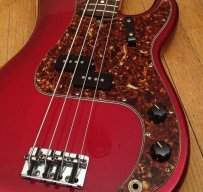
I have a Fender Precision Elite bass, I believe from the 1980s. I bought it from a friend in the early 90s and it is incredibly hard to find parts for. I needed to set it up recently and when I went to intonate it the heads of the intonation screws for the low E and A were stripped badly. So much that I can’t get the saddles back far enough to properly intonate. Do any of you know of anywhere I can find these screws. Don’t know if other bridges’ screws are a match? They only used this bridge for a short time so trying to find it, or parts for it is damn near impossible. This is the bridge in question. Thanks in advance. Also in need of a knob for it, but that’s another story. Lol.


Enjoy the benefits of a premium membership!
Upgrade Account
-
TalkBass has been independent since 1998. Add your voice.
Create a free account to reply to discussions, view embedded media, and browse with fewer display ads.
Join free Log in
Want zero display ads or expanded classifieds tools? Compare plans.
You are using an out of date browser. It may not display this or other websites correctly.
You should upgrade or use an alternative browser.
You should upgrade or use an alternative browser.
Fender Precision Elite Bridge intonation screws
- Thread starter jpeccerillo
- Start date
More options
Who Replied?
Simply remove one of the existing intonation screws and hop-on-down to your local Lowes. They have a sizing guide which will ID the correct replacement. You can also remove or trim-down the spring to gain some extra real estate. Don't forget to set your witness points.
Ha-ha...even has the original fine tuners!
Riis
Ha-ha...even has the original fine tuners!
Riis

The real estate isn’t the problem. The problem is I can’t turn the screw without the head if it stripping out more. It’s a flat head and it’s been chewed away. This is the first time I’ve set it up since I’ve owned it (I’m a guitarist and don’t play it that often). Must’ve been stripped like that since I bought it.Simply remove one of the existing intonation screws and hop-on-down to your local Lowes. They have a sizing guide which will ID the correct replacement. You can also remove or trim-down the spring to gain some extra real estate. Don't forget to set your witness points.
Ha-ha...even has the original fine tuners!
Riis
The real estate isn’t the problem. The problem is I can’t turn the screw without the head if it stripping out more. It’s a flat head and it’s been chewed away. This is the first time I’ve set it up since I’ve owned it (I’m a guitarist and don’t play it that often). Must’ve been stripped like that since I bought it.
Gotcha. If you remove the string, will the screw head hold together long enough enough for you to back it out completely from the saddle and entire bridge assembly? That's job #1. If the slot head is so botched you can not turn it in any fashion, we'll move on to Plan B.
Riis
I’m pretty sure I’ll be able to back the screws out. They seem to be stripped in one direction and that’s tightening.Gotcha. If you remove the string, will the screw head hold together long enough enough for you to back it out completely from the saddle and entire bridge assembly? That's job #1. If the slot head is so botched you can not turn it in any fashion, we'll move on to Plan B.
Riis
I’m pretty sure I’ll be able to back the screws out. They seem to be stripped in one direction and that’s tightening.
Then you're good...do all 4 whilst you have it apart. All mine are PH.
Riis

I’m pretty sure I’ll be able to back the screws out. They seem to be stripped in one direction and that’s tightening.
Those are 6-32 screws. you should buy several different sizes from about 1 inch up to 1 3/4 inches. You want to do that because your saddles aren't threaded all the way through, so several different lengths are in order. Incidentally this is most likely the reason the screws are stripped to begin with; the screw bottomed out but the string was still sharp, so the owner tried to tighten it further and stripped out the head. He was fortunate that the saddle threads didn't strip. Get screws made of soft metal, mild steel or brass, so if something gets stripped it'll be the screws and not the saddle.
If you can't back the screw out, remove/loosen the string, push the saddle back so the screw head is sticking out and use pliers to get the screw turning. In a real pinch you can use a drill to cut the screw head off; if you must resort to this be sure to protect the body with cardboard.
Last edited:
Thank you for the detailed reply. That’s exactly the type of info I was hoping to get. Much appreciated.Those are 6-32 screws. you should buy several different sizes from about 1 inch up to 1 3/4 inches. You want to do that because your saddles aren't threaded all the way through, so several different lengths are in order. Incidentally this is most likely the reason the screws are stripped to begin with; the screw bottomed out but the string was still sharp, so the owner tried to tighten it further and stripped out the head. He was fortunate that the saddle threads didn't strip. Get screws made of soft metal, mild steel or brass, so if something gets stripped it'll be the screws and not the saddle.
If you can't back the screw out, remove/loosen the string, push the saddle back so the screw head is sticking out and use pliers to get the screw turning. In a real pinch you can use a drill to cut the screw head off; if you must resort to this be sure to protect the body with cardboard.
Thank you for the detailed reply. That’s exactly the type of info I was hoping to get. Much appreciated.
Edit your profile to include the city and state/country so you can get appropriate assistance in future.
Last edited:
So just found out today……not 6-32 screws. Bought some and tried them out and they don’t fit. Very close but not quite. I’m wondering if maybe they are the metric equivalent, which would make sense because I believe these bridges were made by Schaller, a German company. I’ll figure it out and let you know.Those are 6-32 screws. you should buy several different sizes from about 1 inch up to 1 3/4 inches. You want to do that because your saddles aren't threaded all the way through, so several different lengths are in order. Incidentally this is most likely the reason the screws are stripped to begin with; the screw bottomed out but the string was still sharp, so the owner tried to tighten it further and stripped out the head. He was fortunate that the saddle threads didn't strip. Get screws made of soft metal, mild steel or brass, so if something gets stripped it'll be the screws and not the saddle.
If you can't back the screw out, remove/loosen the string, push the saddle back so the screw head is sticking out and use pliers to get the screw turning. In a real pinch you can use a drill to cut the screw head off; if you must resort to this be sure to protect the body with cardboard.
The metric equivalent would be M4. Many of the tuners and some of the bridges Fender put on their instruments were made by Schaller. This is the first instance I have come across that SAE parts didn't fit. Sorry for the inconvenience.
Not a problem. I’ll figure it out. I appreciate the help.The metric equivalent would be M4. Many of the tuners and some of the bridges Fender put on their instruments were made by Schaller. This is the first instance I have come across that SAE parts didn't fit. Sorry for the inconvenience.

So just found out today……not 6-32 screws. Bought some and tried them out and they don’t fit. Very close but not quite. I’m wondering if maybe they are the metric equivalent, which would make sense because I believe these bridges were made by Schaller, a German company. I’ll figure it out and let you know.
They’re probably M4 then. The next SAE size up would be 8-32 which is very close to M4. If the screws are the same size but different thread I think M3.5 is the same or almost the same diameter as 6-32 but different thread pitch.
Yeah, I’m thinking probably M3.5. The 6-32 are really close. 8-32 or M4 I believe will be too big. I’ll bring one to the store with me and use their thread guide to verify this time.They’re probably M4 then. The next SAE size up would be 8-32 which is very close to M4. If the screws are the same size but different thread I think M3.5 is the same or almost the same diameter as 6-32 but different thread pitch.
I checked my Schaller 2K roller bridge, which is similar vintage, and although it was a bit hard to get a good reading with the calipers without taking it apart, due to the springs, it seems more likely to be M3 x 0.5mm. M3.5 does exist, but is not very common. If you can't find gold-plated screws, stainless socket-head cap screws from an industrial supply place like McMaster-Carr might be the next best option.
Thank you.I checked my Schaller 2K roller bridge, which is similar vintage, and although it was a bit hard to get a good reading with the calipers without taking it apart, due to the springs, it seems more likely to be M3 x 0.5mm. M3.5 does exist, but is not very common. If you can't find gold-plated screws, stainless socket-head cap screws from an industrial supply place like McMaster-Carr might be the next best option.

i think those are blind holes, meaning that when you keep tightening they're bottoming out and can't go in any more!I’m pretty sure I’ll be able to back the screws out. They seem to be stripped in one direction and that’s tightening.
assuming you haven't actually stripped out the saddles themselves, you might be able to just shorten the screws to get more room to pull the saddles back
Latest posts
-

-

-

-
 NAD - Thrift Store Score – Genz Benz Shuttle 3.0 w/ 10" Docking Cab
- Latest: Kilroy Was Here
-