• TalkBass has been independent since 1998. Add your voice.
    Create a free account to reply to discussions, view embedded media, and browse with fewer display ads.
    Join freeLog in
    Want zero display ads or expanded classifieds tools? Compare plans.

Fender & SR Pup Location - determined by math or trial & error?

I think it's funny that people are talking about the design being 35-50 years old. Like that's nothing in comparison to orchestral instruments. You don't usually hear people saying "oh let's redesign the cello!," though there have been instruments made for sure that expanded on the regular design. Oh one hand, if something works, why mess with it? On the other hand I can see why people would want to experiment. But if you've got a fretboard that does give you limited room to mess around with pickup position.

I think there's a big difference partly because of the way sound is reproduced by electric instruments vs. their acoustic counterparts.

There are more things to change on an electric, and also, changing the body design or pickup placement won't have disastrous effects on the volume. Change a cello's body design too much and it probably won't be capable of projecting nearly as much. With an electric bass, you can just turn up the volume knob on the amp.
 
I think there's a big difference partly because of the way sound is reproduced by electric instruments vs. their acoustic counterparts.

There are more things to change on an electric, and also, changing the body design or pickup placement won't have disastrous effects on the volume. Change a cello's body design too much and it probably won't be capable of projecting nearly as much. With an electric bass, you can just turn up the volume knob on the amp.

Volume, sure. Since an electric bass can't really be heard unless it's plugged in. But the end result is still the same. A design change (pickup placement, body wood, solid vs. chambered or even body mass) can affect the way an instrument sounds, even though with an electric instrument shape isn't as critical.
 
I think there's a big difference partly because of the way sound is reproduced by electric instruments vs. their acoustic counterparts.

There are more things to change on an electric, and also, changing the body design or pickup placement won't have disastrous effects on the volume. Change a cello's body design too much and it probably won't be capable of projecting nearly as much. With an electric bass, you can just turn up the volume knob on the amp.

You most certainly can have disastrous effects on volume and even worse, tone, by changing pickup location. Turning up the amp isn't the same as getting it from the bass itself IMO. Of course that could be better, it doesn't have to be worse.

And you can turn up the mic on a cello.
:hiding:
 
I think it's funny that people are talking about the design being 35-50 years old. Like that's nothing in comparison to orchestral instruments. You don't usually hear people saying "oh let's redesign the cello!," though there have been instruments made for sure that expanded on the regular design. Oh one hand, if something works, why mess with it? On the other hand I can see why people would want to experiment. But if you've got a fretboard that does give you limited room to mess around with pickup position.

Well, the violin went through about 250 years of experimentation, with luthiers trying out many different things before finally settling on what they considered the best design, and they've produced basically the same design ever since. I'd assume the cello went through the same process before its design was finalized too. The electric bass is a very young instrument and I don't think we've yet settled on the best possible combination of all factors like the older instruments have.
 
You most certainly can have disastrous effects on volume and even worse, tone, by changing pickup location. Turning up the amp isn't the same as getting it from the bass itself IMO. Of course that could be better, it doesn't have to be worse.

And you can turn up the mic on a cello.
:hiding:

None of my experience playing upright bass has been with a microphone or even an amp. Nor has most of my aunt's cello playing involved an amplifier or a microphone.


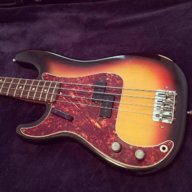
I don't think you can have "disastrous" effects on volume/tone by changing pickup location. Certainly you can have drastic effects on it, and maybe get a sound that you're not trying for, but I don't think on any given bass that there's a possible pickup location between the end of the fretboard and the bridge that's totally unusable. I mean, I don't much care for the standard P-bass location, or the EB-0/Tele bass pickup location (right up against the fretboard) by itself, but a lot of people get good use out of it and I can imagine it working well for some music.

Certain locations will be louder than others, but that can be compensated for by raising or lowering the pickup to get desired gain into the amp.

Whereas, in contrast, change a cello too much and not only is the tone weird, but it might not be able to project sound at any reasonable volume.
 
Volume, sure. Since an electric bass can't really be heard unless it's plugged in. But the end result is still the same. A design change (pickup placement, body wood, solid vs. chambered or even body mass) can affect the way an instrument sounds, even though with an electric instrument shape isn't as critical.

I just think there's more room for experimentation on an instrument where the shape and placement of various components doesn't actually have that much bearing on whether or not it's audible.

With the Cello example, you could change some things and maybe get a tone you liked better, but you might have to sacrifice a lot of volume to do that, something which is very important in an acoustic instrument.

On an electric bass, you can change a bunch of things to get different sounds without compromising the ability to make the instrument heard.
 
The genius of Leo Fender's designs, besides their overwhelming aesthetic appeal, is that they found an excellent balance between quality and economy from the beginning. It's easy to make a bass that's technically superior to a Fender, but it's very difficult to make a bass that is also more economical, aesthetically pleasing, mass-produceable, and instantly recognizable.

It's prudent that the OP made a reference to the moon landing. For the recently cancelled Constellation mission (cancelled because it was too expensive in a recession), which was to retire the shuttle, take man back to the moon, and on to Mars, the capsule design was a throwback to the Apollo CM capsules. Lots of people were asking why in 40 years of technical advance, NASA had resorted to such an archaic design. The answer is that the Apollo design is simply the best design possible for that kind of space travel.

Now I'm not saying that Fender is the best design possible for a bass, but there's a reason Fender has stood the test of time.