
• TalkBass has been independent since 1998. Add your voice.
    Create a free account to reply to discussions, view embedded media, and browse with fewer display ads.
    Join freeLog in
    Want zero display ads or expanded classifieds tools? Compare plans.

Fender "The Bends" Compressor?

Hello everyone!

Has anyone used the Fender "The Bends" compressor pedal?

In my country I found it used at a similar price than I could pay for a Boss LMB3 or an EHX bass preacher.

I searched Ovnilab and didn't find any reviews and there is very little information on the internet too.

The experience with other pedals of the Fender brand is also useful to see its quality, duration, among other observations.

Thank you very much for your answers!
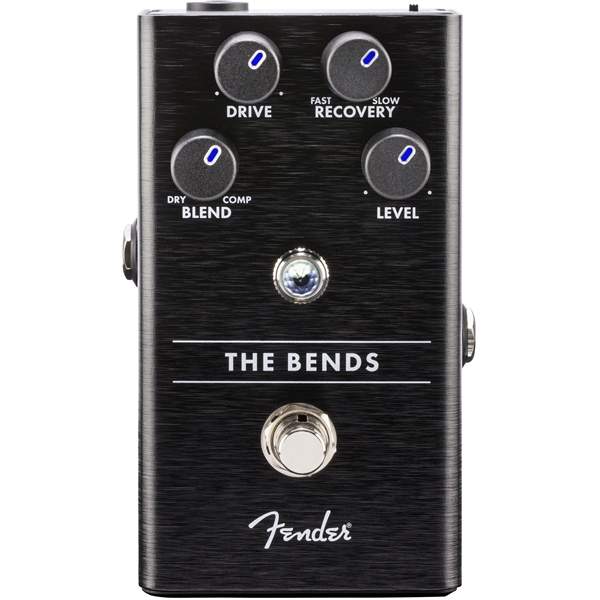
Fender.jpg
 
Hey there! Just picked one up used and will chime in with some thoughts when I've had a chance to mess with it some more. I am on tour right now and have the Smoothie OTA with me and my MS-3 which is the comp currently in my stage rig (I use the 'light compressor' setting.) I feel like the Smoothie will be a great shootout with this pedal because they are in the same family and my first impressions are that they feel similarly buttery to play, tonally transparent, and are both quality, low-noise versions of this kind of pedal. That's already pretty high praise because I adore the Smoothie and the Fender can be found at a sub-$100 price point used. I'll check back in with you soon.
 
  • Like
Reactions: imabuddha
Hey there! Just picked one up used and will chime in with some thoughts when I've had a chance to mess with it some more. I am on tour right now and have the Smoothie OTA with me and my MS-3 which is the comp currently in my stage rig (I use the 'light compressor' setting.) I feel like the Smoothie will be a great shootout with this pedal because they are in the same family and my first impressions are that they feel similarly buttery to play, tonally transparent, and are both quality, low-noise versions of this kind of pedal. That's already pretty high praise because I adore the Smoothie and the Fender can be found at a sub-$100 price point used. I'll check back in with you soon.
Inquiring minds want to know.
 
Ah, sorry everybody! I think I wrote a bit about The Bends in another thread somewhere, like the great compressor shootout or whatnot. I'm not on TB very often. Truth be told I sold this pedal last year in a purge of gear without ever having found a use for it on a recording or anything, and I tried, too. It has a pleasant dark character if memory serves, like clean but on the dark and wooly side of the spectrum, and you can get a bit of grit in the attack by turning up the knob on the top right (I can't remember what it is called but something like response?) There were two things I recall that bothered me about this pedal when I compared it side by side with others, those being a very small clipping artifact at the beginning of the envelope that I couldn't manage to get rid of, and just a general sense of knobs seeming to be fiddly in the way of both being too broad but also never quite finding their way to nailing what I wanted to dial in. It's very easy to nuke the signal with The Bends and I think this is a bit of an issue because I heard some pretty significant compression happening before the jewel really lit up, and often in demos people have it lighting up constantly. A happier medium for me was to have it light only briefly on extreme peaks. For some reason I wasn't thrilled with the envelope of this compressor as a parallel effect even though I have used that to great effect with other units like the Smoothie. As I said, it wasn't bad by any stretch, but there's so much competition these days both from flat better compressors and other used units in the $100 range that I couldn't find anything particular with which to recommend it, either. It's pretty, in my opinion, so there's that. It's also then a little on the large side for a near-standard size enclosure. Whole thing's a bit of a wash for me, sadly!
 
Ah, sorry everybody! I think I wrote a bit about The Bends in another thread somewhere, like the great compressor shootout or whatnot. I'm not on TB very often. Truth be told I sold this pedal last year in a purge of gear without ever having found a use for it on a recording or anything, and I tried, too. It has a pleasant dark character if memory serves, like clean but on the dark and wooly side of the spectrum, and you can get a bit of grit in the attack by turning up the knob on the top right (I can't remember what it is called but something like response?) There were two things I recall that bothered me about this pedal when I compared it side by side with others, those being a very small clipping artifact at the beginning of the envelope that I couldn't manage to get rid of, and just a general sense of knobs seeming to be fiddly in the way of both being too broad but also never quite finding their way to nailing what I wanted to dial in. It's very easy to nuke the signal with The Bends and I think this is a bit of an issue because I heard some pretty significant compression happening before the jewel really lit up, and often in demos people have it lighting up constantly. A happier medium for me was to have it light only briefly on extreme peaks. For some reason I wasn't thrilled with the envelope of this compressor as a parallel effect even though I have used that to great effect with other units like the Smoothie. As I said, it wasn't bad by any stretch, but there's so much competition these days both from flat better compressors and other used units in the $100 range that I couldn't find anything particular with which to recommend it, either. It's pretty, in my opinion, so there's that. It's also then a little on the large side for a near-standard size enclosure. Whole thing's a bit of a wash for me, sadly!
Nice one!! Thanks for coming back to write that. Much appreciated. Very informative.
 
I haven’t checked out the Fender Bends, but I do have the Fender Engager Boost on my pedalboard. Superb clean boost, with very effective EQ controls. Plus it has a switch on the top that allows you to select either true or buffered bypass as well as a switch to turn the blue LEDs on the knobs on or off. I use it to boost my passive 6-string bass to match the volume of my active 4 string. My only nitpick is that the white LED (when you turn the pedal on) is a little too bright for my liking. Aside from that, it’s a great pedal with rock solid construction.

AC063464-6CDD-4B5A-901A-AF2AE03B7721.jpeg
 
I’ve had the bends on my board for a few years now. I previously owned the Diamond Comp, Keeley Comp, boss LMB3, MXR Bass comp and a few others. This has outlasted them all. I’m not a compression snob by any stretch but I found that all the other compressors I tried could only do one thing, albeit extremely well, and I wanted something I could get 2-3 different sound out of and the bends does that for me.

Unlike @ianrossbass I find the compression quite mild overall, even at extreme settings. It may be a little “dark” with the blend farther toward the comp side but I lean toward a darker sound so that suits me fine. It does lose quite a bit of low end with the clean signal blended out but I rarely use it that way so it’s not an issue for me. You can get some clipping by turning the drive way up.

Overall I find it very good but not great in any given area. There are better compressors out there but I haven’t had the urge to even demo any, so I guess that says something.
 
  • Like
Reactions: Bassic_desires
I think for clarification part of my issue was actually that the ratio seems to stay low-ish and so you can turn the sensitivity or threshold (I really should've at least looked at a picture of this thing) up and totally obliterate the front of the note (what I meant by 'nuke') but not get enough sustain for my taste on the back end. I found myself liking the sound better with the threshold pretty low but then wanting a bit more something something and turning it up... and then trying to adjust the attack to de-rubberize the front of the note. And then turning on a different compressor that just did what I wanted to hear. But to be fair, again, I never got that irritated with it. It just didn't quite stack up for me. The Diamond didn't either, and while I think I preferred it slightly I'd encourage people looking into that one to at least play The Bends as well. They inhabit some of the same territory to my ears.
 
I think for clarification part of my issue was actually that the ratio seems to stay low-ish and so you can turn the sensitivity or threshold (I really should've at least looked at a picture of this thing) up and totally obliterate the front of the note (what I meant by 'nuke') but not get enough sustain for my taste on the back end. I found myself liking the sound better with the threshold pretty low but then wanting a bit more something something and turning it up... and then trying to adjust the attack to de-rubberize the front of the note. And then turning on a different compressor that just did what I wanted to hear. But to be fair, again, I never got that irritated with it. It just didn't quite stack up for me. The Diamond didn't either, and while I think I preferred it slightly I'd encourage people looking into that one to at least play The Bends as well. They inhabit some of the same territory to my ears.
 
Hello everyone!

Has anyone used the Fender "The Bends" compressor pedal?

In my country I found it used at a similar price than I could pay for a Boss LMB3 or an EHX bass preacher.

I searched Ovnilab and didn't find any reviews and there is very little information on the internet too.

The experience with other pedals of the Fender brand is also useful to see its quality, duration, among other observations.

Thank you very much for your answers!

View attachment 3601831

I bought one out of curiosity. I use a Walrus Mira that I quite like and before that, I was using a dbx rack unit for the past 3 decades. I picked this one because I got a deal on it and I wanted a compressor that would accept a battery. I find the controls rather counter-intuitive and was never really clear on exactly was happening though it does sound very good for how I use it. It does not do peak limiting in my book. It never gets really squishy which you may prefer as it's hard to get in trouble with this one. I directly compared to a Seymour Duncan Studio Bass compressor. I found that I could get basically the same sound out of it as my favorite setting on the SD which I sold after getting the Fender. I had asked Fender to describe the controls better as I really wanted to know what the available compression ratios were and where to find, say, 4:1. It took a long time but I finally received a response from Fender which I've pasted below:

"You can think of this as being sort of like a Vari Mu compressor where the compression ratio varies dynamically with how much gain reduction is going on and so there is not a single, fixed ratio. The Drive knob behaves a bit like an input gain control although it technically is not an input gain control and doesn’t adjust an audio signal at all. The threshold is not fixed - the whole system is a loop and the “threshold” (the behavior where the gain reduction begins to happen) is completely variable. I guess a way to look at it is that the input gain and threshold are both being varied. The Drive knob actually varies the control loop gain. More drive increases the through-gain and also makes the threshold effectively lower. It absolutely will limit to a high ratio (“limiting” generally defined as greater than 10 or 20:1) but you have to hit it pretty hard with the drive control set fairly high. It has a very fast attack time (the time it takes the compressor to respond to an incoming increase in input signal) and so will catch peaks - it was specifically designed to minimize the percussive “pop” at the front of an aggressive note by being very fast. Having said that, it may not meet your definition of what a peak limiter is - you might be thinking of something specific. The Recovery knob is a release control. It’s the time it takes the compressor to recover after gain reduction occurs. This control is common on a lot of pedal compressors and some companies label it “Attack” because with longer release times, the first transient stands out more where with a shorter recovery (or release) time, the compressor quickly fills in after the peak, making the sustain feel longer and the attack less percussive. It really is a recovery time control though so we labeled it that way. It’s not adjusting the time it takes the detector to respond to an incoming signal, which is what a traditional Attack control does."