• TalkBass has been independent since 1998. Add your voice.
    Create a free account to reply to discussions, view embedded media, and browse with fewer display ads.
    Join freeLog in
    Want zero display ads or expanded classifieds tools? Compare plans.

Double Bass Fiberglass repairs on DB withstand test of time

sq105

Country Squire
Jan 19, 2013
89
4
Owen Sound, Ontario
My old blonde double bass has cracks & seams which were repaired with fiberglass a long time ago (outside repairs). There's a 1947 repair label inside the body which quite possibly is the date the work was done. Looks old. But despite the unorthodox methodology it looks fine - the fiberglass was sanded & smoothed, & cracks cleated from inside, and all is holding well. I was going to remove the stuff but having second thoughts...
I wondering if anyone else has encountered this and would like to share their thoughts. I read that fiberglass was invented in 1938. Its quite possible its been holding my bass together for 75 years.
 

Attachments

  • IMG_5874.JPG
    IMG_5874.JPG
    76 KB · Views: 361
Boat are made and repair with FG, Epoxy... crude repair work YES, but i think i will hold up the test of time...

I may be wrong but this way isnt actully stronger that wood alone?

I think so, yes, on both points. No reputable luthier would do this nowadays, but what's done is done. No reason to try to undo it unless it's a 1700's Italian relic!
 
Many boats also have a built in toilet.....

This may be structurally sound, but......I may not be Rob's version of a "reputable luthier" ( are we talking about during business hours or after hours????)....not only would I never do this kind of "repair', but I'd likely refuse to work on the bass because of this previous work; there seems to be a trend whereby as soon as you do any work on an instrument, your name gets attached to all preious work. There is a violin shop here in town that hates basses and thinks this kind of work is perfectly acceptable on them- 'rings up a $2000 bill to drop the street value by $2500.....:hmm:

j.
www.condino.com
www.kaybassrepair.com
 
Many boats also have a built in toilet.....

This may be structurally sound, but......I may not be Rob's version of a "reputable luthier" ( are we talking about during business hours or after hours????)....not only would I never do this kind of "repair', but I'd likely refuse to work on the bass because of this previous work; there seems to be a trend whereby as soon as you do any work on an instrument, your name gets attached to all preious work. There is a violin shop here in town that hates basses and thinks this kind of work is perfectly acceptable on them- 'rings up a $2000 bill to drop the street value by $2500.....:hmm:
j.
www.condino.com
www.kaybassrepair.com

+1 this type of work decrease the value of the instrument, it should not be done in first place...

As a general rule there should only be use hide glue in basses with very few exeptions
 
The old repair label is marked 1947 and 1951 – so perhaps bass is victim of an overly joyful rockabilly player who needed the reinforcements. I agree that it’s a stronger hold than straight wood.

Any thoughts on tone? I'm thinking it would have a minimal affect since it’s only at the outer edges of the plate.
 
The fiberglass as been sanded to very thin over the top cracks. What's curious is that it had bonded with the wood so well, and despite all the climatic changes over the years it shows no sign of coming apart or trapping moisture underneath.
 
I would never repair a double bass with fiberglass, but I have a baritone sax case that I patched up with fiberglass about ten years ago and it is still going strong. The key was surface preparation, so the polyester resin could soak well into the wood. A baritone sax case, at the woodworking level, does have some similarity to a double bass, both of them being big wooden boxes that take a fair amount of handling abuse (a lot more abuse in the case of the case). I guess repairs to the inside of a double bass, where there is no finish, would hold up well. If anything ever needs to be done under the glass, though, oh my god. I would be surprised if any repair person would even take it on, not only for reasons alluded to above, but also just because of the hassle and time required to deal with it.
 
I would never repair a double bass with fiberglass, but I have a baritone sax case that I patched up with fiberglass about ten years ago and it is still going strong. The key was surface preparation, so the polyester resin could soak well into the wood. A baritone sax case, at the woodworking level, does have some similarity to a double bass, both of them being big wooden boxes that take a fair amount of handling abuse (a lot more abuse in the case of the case). I guess repairs to the inside of a double bass, where there is no finish, would hold up well. If anything ever needs to be done under the glass, though, oh my god. I would be surprised if any repair person would even take it on, not only for reasons alluded to above, but also just because of the hassle and time required to deal with it.

A baritone sax case, at the woodworking level, does have some similarity to a double bass, both of them being big wooden boxes that take a fair amount of handling abuse :D Very true! Because the OP's repair has held up so well for so long then we are perhaps being a bit puritanical about the use of synthetic resins for bass repair. I think a good rule would be the Hippocratic Oath - First, do no harm. If the work is done well and in a way that the top can still be removed, and the bass is not of high value, then maybe we should not throw our stones too hard. There are many past threads about dealing with epoxy and construction glues used in amateur repairs. Most of the time it seems you just have to cut away any wood that has been adulterated and rebuild from there. On some basses it's worth the effort, on many others not.

I wonder if luggage and case repairers have any ethical issues about what repair techniques are acceptable? "I'd like to help you, but this '39 Hartmann Tweed Knockabout you've got here has clearly had a punch repair done with PU. I could fix the broken hinge, but then the glue job would forever be connected to my shop. Sorry, I just can't risk my reputation. You just have to go somewhere else:hyper:
 
So after much deliberation I've decided to leave the fiberglass alone, and enjoy the bass the way it is. If I felt the fiberglass devalued the bass by more than a couple hundred dollars then I'd take an afternoon and simply remove it, no big deal. But under normal lighting its hardly noticeable, and its probably made the bass a little hardier. Had to go around the inside with a USB endoscope/camera to check for open seams though. New bridge, soundpost and fresh obigatos this bass is such a joy to play!! I love it :-)

Thanks to all for your input its much appreciated.

About vintage cases I've used hide glue and denim before (when vintage value didn't matter) works quite well
 
I can't believe I have another bass with fiberglass, only this time none is on the outside but the inside is full of it. The entire top is sealed down with fiberglass and some has been wiped on to the inside of the belly. To rub salt in the wound someone glued the back to ribs with some black construction adhesive. NOt nice at all.

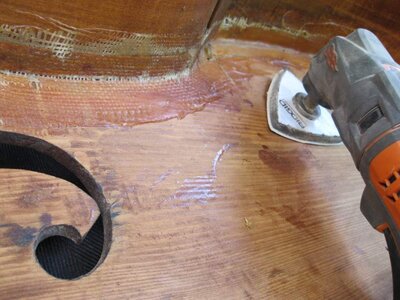
I have to install a bass bar patch and regraduate the top. Already removed most of the fiberglass from the belly. Biggest scare was inhaling the dust. I wore a mask and a towel over the mask as a double precaution. I'm leaving the fiberglass on the ribs because I don't think it affects the sound as much, and afraid of damaging the instrument in doing so. Will cut off any loose threads to avoid possible buzzing. Don't know of any solvent that will remove fiberglass; would be afraid of ruining the wood with any such harsh chemicals anyway.

The rib cracks which were repaired with fiberglass are actually holding quite well - looks like they'll never come apart. Not saying that I support the idea, just saying its holding.

I feel like putting a heads up sticker inside for the next repairer. Don't think the top is ever coming off this thing. LOL
 

Attachments

  • IMG_7705dc.JPG
    IMG_7705dc.JPG
    90.1 KB · Views: 112