• TalkBass has been independent since 1998. Add your voice.
    Create a free account to reply to discussions, view embedded media, and browse with fewer display ads.
    Join freeLog in
    Want zero display ads or expanded classifieds tools? Compare plans.

Filiberto Position Studies - What does the circled notation mean?

Feb 23, 2007
87
104
Hopefully somebody here is familiar with "Bass Position Studies by Robert Filiberto"

In the book there are these circled numbers:
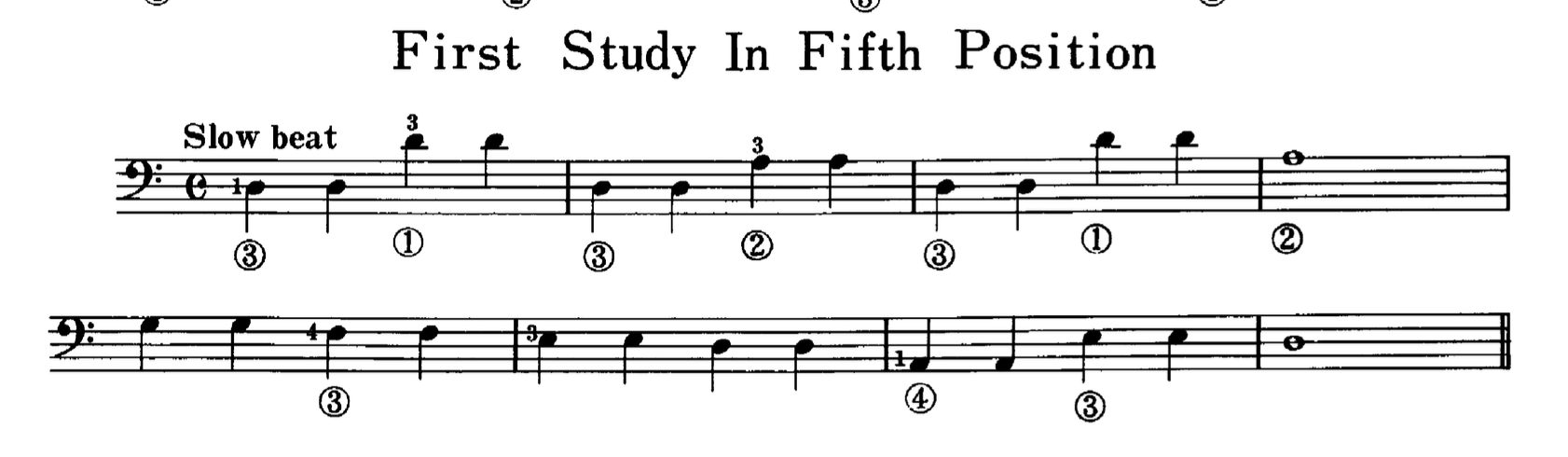
first-study.png


They do not correspond to frets, this section is focused on the "Fifth Position" starting at the 5th fret.
They also do not correspond to fingers since those are already denoted.

Your help is appreciated. Thank you.

 
Hopefully somebody here is familiar with "Bass Position Studies by Robert Filiberto"

In the book there are these circled numbers:

View attachment 7025157

They do not correspond to frets, this section is focused on the "Fifth Position" starting at the 5th fret.
They also do not correspond to fingers since those are already denoted.

Your help is appreciated. Thank you.
String Changes?

1 = G
2 = D
3 = A
4 = E


This is is the opposite of how I would number the strings.
 
Aha! You were withholding important information! In the top section you just posted the numbers look to me like strings -- numbered backwards from the way most of us would -- with the ascending part moving from E to G and the descending part moving back from G to E. It looks to me like a clumsy way to annotate standard notation to accomplish what could more easily be done with tabs.
 
Maybe, but yeah that would be the opposite of how I would number them as well.


IMHO this book appears order the strings from high to low. Get a different book and it may order the strings from low to high. So you need to understand the convention each book uses. Some books start with a section that explains their system.

IMHO, Better to just use the string name.
 
I guess they are just string numbers. There is no explanation in the book for any of the notation.
The standard notation here is pretty straightforward and you are playing in a position so string indicators seem unnecessary.

c'est la vie

Thank you all!
 
  • Like
Reactions: Wasnex
They're numbering strings, but they're doing it in a way that I've usually only seen from guitarists. My inclination has always been to number strings from low to high (if at all).

Seems like their goal is to give you multiple clues as to which strings and fingers to aim for in addition to the traditional notation. I get what they're aiming for, and hopefully it makes a bit more sense now! :thumbsup:

It looks to me like a clumsy way to annotate standard notation to accomplish what could more easily be done with tabs.
Nailed it.
 
They’re string numbers. Ordering I-IV from high to low is standard for strings in classical pedagogy.
this is exactly correct and when you look at it this way it makes perfect sense. This is a good exercise for beginners and for anyone learning to read music-- AVOID TAB AT ALL COSTS!!!!
 
The circled numbers are the string numbers. On any guitar or bass, the highest string is number 1. So G = 1, D = 2, A = 3, E = 4

This is an excellent book, one I used when I was coming up and one I use with my students. I highly recommend this book. It will improve your reading and understanding of the fingerboard especially in the vital upper position. Some of the content is outdated and old school, but regardless it’s a great asset to understand the bass.
 
  • Like
Reactions: albertus
They're numbering strings, but they're doing it in a way that I've usually only seen from guitarists. My inclination has always been to number strings from low to high (if at all).
Next time you get a pack of bass strings, see whether or not your inclination is correct. Every pack I have bought says G is the 1st string and E is the 4th string. I use DR strings, but I’m not aware of any other brands that change the string numbers.
 
  • Like
Reactions: Brandon Shea
Yeah. These are string numbers, numbered high to low (this is the convention in guitar music).
Anyhow, in order to avoid the need for the reader to guess in which order the strings are numbered, I usually use the string names (E, A, D, G) for that purpose.
 
  • Like
Reactions: ProbablyTooLoud
Next time you get a pack of bass strings, see whether or not your inclination is correct. Every pack I have bought says G is the 1st string and E is the 4th string. I use DR strings, but I’m not aware of any other brands that change the string numbers.
Great point, I actually remember that from my last string change now that you mention it.
 
Hopefully somebody here is familiar with "Bass Position Studies by Robert Filiberto"

In the book there are these circled numbers:

View attachment 7025157

They do not correspond to frets, this section is focused on the "Fifth Position" starting at the 5th fret.
They also do not correspond to fingers since those are already denoted.

Your help is appreciated. Thank you.

Yep strings notation.

BTW this is a great book for beginners. It started there for me.