If you are going to get into this level of detail about threads, you need to open up your Machinery's Handbook and study carefully the sections on Unified threads. All will be made clear.

Enjoy the benefits of a premium membership!
Upgrade Account
-
TalkBass has been independent since 1998. Add your voice.
Create a free account to reply to discussions, view embedded media, and browse with fewer display ads.
Join free Log in
Want zero display ads or expanded classifieds tools? Compare plans.
You are using an out of date browser. It may not display this or other websites correctly.
You should upgrade or use an alternative browser.
You should upgrade or use an alternative browser.
Double Bass Fill and resize bridge adjusters?
- Thread starter Jeremy Darrow
- Start date
More options
Who Replied?

I looked those up: they are only 1/4" deep and still need a 3/8 bore, same as a basic EZ-Lok threaded insert. I'd use the threaded insert.I had never seen these before - Yes, you're adding a metal insert, but these look smaller/shorter and lighter(?) than the "externally threaded" insert type.
Could these be installed using epoxy? (Yes, this is not a reversible solution.)
I believe a standard 1/4-20 counterbore is 7/16". I don't know the exact O.D. of the insert.
Hmmm....
What's clear is that an Acme thread is better suited for this application.If you are going to get into this level of detail about threads, you need to open up your Machinery's Handbook and study carefully the sections on Unified threads. All will be made clear.

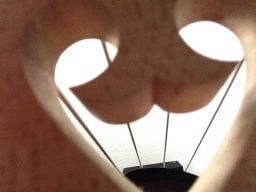
I looked those up: they are only 1/4" deep and still need a 3/8 bore, same as a basic EZ-Lok threaded insert. I'd use the threaded insert.
Hi neilG,
I thought that these needed a 7/16" counterbore (?, 1/4" deep), and might be a last-ditch solution before replacing the whole bridge, (a la "Gilligan's Island"?)
They might be lighter that an EZ-Lok, as they are shorter. But, I think their shortness might also introduce unwanted "slop" into the system, as well.
Just spitballin' here, as usual.
Thanks for your interest.
Last edited:
What's clear is that an Acme thread is better suited for this application.
True in theory, but I doubt they come that small. Acmes are a b**ch to thread, too, due to the flat surfaces rather than the rounded points of Unified. Anyway, all kinds of adjustable equipment uses Unified threads. The one thing that's clear is that for adjustability you ought to be using fine pitch threads, but you can't due to threading into wood.
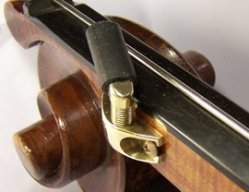
Frankly, I don't understand why one wouldn't just Helicoil the holes rather than all the alternatives that end up consuming far more wood, that is if you're concerned about acoustic effects of replacing wood with metal. It seems to me that trying to fill the holes with dowels that have the grain running in the right direction will end up costing more in the money value of time than replacing a new bridge, due to the difficulty of getting such dowels (you will have to make them) and the difficulty of re-drilling and ensuring everything is square. (With Helicoils you at least have the existing hole to pilot your drill. I think you would not want to use the usual metal cutting drill they supply with Helicoils but rather something less aggressive (not sure what that would be) that would be more prone to follow an existing hole. Maybe a straight flute drill?)
- Aug 1, 2005
- 3,546
- 1,421
- Disclosures
- Private Inventor - Bass Capos
Turf3,
I'm with you on the helicoil for repairs. I maintain though that 1/4UNC works fine straight into maple, as long as the installer has a decent drill press and vise. I don't have a tilting vise, and I try to avoid tilting the table, but I can make precise wedges with my mill or table saw. We can only expect so much of this type of mechanical engineering from bass luthiers, few of whom are likely to be familiar with Machinery's Handbook. They have other things to deal with
I'm with you on the helicoil for repairs. I maintain though that 1/4UNC works fine straight into maple, as long as the installer has a decent drill press and vise. I don't have a tilting vise, and I try to avoid tilting the table, but I can make precise wedges with my mill or table saw. We can only expect so much of this type of mechanical engineering from bass luthiers, few of whom are likely to be familiar with Machinery's Handbook. They have other things to deal with
Last edited:
Turf3,
I'm with you on the helicoil for repairs. I maintain though that 1/4UNC works fine straight into maple, as long as the installer has a decent drill press and vise. I don't have a tilting vise, and I try to avoid tilting the table, but I can make precise wedges with my mill or table saw. We can only expect so much of this type of mechanical engineering from bass luthiers, few of whom are likely to be familiar with Machinery's Handbook. They have other things to deal with
Agreed that decades of successful use of 1/4-20 threads into maple trumps the theoretical crumminess of small Unified threads cut into wood.
I've used these on all 4 El. Basses that I've assembled or modified, in place of the Neanderthal "wood screws" that are usually used to affix the neck and bridge to the slab body.Is there some reason you guys would use Helicoils rather than something like an EZ-Lok insert?
I use the 10-32 (inner thread) version (3/8 -16 external thread), epoxied into place. I have never used them on a DB bridge, (but I'd like to), as they would be a very durable mechanical solution, (with great micro-adjustability), IF, you're OK with adding some "metal" to the bridge.
This...
Is there some reason you guys would use Helicoils rather than something like an EZ-Lok insert?
I was just responding to the desire to minimize the amount of metal used. Actually, the insert shown above - its diameter looks like it approaches the thickness of the bridge which would not be a good idea. I think for an insert going into a brittle material like wood it would be best to minimize the OD of the insert. I would be concerned about the wood breaking at the thin points.
- Aug 1, 2005
- 3,546
- 1,421
- Disclosures
- Private Inventor - Bass Capos
Yes! With this typical helicoil you only drill the hole out to 17/64ths (or Letter H if you have one). A bag of ten costs five bucks. I imagine it's much lighter than a threaded insert as well. Downside: You need a few specialized tools to install them.I think for an insert going into a brittle material like wood it would be best to minimize the OD of the insert.

Last edited:
Matthew Tucker
Commercial User
- Aug 21, 2002
- 2,686
- 387
- Disclosures
- Owner: Bresque Basses, Sydney Basses and Cellos
Personally I wouldn't muck around with helicoils or metal inserts because it is really easy to make an 8mm crossgrain maple plug using a plugcutter bit, even a slightly tapered plug, and glue it into place with hide glue.
If you put a 1mm hacksaw cut aligned with the grain on plug, you can easily align the grain with a screwdriver before the glue sets.
I align and tack the feet back on with CA glue, redrill the pilot hole, then break open the CA bond with a sharp tap, and rethread and clean up the wood surfaces.
If you put a 1mm hacksaw cut aligned with the grain on plug, you can easily align the grain with a screwdriver before the glue sets.
I align and tack the feet back on with CA glue, redrill the pilot hole, then break open the CA bond with a sharp tap, and rethread and clean up the wood surfaces.


