Longtime bassist and woodworker here. I’ve accumulated a substantial stash of tonewood over the years and recently began milling small batches of bass fingerboard blanks from climate-controlled stock. Curious what builders look for most in bass-specific boards

Enjoy the benefits of a premium membership!
Upgrade Account
-
TalkBass has been independent since 1998. Add your voice.
Create a free account to reply to discussions, view embedded media, and browse with fewer display ads.
Join free Log in
Want zero display ads or expanded classifieds tools? Compare plans.
You are using an out of date browser. It may not display this or other websites correctly.
You should upgrade or use an alternative browser.
You should upgrade or use an alternative browser.
Finger board question
- Thread starter Junkballer
- Start date
More options
Who Replied?
Straight grain, stability, ability to be easily machined, resistance to discoloration from finger contact, color dependant upon inlays if they will be used. Cost can be a factor, but not a main concern for me.
Pau Ferro (morado) is probably my favorite choice, occasionally walnut but selected for hardness if it is to be used.
Fretless boards need to be resistant to string wear, ebony is my preferred choice for a fretless board.
Jatoba (Brazilian Cherry) is a good choice for fretted or fretless boards, but requires a bit of extra care when gluing.
I don't use maple or other light colored woods because I'm not a fan of the need to top coat them.
Wenge is really bad for splintering, so no thanks to that.
What most folks who build instruments refer to as "tonewood" wouldn't normally be associated with good choices for fingerboards.
Pau Ferro (morado) is probably my favorite choice, occasionally walnut but selected for hardness if it is to be used.
Fretless boards need to be resistant to string wear, ebony is my preferred choice for a fretless board.
Jatoba (Brazilian Cherry) is a good choice for fretted or fretless boards, but requires a bit of extra care when gluing.
I don't use maple or other light colored woods because I'm not a fan of the need to top coat them.
Wenge is really bad for splintering, so no thanks to that.
What most folks who build instruments refer to as "tonewood" wouldn't normally be associated with good choices for fingerboards.

Thanks for the information. Being a bassist since the mid sixties, it didn’t take me long to discover I prefer certain fingerboards. I agree with your“tonewood” statement. Over the years I’ve seen basses with all kinds of wood. Purple Heart, Zebrawood, Wenge, just to name a few.
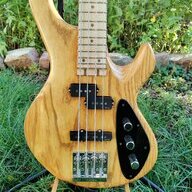
Hardness and aesthetics, to be terse. Hardness, particularly for fretless boards but not a bad thing for fretted as well. Aesthetics is a bit tricky because its not just "on its own" (easy) but also how it can pair with body woods or colors. Right now in my "really want to use" stack I have olive, mulberry, a couple "blackwoods" (Royal and Tek), and pau ferro. I have maple and walnut on standby for any pairings that speak to either of them. In my "I guess I'm stuck with it" pile I have one or two uninspiring rosewoods.
Had a bubinga blank once but I could never find a match that worked with it's greenish cast, and when a friend wanted to use it with some inlays, I broke a couple chisels on it before giving up. So, yeah, machinability/workability is also in the mix.
Had a bubinga blank once but I could never find a match that worked with it's greenish cast, and when a friend wanted to use it with some inlays, I broke a couple chisels on it before giving up. So, yeah, machinability/workability is also in the mix.

Longtime bassist and woodworker here. I’ve accumulated a substantial stash of tonewood over the years and recently began milling small batches of bass fingerboard blanks from climate-controlled stock. Curious what builders look for most in bass-specific boards
Are you asking what species of wood we builders are looking for? Or what dimensions/cut/process/quality we want?
In that regard, I'll throw in this one: I like to be able to get a 24-fret board out of a piece, including some room for transitioning below the last fret. I've walked away from a few nice boards cut just long enough to get a Fender 20 or 21-fret finished board out of. It may be a wasted couple inches for the traditionalists, but some of us want moreAre you asking what species of wood we builders are looking for? Or what dimensions/cut/process/quality we want?


I have a couple of 12/4 planks of African Blackwood. I use it for small stuff usually.
But I could take a thin ripping off an edge and get a pretty straight grained fingerboard blank.
I've thought about it but haven't done it. It's denser than ebony or pau ferro.
But I could take a thin ripping off an edge and get a pretty straight grained fingerboard blank.
I've thought about it but haven't done it. It's denser than ebony or pau ferro.

Along the lines that @gormsby mentioned, if you’re building 5, 6 or more string basses enough width as well. A lot of fingerboard blanks sold online are only wide enough for a 4 string.

I forgot to mention that I’m pushing 80 and have been “collecting” for quit a while. Still playing bass and loving it!
I have Ziricote, Katalox, Cocobolo, East Indian Rosewood, Zebrawood, Bubinga, Madagascar Rosewood, Macacauba, Macassar Ebony, Morado, Purpleheart. All in 5/4 to 8/4. I have other not mentioned in 4/4.
Sounds like some wonderful possibilities. Ziricote and Katalox can be very nice looking. Are you set up to radius and slot them also?
No. My goal was to resaw for multiple blanks. Not sure if I want to leave them rough or S2S. Control grain orientation (quarter vs rift). Grade visually before cutting and optimize yield from figured pieces (especially ziricote and Macassar).
No. My goal was to resaw for multiple blanks. Not sure if I want to leave them rough or S2S. Control grain orientation (quarter vs rift). Grade visually before cutting and optimize yield from figured pieces (especially ziricote and Macassar).
I recommend resawing fingerboard blanks to about 3/8"+ thickness, and then S2S them to around 5/16". Most bass builders finish up their fingerboards to around 1/4", after radiusing and sanding. 5/16" is what they prefer for the blank.
Small-shop builders looking for "exotic" wood fingerboard blanks are mainly looking for one thing: Beautiful looking grain pattern and color. That's why you should supply them S2S, so they can clearly see what they look like.
And, the visual appearance of the grain should also guide how you cut the boards; grain orientation, alignment down the length, line spacing, etc. The most desirable boards have grain lines that go almost straight down the board and are fairly symmetrical about the centerline, in density and spacing. Some of our favorite fingerboard suppliers will deliberately cut to a mild rift angle, to get the grain spacing on the surface evened out side-to-side. Boards that have a sweeping grain are best cut with the sweep fairly even down the length. Sometimes flatsawn is best for symmetry. With figured boards like flame and bird's eye, again, the important thing is that the figure is fairly even and centered on the board.
With fingerboards, the visual beauty is (almost) everything. It's a major part of the finished image of the instrument. Most of us aren't that concerned about flat vs quarter vs rift sawn. The selling feature is that it's pretty, and that it's nearly flat in finished form, and doesn't show any signs of cracking or internal stresses. That's what we shop for.
The common widths are: 2 3/4" wide for 4-string basses, 3 1/4" wide for 5-strings, 3 5/8" for 6-strings.
Lengths: 25" minimum for a Fender-size 34" scale, 20 fret; 26" for 34" scale 24 fret; 27" for 35" scale 24 fret.

Thanks so much for the info! I mostly seek out rift or quarter sawn woods but sometimes the wood is so beautiful I don’t care.
I focus on carefully resawn, properly oriented fingerboard blanks - selected for stiffness, stability, and clarity. I mill in small batches and let the wood rest. But I don’t worry about movement as much of the exotic stock has been stored stickered for years.
I focus on carefully resawn, properly oriented fingerboard blanks - selected for stiffness, stability, and clarity. I mill in small batches and let the wood rest. But I don’t worry about movement as much of the exotic stock has been stored stickered for years.
Here is some pix of my first batch of finger boards. It kept me busy and was fun. Still have lots of wood to go through but I’ll get to it. Comments welcome.
Attachments


These look great. What are your plans for these?Here is some pix of my first batch of finger boards. It kept me busy and was fun. Still have lots of wood to go through but I’ll get to it. Comments welcome.
Not sure yet. I’m an older guy (almost 80) trying to reduce my inventory. I build furniture. But I’ve been a bass player a long time too. And because I was a woodworker, I had many conversation’s with my band mates and others, about building guitars and basses. Not my thing. But making “parts” might be ok…just don’t know yet.
does anyone here specialize in domestic woods for fingerboards? I have heard some very nice things about Pistachio wood for fretless fingerboards if you are OK with a lighter color of wood

Wow, pictures of the green pieces are beautiful. I need to know more about this if you try it.does anyone here specialize in domestic woods for fingerboards? I have heard some very nice things about Pistachio wood for fretless fingerboards if you are OK with a lighter color of wood
I’m milling some blanks fingerboard blanks from Osage Orange that’s been laying around. Nice color. Hard and dense. Anyone have experience with it?


