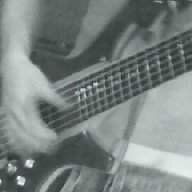
Exercises take many forms and have many functions, but a grip trainer only trains your hands to grip, playing bass is as much as about lifting and opening your fingers rather than closing it.
This is a great exercise to prove the point,
Place all the fingers in a line one behind each other on a fret.
Try A Ab G Gb at the 12th string on the 3rd string.
So your fingers are all on the fretboard, they all support each other, the spread of the fingers should not feel tight (if it does it is the tendons not the muscles, this is what a grip trainer does, give the muscles and tendons strength, but it is a trade of in flexibility and dexterity)
We can play the A with the little finger, but to play the Ab we must lift off the little finger.....not put it down. So it follows to play the G we must lift off the ring finger to play it, and so it follows we lift of the middle finger to play Gb.
A grip trainer does not facilitate this movement because it cannot train the extensor muscles that lift the fingers off.
The hand has two very separate actions in opening and closing the fingers, each with its own muscle groups, a grip trainer only trains one groups over another and at the expense of the other by having the action of fretting on dominate fretting off.
Best exercise to train the hand in a balanced way is this one
Lets stay at the 12th fret and fret these notes across the 1st and 2nd strings,
E C C# G so the fingers are in line, one fret each but across two strings.
Forefinger on the E on the 1st string.
Middle finger on the C on the 2nd string.
Ring finger on the C# on the 2nd string.
Little finger on the G on the 1st string.
So we keep all finger on the fretboard notes stated though out the exercise.
1/ lift off and on the little finger only so it plays two notes, (E and G)
2/ Lift on and off the ring finger so it plays two notes (C and C-#)
You can pluck them to start with or trill the note as previously mentioned (see the link or do a search). The exercise is to to be able to trill each exercise for as long as you can and as fast as you can, keeping the un-used finger down, before you slow down and tire.
It is important the un-used fingers stay down as they are having the tendons stretched while the finger lifting on and off is having the muscles developed.
Two very separate actions being worked on here, but the tendons that are being stretched will be the ones the muscles will pull on when the exercise alternates between point 1 and 2.
This exercise develops across the whole hand and develops the flexor muscles to close the fingers, and the extensor muscles to open the fingers, so you develop fretting on and off. The span of the fingers introduces tension to the finger tendons to allow them to gently lengthen over time and so become looser in your playing use. This develops lightness in touch because you are not lifting off against excess tension, by being able to close the fingers gently and controlled without tension is not a grip.
There are other combinations to this exercise that involve developing the extensors and flexor muscles while gently stretching the tendons. These exercises should be done in short durations as the exercise is about how fast you do them before the hand tires, the fact the hand tires tells you to stop, never work a tired hand.
The hand will get better at maintaining the use so the player gets better at maintaining there tempo and stamina.
Using the first example as the template here are the other exercise positions, remember you lift on and off the front finger of the pair on any one string.
Moving it on to heaver strings and lower fret positions increases the development, but also increases the chance of injury. This is why we start on the thinnest strings in higher positions because the spans are closer with less tension on the hand, go to higher fret positions if need be.
ORIGINAL POSITION 12th FRET
E C C# G so the fingers are in line, one fret each but across two strings.
Forefinger on the E on the 1st string.
Middle finger on the C on the 2nd string.
Ring finger on the C# on the 2nd string.
Little finger on the G on the 1st string.
B C Gb G
Forefinger is on the B on the 2nd string.
Middle finger is on the C on the 2nd string.
Ring finger is on the Gb on the 1st string.
Little finger is on the G on the 1st string.
Lift off the C to the B,
Lift of the G to the Gb
B F C# G
Forefinger is on the B on the 2nd string.
Middle finger is on the F on the 1st string.
Ring finger is on the C# on the 2nd string.
Little finger on the G on the 1st string.
These three exercises are all that is needed to develop and train a balanced healthy use in the hand for fretting, but they also have to work with the plucking hand.
Work on the plucking the notes as you lift off and on, then work on the trill, the trill will develop a hammer on/ pull off use as the hand becomes stronger and can maintain the force needed to use the technique.
As said playing will develop the skills but playing like this exercise will target them and keep the hand use balanced.
When i say balanced i mean no one part of the hand gets over used, in these exercises every finger will get a daily use, so you get a balanced use across the hand and each finger has the same ability to be used if need be.
If this post raises any questions, post them or PM me and if i can answer them i will.