• TalkBass has been independent since 1998. Add your voice.
    Create a free account to reply to discussions, view embedded media, and browse with fewer display ads.
    Join freeLog in
    Want zero display ads or expanded classifieds tools? Compare plans.
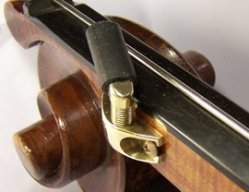
Double Bass Fingerboard ebony-like substance

paintcan_zps3584f0a3.jpg
 
Depending on what you are defining as "student quality" there are a ton of answers. I have seen white wood (probably maple?) boards with black paint on them. There are some really cheap boards out there with a coloured epoxy on them. Some have a thin veneer of darker wood on them. Some of them are "lesser" grades of ebony that have a lot of colour in them that is dyed black.

If the board is dyed, which happens even with high quality ebony boards on professional instruments, various shops have various methods of doing this. Leather dye is a common one in some shops, but there are some other methods out there too. It comes down to the individual shops and what they found works for them.
 
Get a new board.

That would be optimal but this quality of bass doesn't warrant the cost of a real ebony board.
I'm not talking about the dye or stain, I've already used a black aniline dye on it. I'm asking about the finish to put over it. The original was some sort of thick hard paint or lacquer. I may just use some polyurethane as used on floors. That stuff is very hard and this bass doesn't need to last forever.
 
Understandable. The "Get a new board" was directed at the idea of "unebonizing" because depending on the process used, it can't/shouldn't really be done.

What is the current board made out of? What problems are you having with it? Is it really too soft? There are double basses out there with Rosewood fingerboards, and there are other woods that are possibilities as well. Ebony is hard, but plenty of woods are hard enough to be used successfully. If it is a student bass and it doesn't need to last forever, then it could very well last more than long enough without an ebony/ebonized board.

You can go the epoxy route if you really want to, but it will feel like epoxy, not wood under your hands. If that isn't a problem, some fretless electric players have done it with a lot of success. If needed, the board can be "dressed" by sanding and applying another layer of epoxy, but I can already see several of our luthier friends shudder/cry/scream at these suggestions.

If it isn't a big problem or made out of balsa wood or something, maybe just leaving it is an option to consider?
 
I asked the folks at several of the more common luthier supply places this question: I already have your black anilyne dyes and I already have your shellac and I already have your lampblack. Should I buy some of the black fingerboard treatmant? The answer that every one of them told me was: our fingerboard treatment is a mixture of black anilyne dye, lampblack, and shellac, in a fancy relabeled can.

If you are the type of person whose shop is one giant vaporizer of epoxy fumes, you could also mix a bit of that with the color, but thin it out a bit so that it does not go on too thick. I try to avoid epoxy whenever possible.

j.
www.condino.com

 
Understandable. The "Get a new board" was directed at the idea of "unebonizing" because depending on the process used, it can't/shouldn't really be done.

What is the current board made out of? What problems are you having with it? Is it really too soft? There are double basses out there with Rosewood fingerboards, and there are other woods that are possibilities as well. Ebony is hard, but plenty of woods are hard enough to be used successfully. If it is a student bass and it doesn't need to last forever, then it could very well last more than long enough without an ebony/ebonized board.

You can go the epoxy route if you really want to, but it will feel like epoxy, not wood under your hands. If that isn't a problem, some fretless electric players have done it with a lot of success. If needed, the board can be "dressed" by sanding and applying another layer of epoxy, but I can already see several of our luthier friends shudder/cry/scream at these suggestions.

If it isn't a big problem or made out of balsa wood or something, maybe just leaving it is an option to consider?

We had to strip the entire board of its black coating because it had been too badly damaged by solvents. Underneath is an unidentified white wood which is, in my limited experience, too soft to last very long on its own. It's softer than maple for sure. It's been sanded smooth and dyed. I figure that using a poly finish, it will be hard and still sandable. New applications of poly down the line might keep the beast useful through high school.
Scraping and sanding the board took less than an hour. This one didn't need planing.
 
I asked the folks at several of the more common luthier supply places this question: I already have your black anilyne dyes and I already have your shellac and I already have your lampblack. Should I buy some of the black fingerboard treatmant? The answer that every one of them told me was: our fingerboard treatment is a mixture of black anilyne dye, lampblack, and shellac, in a fancy relabeled can.

If you are the type of person whose shop is one giant vaporizer of epoxy fumes, you could also mix a bit of that with the color, but thin it out a bit so that it does not go on too thick. I try to avoid epoxy whenever possible.

j.
www.condino.com

Thanks for that info. I was planning on using some of the low fume water based polyurethane that is intended for floors. That stuff has to be harder than shellac. Anybody know for sure?
 
I used to do a fair amount of "ebonizing" using black leather dye. It penetrates into the wood, as opposed to sitting on top. Apply the dye, let it dry then rub off the excess and buff it. Ideally there should be a harder surface coat. System Three Epoxy makes a product called Clear Coat which is a very hard epoxy. I've used it for fretless electric bass fingerboards. The downside is you only need a 1/4 cup if that to do several coats. It doesn't off gas
 
  • Like
Reactions: Swampmuzik
Thanks for that info. I was planning on using some of the low fume water based polyurethane that is intended for floors. That stuff has to be harder than shellac. Anybody know for sure?

There's a lot of lampblack (or iron oxide) in the formula for the black paint used on the cheaper basses. The binder is shellac - the toughness comes from the iron, not the shellac. Think of it as an iron coating with just enough shellac to glue it on.
 
I used to do a fair amount of "ebonizing" using black leather dye. It penetrates into the wood, as opposed to sitting on top. Apply the dye, let it dry then rub off the excess and buff it. Ideally there should be a harder surface coat. System Three Epoxy makes a product called Clear Coat which is a very hard epoxy. I've used it for fretless electric bass fingerboards. The downside is you only need a 1/4 cup if that to do several coats. It doesn't off gas

If you're coating whitewood to "ebonize", you're working too hard here. Black Krylon that cheap crap! Though I do like the lamp black idea, it helps give more opaqueness. Better yet, mixed with the shellac, it isn't so matte. The leather and/or fingerboard dye is too transparent..

 
If you're coating whitewood to "ebonize", you're working too hard here. Black Krylon that cheap crap! Though I do like the lamp black idea, it helps give more opaqueness. Better yet, mixed with the shellac, it isn't so matte. The leather and/or fingerboard dye is too transparent..

The main concern is to have a hard enough surface so it lasts a while. Good color is secondary.