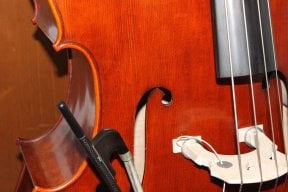
why do some fingerboards have a flattened side under the E string , if this question has been asked before please point me in the right direction

Enjoy the benefits of a premium membership!
Upgrade Account
-
TalkBass has been independent since 1998. Add your voice.
Create a free account to reply to discussions, view embedded media, and browse with fewer display ads.
Join free Log in
Want zero display ads or expanded classifieds tools? Compare plans.
You are using an out of date browser. It may not display this or other websites correctly.
You should upgrade or use an alternative browser.
You should upgrade or use an alternative browser.
Double Bass Fingerboard
- Thread starter tez123
- Start date
More options
Who Replied?
It has been discussed but it would take more effort to look it up than to just answer. To the best of my knowledge, the bottom line is that it gives more space for the E string elipse when played hard. There are likely lots of interesting facts in the old threads about the E side bevel.
It is known as a 'Romberg Bevel' and it is there for precisely what was mentioned above. Not all basses have them but the majority of the larger ones do.

The purpose of the Romberg bevel as was explained to me actually has nothing to do with giving the string more clearance. When you think about the geometry involved, it actually seems to me that the bevel gives the E string less clearance. Instead, the bevel allows players to predictably press down the string without it wiggling side to side. This is a throw back to the days of fat, squishy gut strings and high action. Supposedly, Yo-yo Ma's bevel is actually concave shaped. This gives the string even less clearance, but would make the string really lock into place when pressed to the fingerboard.
Th purpose of the Romberg bevel as was explained to me actually has nothing to do with giving the string more clearance. When you think about the geometry involved, it actually seems to me that the bevel gives the e string less less clearance. Instead, the bevel allows players to predictably press down the string without it wiggling side to side. This is a throw back to the days of fat, squishy gut strings and high action. Supposedly, Yo-yo Ma's bevel is actually concave shaped. This gives the string even less clearance, but would make the string really lock into place when pressed to the fingerboard.
I'm not picturing this. Is the nut then slotted lowered under the E? That's not what I've seen. The one I saw had the nut slotted as if for a curved board but the board was beveled off leaving more clearance.
I can't picture how it stops a side-side motion (which I have not experienced). It seems to me that the bevel would give more of a slope under the E which would cause a straight force toward the back of the neck to slide the string toward the E side edge of the board. Otherwise it would require more of a "pull" back into the palm with the finger tip to press down perpendicular to the beveled section of the board.
Can you "illuminate" the physics of this for me? It seems that the extra information has left me less informed.
Thanks
The slot at the nut should be lowered to be at about a business card in height over the fingerboard regardless of there being a bevel or not. This side to side issue isn't as much of an issue today because of modern strings. Try playing in thumb position on the E string and I think you will discover what I am talking about however. When you pull the string down, it is never directly towards the back of the neck. Your hand naturally pulls the E string closer to the A.
I made a crude drawing to illustrate why I believe the bevel actually decreases the amount of room the E string has to vibrate. The drawing shows that a round fingerboard gives the E string the most vibrational clearance. A round fingerboard will also allow for the greatest variation of vibrational direction. It's possible I'm missing something so see if it makes sense to you. The drawing didn't scan perfectly, but it should be relatively clear.
Attachments


"Romberg Bevel/E-Bevel (not pictured): An optional flat-planed area of the fingerboard beneath the E string, which allows for more area for the large E-string to vibrate, so it doesn't hit the board. This is a tradition dating from when E-strings were larger in diameter and "floppier" - the "need" for the bevel has diminished with more modern string technology. However, some basses are still made with one because they are a "tradition" and some players prefer them." (B. Gollihur)
I made a crude drawing to illustrate why I believe the bevel actually decreases the amount of room the E string has to vibrate. The drawing shows that a round fingerboard gives the E string the most vibrational clearance. A round fingerboard will also allow for the greatest variation of vibrational direction. It's possible I'm missing something so see if it makes sense to you. The drawing didn't scan perfectly, but it should be relatively clear.
Interesting!
Thanks!
I made a crude drawing to illustrate why I believe the bevel actually decreases the amount of room the E string has to vibrate. The drawing shows that a round fingerboard gives the E string the most vibrational clearance. A round fingerboard will also allow for the greatest variation of vibrational direction. It's possible I'm missing something so see if it makes sense to you. The drawing didn't scan perfectly, but it should be relatively clear.
Your drawing seems off, as the E string position keeps dropping compared to the high point of the fingerboard. Keep the string in the same spot and see what happens.
Are you implying that when a beveled fingerboard is used, one has to have a higher E string? If you were to plan a bevel into a fingerboard that was originally round and left the bridge and nut alone, then what you describe would happen. What actually happens is that a round and beveled FB have very different curves so that they can accomodate the same bridge curve and the same string clearance. You couldn't just plane a bevel into a round fingerboard as there isn't enough wood to achieve the correct angle. My drawing shows(roughly) that given the same string height, the round fingerboard will give the most clearance.
I am quite sure it has a lot to do with clearance for the string. Back in the day, when strings were lower tension and beefier (for lack of better words), there was more need for clearance as the string rolled. I have had several instruments with Rombergs in the past and found I had to play with more flex in my wrist than I was comfortable with in order to stop the E-string properly. My current bass does not have the bevel and it is much easier on the wrist. The trade-off is excessive E-string noise against the FB with louder dynamics (and yes, the bass is set-up properly). I have had the bridge trimmed in such a way as to avoid excessively jacking-up of the bridge adjuster on the E-string side. Instruments that I owned in the past with the bevel never had issues with E-string noise provided they were set-up properly.
My bass has the bevel, and I find it nearly impossible to play the E in thumb position... but then, I can absolutely cane it arco in the low positions with a 9mm string height and never, ever get any rattles. This makes me think that the bevel is something you want if you're playing in orchestras, less so for Jazz or solo work.
Keep in mind that a lot of things can contribute to string buzz. On most round fingerboards, the radius is really too flat for the accompanying bridge curve. This means that when bowing the E or G strings, your bow is moving at a steeper angle than what is tangent to the fingerboard. You are essentially bowing the string directly into the fingerboard. One of the advantages of the bevel is that it allows one to achieve a properly steep angle under the E string with a relatively thin fingerboard.
The purpose of the Romberg bevel as was explained to me actually has nothing to do with giving the string more clearance. When you think about the geometry involved, it actually seems to me that the bevel gives the E string less clearance. Instead, the bevel allows players to predictably press down the string without it wiggling side to side. This is a throw back to the days of fat, squishy gut strings and high action. Supposedly, Yo-yo Ma's bevel is actually concave shaped. This gives the string even less clearance, but would make the string really lock into place when pressed to the fingerboard.
I've only owned four basses. I can't recall the configuration of the fingerboards of the Epiphone and Kay I started with 50 years ago. But the two old, wood basses I now own have the bevel, and I must say I've never given the bevels a second thought.
I believe, Joey, that yours is the best explanation. The E and A strings are less likely to slide "down the curve" when pressed to a flat fingerboad. However, I had never heard of Yo-Yo Ma's concave fingerboard. Perhaps in his case the string slides "to the bottom of (forgive my term) ditch?" Interesting idea.
Thank you for the drawings. I think I get the point. I don't know how I would feel about the bevel. I am very comfortable with the arc of my board and have learned how to "roll" my right hand around the bottom end of the board to get a solid attack on the E without sending it in to the board.


