
• TalkBass has been independent since 1998. Add your voice.
    Create a free account to reply to discussions, view embedded media, and browse with fewer display ads.
    Join freeLog in
    Want zero display ads or expanded classifieds tools? Compare plans.

Fingers will not arch no matter what I do

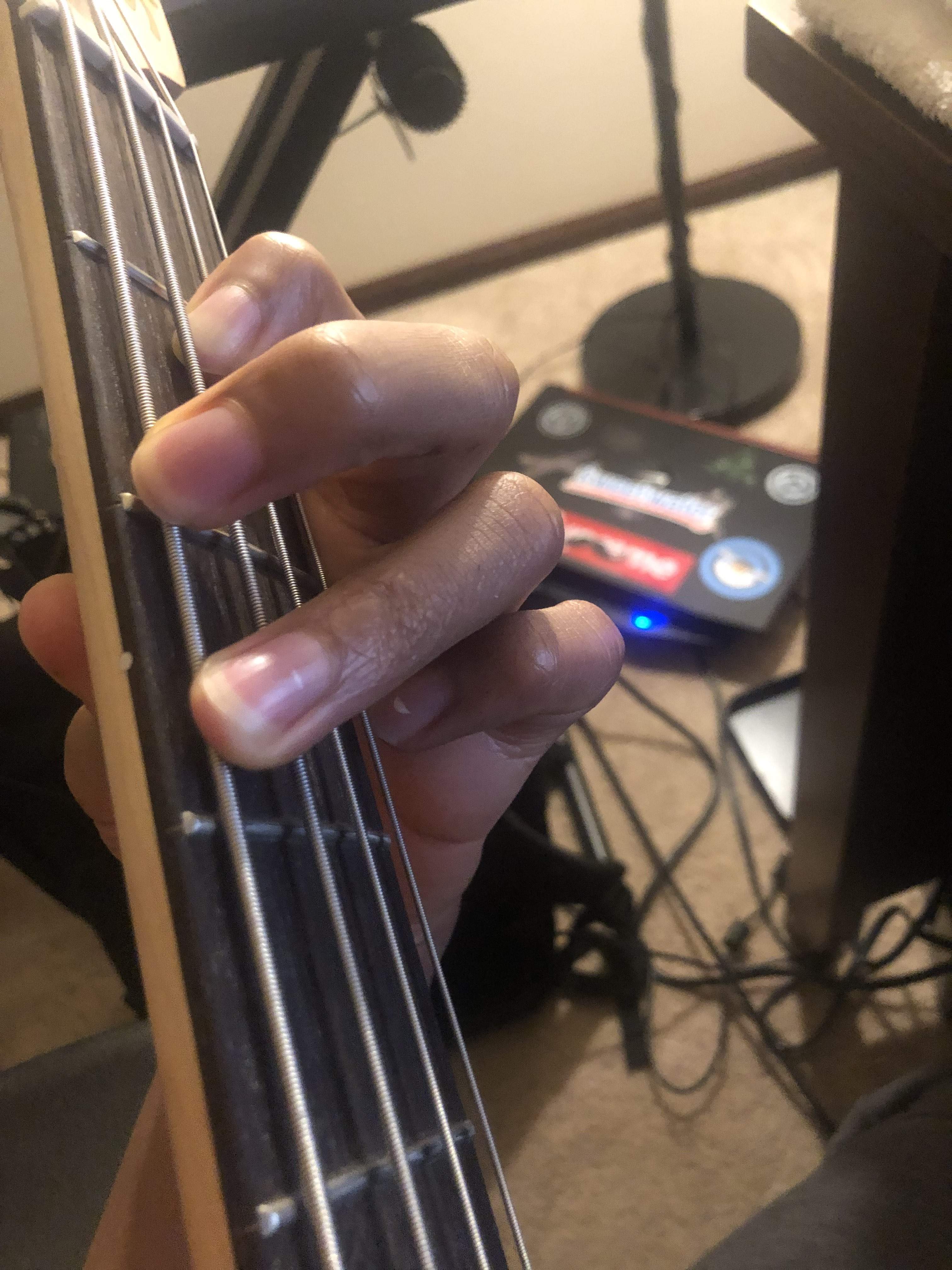
Hi, I'm a beginner bass player who has been playing for about 3 months now. I play bass at one of the clubs at my school and I really want to improve enough to start playing with my friends confidentially, but currently, I have been stuck with a problem that is super frustrating all the time that I play. When I'm fretting and positioning my left hand to play notes, my ring finger and my middle finger often straighten up and this is a no-go and when looking at everyone else play their fingers are arched and don't have this problem. I'm making a conscious effort to improve this but it's super frustrating when I correct myself and a few seconds later it happens. It's like I have no control over if it arches or not. I was wondering if anyone had any tips for me to fix this problem or should I just ignore it? I'm not sure.
IMG_7728.jpg
 
A couple questions:

Can you share a photo or short video of your entire body when playing? It helps to see if you are sitting or standing and exactly what position you are in. Where the bass sits on your body, the angle of the neck, and your posture can all contribute.

How hard are you gripping the neck with your left hand? It's a common issue for new players to feel like they need to hold it tight like a baseball bat, or as if the bass will fall away if the hand isn't controlling it. Ideally your touch should be light, so you can move across the bass rather than dragging it around with you.

Without seeing your entire posture it's hard to make specific recommendations, but the biggest thing is to relax. Make sure you can move your head and "roll" it around on your shoulders while you play. Then make sure your shoulders are relaxed even while holding your bass. That tension travels all the way down your arms and tendons, so a tight neck really can result in tight fingers that don't want to move properly.
 
@Surveyor87Fan
In addition to what @JonathanPDX mentions on being relaxed, I think you need to start by trimming your nails back. As they are they will be preventing your fingertips from addressing the strings correctly. Whilst the tips do not need to be perpendicular all of the time, the more tip you can get down the easier it will be for you to develop good hand-shape. Developing hand-shape should be your focus right now.

After that you should be exercising every day using simple chromatic drills in the lower positions. Begin with single position drills such as these. Start slowly, say 60 BPM, using only fingers 1, 2 and 4. Concentrate on keeping your fingers curved and playing each note with the tips of the fingers, using as little pressure as necessary to keep the notes clean:
upload_2022-1-7_12-1-49.png
 
I'd add that the guitarists ideal left hand hold - all fingers arched - is NOT the desired approach on a bass. There was a good video by Adam Neely called something like 'left hand healthy technique' which was very good, despite Mr. Neely's rather empty newer YouTube stuff.
The reason that guitar left is different from bass left comes from need to mute unplayed strings, and from bass's longer scale. You're gonna find this out, just don't stick to guitar rules, and look for approach that doesn't hurt.
The best way to learn it, imo, is to play some scale, say G major, very slowly, thinking about what every finger does. It will take a few weeks.
As for the strength of touch, you can try a simple practice: lay your 1st finger on a string, pluck, there's percussive sound. Press harder and pluck. At some moment, the tone will start to sound. That is the strength you should generally use.
 
I'd add that the guitarists ideal left hand hold - all fingers arched - is NOT the desired approach on a bass.
...

Perhaps, perhaps not. I do think (agree?) that the cuves shown in the video are a little too much and will do nothing to assist muting. On the other hand, collapsed fingers and over-extended joints are never good news, so that is what needs working on in the first instance. At present it looks like the OP's hand does not have sufficient condition to play with flatter fingers. Hand-shape can be 'flattened' over time once there is sufficient strength and condition to control the collapsing knuckles.
 
Watch some videos. Guitarists play with bowed fingers because they have to play chords. Bass players don't so straight or bowed shouldn't be an issue. Guitarists play with the ends of their fingers, bass players usually use the pads of their fingers.

Francis Rocco Prestia rarely bowed his fingers, Scott Devine does both, I play with straight fingers most of the time.

If you can comfortably play the songs you want to play, you don't have a serious problem.
 
Watch some videos. Guitarists play with bowed fingers because they have to play chords. Bass players don't so straight or bowed shouldn't be an issue. Guitarists play with the ends of their fingers, bass players usually use the pads of their fingers.

Francis Rocco Prestia rarely bowed his fingers, Scott Devine does both, I play with straight fingers most of the time.

If you can comfortably play the songs you want to play, you don't have a serious problem.

This is not about stylistic or technical choices (of curved or straight fingers) that the OP is in no position to make. It's about basic conditioning and training to control collapsing joints.
 
  1. Your fingers definitely shouldn't be collapsed (like your ring finger in that photo) but they also don't need to be steeply arched or curved. A flat/natural shape to the hand, is a good, place to start. (I always try to keep my hand soft and relaxed, as if I'm holding a baby with its head cradled in my left hand. If I squeeze the baby's head with a stiff, tense, contorted claw-hand, the mom is going to freak out and want her baby back!)
  2. Are you aware that a lot of players don't use their 3rd/ring finger, when they are playing that low on the neck? Has your teacher shown you the 1-2-4 technique yet? A lot of players would use their 4th/pinky finger to fret that G note at the 3rd fret. Give it a try and see if it's more comfortable, to use your 4th finger instead of your 3rd!
  3. Good left-hand technique all starts with comfortable thumb position. I can see that your thumb is collapsed and tense. That automatically puts your hand in bad position. To solve the problem with your ring finger, you should start by fixing the problem with your thumb.
  4. Your 1st and 4th fingers are oddly positioned. Since you aren't using those fingers, they should be in a relaxed, neutral position, ready for when you need them. It's unnecessary to hold tension in unused fingers (especially if doing so creates additional tension in the finger you are using).
  5. I agree with the comments above: We could help you better, if we saw a more zoomed-out photo that show your arms and shoulders. Are you standing up straight? Are your shoulders level? Are your elbows relaxed and "sinking" down toward the floor? Do you have a wide, comfy strap?
 
Last edited:
Thanks! I managed to edit it before the lock. :)
These new rules about not being able to edit typos in our posts past 1 hour, really suck for those of us with dyslexia or other learning disorders. It's an awful feeling to know that you made a dumb typo because of your disability, but not able to fix it. Talkbass has become very 'ableist' lately. :(

The edit limit is a menace - 60 minutes is just not enough. :thumbsup:
 
A couple questions:

Can you share a photo or short video of your entire body when playing? It helps to see if you are sitting or standing and exactly what position you are in. Where the bass sits on your body, the angle of the neck, and your posture can all contribute.

How hard are you gripping the neck with your left hand? It's a common issue for new players to feel like they need to hold it tight like a baseball bat, or as if the bass will fall away if the hand isn't controlling it. Ideally your touch should be light, so you can move across the bass rather than dragging it around with you.

Without seeing your entire posture it's hard to make specific recommendations, but the biggest thing is to relax. Make sure you can move your head and "roll" it around on your shoulders while you play. Then make sure your shoulders are relaxed even while holding your bass. That tension travels all the way down your arms and tendons, so a tight neck really can result in tight fingers that don't want to move properly.

Hi, thanks for the advice. I will post a better photo when I get home of my arm and my playing posture. Roughly 6 hours from now.
 
  • Like
Reactions: SteveCS and Mushroo
Hi, I'm a beginner bass player who has been playing for about 3 months now. I play bass at one of the clubs at my school and I really want to improve enough to start playing with my friends confidentially, but currently, I have been stuck with a problem that is super frustrating all the time that I play. When I'm fretting and positioning my left hand to play notes, my ring finger and my middle finger often straighten up and this is a no-go and when looking at everyone else play their fingers are arched and don't have this problem. I'm making a conscious effort to improve this but it's super frustrating when I correct myself and a few seconds later it happens. It's like I have no control over if it arches or not. I was wondering if anyone had any tips for me to fix this problem or should I just ignore it? I'm not sure.View attachment 4532384

Maybe it is just the particular angle of the picture, but your action also looks really high on the g string. Do you know how to do setups? Many good Youtube tutorials on it.
 
No expert, and I can't add much to the above, just a general thought on changing one's technique:

I'm making a conscious effort to improve this but it's super frustrating when I correct myself and a few seconds later it happens.

Some people seem to be of the school that when you spot bad technique you must fix it immediately and completely and not work on anything else until it's fixed, to avoid learning bad habits.

Personally I find that standard impossible to meet. It takes time to learn new technique, and I can't necessarily stop the world while I do it.

So my approach is usually: spend a few minutes a day really concentrating on just that one problem. Then continue the rest of my practice as normal without obsessing over it too much.

Over time those few minutes a day will make the new technique easier, and it'll gradually start seeping into your regular practice, and eventually you can get stricter about it.

But starting out I don't force myself to immediately go cold turkey, I just find that too frustrating.

That's not the same as ignoring the problem completely, though--you do still have to have that daily work focused on solving that one problem if you're going to make progress on it.
 
Last edited:
Maybe it is just the particular angle of the picture, but your action also looks really high on the g string. Do you know how to do setups? Many good Youtube tutorials on it.

Hi, Yeah my action is pretty high, according to my bass teacher at school. I’m not really sure what that means but it makes it harder to play. I haven’t been rough with the bass and I haven’t had it for too long but it’s a squier, so I’m going to get that fixed soon. Hopefully. I really don’t wanna spend $100 on my $400 squier