• TalkBass has been independent since 1998. Add your voice.
    Create a free account to reply to discussions, view embedded media, and browse with fewer display ads.
    Join freeLog in
    Want zero display ads or expanded classifieds tools? Compare plans.

Fingers will not arch no matter what I do

Watch some videos. Guitarists play with bowed fingers because they have to play chords. Bass players don't so straight or bowed shouldn't be an issue. Guitarists play with the ends of their fingers, bass players usually use the pads of their fingers.

Francis Rocco Prestia rarely bowed his fingers, Scott Devine does both, I play with straight fingers most of the time.

If you can comfortably play the songs you want to play, you don't have a serious problem.

That's not accurate at all. Here's one of the greatest bass players out there doing quite a bit with chords, and using flawless technique to ensure proper muting and allowing everything to ring as needed. Note that it's on a 30" bass:


Nobody should ever learn bad technique just because it makes it easier to play easy stuff. Guitarists have to do plenty of muting, especially in the jazz realm when they are rarely playing all 6 strings at once but have multiple parts moving simultaneously. Go watch any great classical or solo jazz guitarist and you'll see a huge variety of left-hand techniques, the same as you'd see if you've ever watched someone like Victor Wooten perform.
 
This isn't medical advice and it's impossible to be sure over the internet, etc etc. but I believe you and I have similar issues I have a "double jointed" pinky, and it does occasionally lock up and look like what your pictures are showing. I went on to play double bass in the symphony, 6-string bass, Fretless, all sorts of stuff. So it won't hold you back, you just gotta learn to manage it. I developed a preference for light gauge low tension strings with low action. That helps a lot. Another thing is that quite frequently when playing electric bass I will use double bass technique and finger things 1-2-3+4 as opposed to one-finger-per-fret. In other words my 3rd and 4th fingers move as a unit and act as one. There's anatomical reasons behind this that matter for double bass, those fingers kind of connect to the same tendon ultimately, with electric I float freely between both styles. Hope that helps! Best of luck!
 
  • Like
Reactions: Surveyor87Fan
This isn't medical advice and it's impossible to be sure over the internet, etc etc. but I believe you and I have similar issues I have a "double jointed" pinky, and it does occasionally lock up and look like what your pictures are showing. I went on to play double bass in the symphony, 6-string bass, Fretless, all sorts of stuff. So it won't hold you back, you just gotta learn to manage it. I developed a preference for light gauge low tension strings with low action. That helps a lot. Another thing is that quite frequently when playing electric bass I will use double bass technique and finger things 1-2-3+4 as opposed to one-finger-per-fret. In other words my 3rd and 4th fingers move as a unit and act as one. There's anatomical reasons behind this that matter for double bass, those fingers kind of connect to the same tendon ultimately, with electric I float freely between both styles. Hope that helps! Best of luck!

Hey thanks for the help. I'm still really inexperienced so I'm not really sure what impact different strings make and I was recently made aware that my action is too high which is why I'm playing really weirdly and strumming weirdly as well. I'm going to look into doing the 1 2 3+4 thing as I have been only using my index middle and ring fingers to fret and sometimes my pinky when I'm stretching for a note.
 
  • Like
Reactions: BassFalcon
Maybe your left hand strength isn't up to par? The ring finger always seems to the weakest. My first suggestion would be to get one of those hand exercisers that you squeeze to build up hand strength ... and keep practicing!
hand exerciser at DuckDuckGo

Thank you! I will for sure get one of these as I find it hard to apply with my ring and pinky fingers on the fretboard. And I will keep practicing, right now I'm using a combination of fender play and learning the baseline to my favorite songs like battery and for whom the bells toll by Metallica. Thanks again
 
My first suggestion would be to get one of those hand exercisers that you squeeze to build up hand strength ...

Thank you! I will for sure get one of these as I find it hard to apply with my ring and pinky fingers on the fretboard.

In all seriousness, don't! Grip strength is not what you need here. You need fine motor control, flexibility and fluency of movement. If the strings are too hard to press down you need a good setup, not a death grip.
 
Last edited:
That looks more like the position of your bass and your fingers have to accommodate by slanting in. Try a higher strap or resting on your right leg straight against your body and sit up straight. Your forearm will align more perpendicular. Try to angle the neck a little flatter. There's no "perfect" position but it looks to me as this is part of the issue.
 
  • Like
Reactions: Surveyor87Fan
I haven't been rough with the bass and I haven't had it for too long but it's a squier, so I'm going to get that fixed soon. Hopefully. I really don't wanna spend $100 on my $400 squier

The highest-end basses can still need tweaking to fit you, and/or some occasional maintenance.

So, don't think of it as sinking money into a particular bass, think of it as something like tuning or replacing batteries or old strings: it's just a normal part of being a bass player, independent of what bass you own.

You can also save the money and DIY it. There are youtube tutorials that'll show you how to adjust the action. I'm personally of the school that for a beginner still getting used to what a bass "should" feel like, it's smart to take it to a pro, at least the first time--they'll also be able to tell you if there's some flaw in the bass that prevents lowering the action.

Probably there isn't, though (or if it is, and it's new, it's almost certainly still under warranty). Squiers are totally respectable instruments.
 
In a seriousness, don't! Grip strength is not what you need here. You need fine motor control, flexibility and fluency of movement. If the strings are too hard to press down you need a good setup, not a death grip.

Yeah, 100% this.

And, since you've got a teacher at school, run the advice you're getting here by them when you get the chance. There's a lot of smart helpful people here, but also a lot of us are amateurs with no particular expertise. And your teacher is sitting right there in front of you where they can see your bass and your fingers. They're your most reliable source.
 
Last edited:
It requires only a little finger strength to play bass. If you're pumping iron when you play then you can't enjoy learning.

The most important step for you right now, as you know, is to have a proper setup done. Yes, it will cost money but it will be so-o-o-o worthwhile! Squiers are quite good instruments and with a setup you will have a $500 bass you can enjoy playing instead of a $400 bass that holds you back. Good luck with learning bass!
 
so to improve like my motor skills and flexibility it would like to help to stretch more?

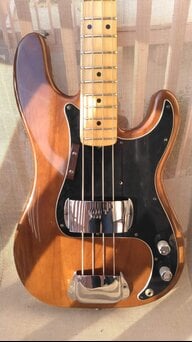
I'm not really a fan of gadgets, but if you feel you want to use something to develop dexterity, then get a set of these...
20220107_170329.jpg
 
Starting out, definitely try to use you ring and pinky fingers together as a unit, and finger three frets as 1-2-4. It's called "Simandl" technique, and it is the traditional style for all bass playing. Position the guitar and neck in a way where you can finger notes like this with a straight wrist (!!!) - like punching a heavy bag, you always want to keep a straight wrist to avoid injury, everything else is secondary to a straight wrist. The Simandl left hand, with a straight wrist will force a good arch in your finger, and build strength in your ring and pinky together. Once you get comfortable with that hand position, you can probably use 1-2-3-4 fingerings on most of the neck comfortably and safely, so long as you fingers and wrist don't start collapsing while playing.
 
  • Like
Reactions: BassFalcon
In all seriousness, don't! Grip strength is not what you need here. You need fine motor control, flexibility and fluency of movement. If the strings are too hard to press down you need a good setup, not a death grip.
Those grip things are about the dumbest idea ever. You need exactly enough strength to press the string. It doesn't help a bit if you can balance a Volkswagen on your fingers. I would bet that they CAUSE more injuries than they prevent.

OP - The FIRST thing you should do is get your bass set up properly and don't worry about the cost. A well set up Squier will be all the bass you need to develop great skills. At this point those sky high strings are hindering your playing.

Developing great technique is not fun or easy, but having great technique makes playing fun and easy. The whole point of great technique is being able to concentrate on making music, and not having to worry about the mechanics of playing.
 
Hi, Yeah my action is pretty high, according to my bass teacher at school. I'm not really sure what that means but it makes it harder to play. I haven't been rough with the bass and I haven't had it for too long but it's a squier, so I'm going to get that fixed soon. Hopefully. I really don't wanna spend $100 on my $400 squier

What it means is that the strings are far from the fretboard.

Might have seemed off topic from your post, but it is quite possible your bass is just unreasonably uncomfortable to play and that is pushing you to change your finger orientation.

This happens because one or all three things are going on
1) the neck is overly bowed
2) The saddles (the adjustable parts on the bridge) are too high
3) the nut is too high

Adjusting the 'truss rod' (a metal rod running through the neck) can change the neck bow. You usually want a little bit of forward bow (i.e. concave re the strings/forward away from your body). Though some instruments can play okay with a near straight neck, you're typically going to get the best action with a little bow. Back bow, (i.e. convex re the strings) is never going to be useful.

The tension of strings can also change the neck bow, older strings can gradually get more tense, though they usually plateau at some point. But that's another time you'd often need to adjust and why people will tend to stick with one particular set of strings for a particular instrument.

Seasonal or other humidity can make the wood in the neck move.

That is all normal for any instrument, nothing particular about your Squier. Though if it is new, newer instruments will tend to need adjustments more frequently, as the wood settles.

Too high action can throw off your intonation as well.

For all those reasons, I highly recommend learning to do your setups. Including truss rod adjustment, saddle adjustment, and intonation. The one thing I would recommend taking to a professional (if it is an issue) is nut filing. You need special tools to do that well and it is the thing in this mix that is easier to really mess up.

From your picture, the nut isn't your big worry, it looks just a little high.

I just skimmed this one, but this looks fine
 
  • Like
Reactions: BassFalcon
Good left-hand technique all starts with comfortable thumb position. I can see that your thumb is collapsed and tense. That automatically puts your hand in bad position. To solve the problem with your ring finger, you should start by fixing the problem with your thumb.
This was the first thing I noticed in the OP's picture.
 
The highest-end basses can still need tweaking to fit you, and/or some occasional maintenance.

So, don't think of it as sinking money into a particular bass, think of it as something like tuning or replacing batteries or old strings: it's just a normal part of being a bass player, independent of what bass you own.

You can also save the money and DIY it. There are youtube tutorials that'll show you how to adjust the action. I'm personally of the school that for a beginner still getting used to what a bass "should" feel like, it's smart to take it to a pro, at least the first time--they'll also be able to tell you if there's some flaw in the bass that prevents lowering the action.

Probably there isn't, though (or if it is, and it's new, it's almost certainly still under warranty). Squiers are totally respectable instruments.

i'll pile on and agree. I like to think of it like a car. You have to adjust the seat and mirrors to your preference, that's all a setup is, adjusting the seat and mirrors so it's comfortable to you. Have no shame in your squier, as mentioned it's a perfectly good instrument. Take it in for a setup and talk to the person about what you think you want so they can set it up for your preferences be sure to discuss strings too, maybe ask for a lighter gauge softer string. When you go to pick it up be sure to play it to make sure it feels good, don't be afraid to ask for small tweaks at this point. A good tech/luthier knows setups are personal things and they will want to get it right for you.
I live in the Midwest which sees wild temperature and humidity swings. I usually have to set up my basses 1 or 2 times a year. I usually do it myself. Sometimes if I have more money than time I'll take it to a trusted shop. It's not as intimidating as it sounds. I'm not associated with the company, I just really like their products, but I recommend Music Nomad for about the price of a single setup you can get a set of tools to do it as many times as you'd like. Even if you don't buy their tools they have excellent free videos on how to do the adjustments. A pen and paper is your friend here. Take all the relevant measurements before you start tinkering, that way you if it goes sideways you can always take it back to square one. Also, regarding setups the lower you like your action the better the fretwork has to be. I like loooooww action so my frets have to be perfect. Every now and then no matter how high I crank the humidifier sometimes the dry winter air will force a fret to pop up. Raising my action a hair is a quick band-aid type fix until I get around to dropping it off for a little fretwork. No big deal, it's not a sign of a defect, it's just that wood and metal move at different rates and sometimes the wood pushes the metal out. It happens at some point in almost every instruments life.
 
Hi, I'm a beginner bass player who has been playing for about 3 months now. I play bass at one of the clubs at my school and I really want to improve enough to start playing with my friends confidentially, but currently, I have been stuck with a problem that is super frustrating all the time that I play. When I'm fretting and positioning my left hand to play notes, my ring finger and my middle finger often straighten up and this is a no-go and when looking at everyone else play their fingers are arched and don't have this problem. I'm making a conscious effort to improve this but it's super frustrating when I correct myself and a few seconds later it happens. It's like I have no control over if it arches or not. I was wondering if anyone had any tips for me to fix this problem or should I just ignore it? I'm not sure.View attachment 4532384
You're looking at the wrong people.
Play however is natural and gets what you need. Push it clean so it don't buzz and make it sound right. Everyone is different. I have seen people with the arches... some without... try keeping the arch playing a 7 string bass. Build your strength, precision, and speed however your body will let you. Just get a good playing position and rock it.

Hell, you may be double jointed... you may be able to make it benefit you.
 
  • Like
Reactions: Watchootognbout