A lot of good advice here. However-- two octaves in every hand position?Really good advice already.
My advice is "just stick at it".
For me it's a very different instrument to a four-string: two octaves in every hand position, a fretted bottom E with a four-string built in at the 5th fret!
Throw into the mix that you've got the circle of 4ths and 5ths at every fret and what's there not to love? As long as you're happy with the neck width and B string tension you'll be laughing!
Just stick at it because there's definitely a (re-)learning curve.
Now, about those pics

Enjoy the benefits of a premium membership!
Upgrade Account
-
TalkBass has been independent since 1998. Add your voice.
Create a free account to reply to discussions, view embedded media, and browse with fewer display ads.
Join free Log in
Want zero display ads or expanded classifieds tools? Compare plans.
You are using an out of date browser. It may not display this or other websites correctly.
You should upgrade or use an alternative browser.
You should upgrade or use an alternative browser.
First 5 string
- Thread starter Atknerd
- Start date
More options
Who Replied?

First tip, no pics = no bass.
2nd tip, I found I had to look at my right (plucking) hand the first few weeks I switched to 5 string. Otherwise I was missing 1 string high often. Had no curve with my fretting hand. After that I was able to rotate 4 and 5 just fine.
2nd tip, I found I had to look at my right (plucking) hand the first few weeks I switched to 5 string. Otherwise I was missing 1 string high often. Had no curve with my fretting hand. After that I was able to rotate 4 and 5 just fine.


I agree with others and ezstep...
For me, it was only playing the 5 string and don't fall back to the 4 string because it feels familiar.....at rehearsals, solo practice, and all gigs. It might be a little ruff at first but you'll be forced to adapt and adjust.
Put away the four stringers and play the fiver only for several months. People often complain that they get confused easily on a fiver and then confess that they switch back and forth, four to five.
For me, it was only playing the 5 string and don't fall back to the 4 string because it feels familiar.....at rehearsals, solo practice, and all gigs. It might be a little ruff at first but you'll be forced to adapt and adjust.
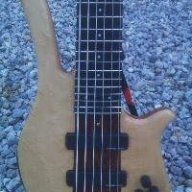
Interesting perspective. I found it to be easier thinking of it as a 4 string with just an extra string or 2. It just seemed to make more sense. I found that transposing songs down an octave can add a lot of girth, which I like. I agree that ignoring those closed minded 4 string players is a good idea. Just because they don't like 5 or 6 string basses, doesn't make them right.1: put your 4 strings away and only play the 5 until it becomes completely natural.
2: get an instructor at least for a while who plays a 5 like a 5 and not a 4 with an extra string.
3: go back and woodshed all your scales again, starting with C on the B and realise you now have 2 octaves under your hand and can play more efficiently across the neck much of the time rather than along it as you often do on a 4. Then relearn your repertoire playing it as if you first learnt it on a 5. Then transpose down a step for the practice because you never know when you'll get a singer who want's to sing in a different key.
4: ignore tone and other stuff until you've done the above. Get your fretting hand sorted first.
It doesn't take that long to make the change if you have a flexible mind and like learning new things. And try to ignore the 4 only players who can't and will give you every excuse to stay with a 4 because of their limitations.
What he said.
I like what everyone has said about relearning the neck and working on scales. No one has mentioned the extra muting you have to do to make sure the low B only rings when you want it to! It will make you sound MUCH better and cleaner if you remind yourself to keep the other strings muted when playing.

5th fret of the B string is an E so you can move all of the patterns you know over 1 string and up 5 frets. It's like playing a really short scale bass, but you have to reach across the board one more string. Comes in really handy when your guitar player detunes to Eb to sound like Stevie Ray Vaughn.

If it's your first attempt at learning to play a 5-string, it will probably be confusing at first. My best advice is to resist going back to your 4-string and just keep practicing everything on the 5 until it starts to feel comfortable. In fact put the 4-string back in its case and hide it under your bed so that it's a PITA to get to it. Give it at least a month or two to just focus on playing and exploring the 5-string exclusively. Start by relearning old songs you already know.
Oh, and no low D/C/B notes before the first chorus!
Oh, and no low D/C/B notes before the first chorus!

And beware the "Jaco played only 4-strings" nay-sayers. They are no help.....
Jaco owned at least two 5 strings - there's plenty pictures online of him playing them (which is good enough a reason for me to never play anything else
 )
)
The advice is: don’t sweat it too much. It’s just more low notes bruh
There’s a little technique difference, especially in where you sort of hold your right hand. Other than that, explore LIBERALLY using the B string octaves of any major notes you would normally play on the A string of a 4 stringer. Any songs you used to rock a C, or D, or whatever, play around with doing them an octave down on your new B string. That’s really the only “code” you need to unlock in your brain.
There’s a little technique difference, especially in where you sort of hold your right hand. Other than that, explore LIBERALLY using the B string octaves of any major notes you would normally play on the A string of a 4 stringer. Any songs you used to rock a C, or D, or whatever, play around with doing them an octave down on your new B string. That’s really the only “code” you need to unlock in your brain.
Didn't read any of the other posts, so sorry if this is redundant, but I do really feel like this was my epiffany for being able to switch between a 4 and a 5 without having a mental overload:
Just play it like a 4 for a bit. Digest the new neck size and feel.
Once you feel good about it, and can play your new 5 without too much difficulty think in terms of the B string being this thing that contains the lower 5ths for all of notes on the E string. You don't even need to know the names of the notes, but they will start sticking in your head after a while.
Like, if you're playing something in G, the F# on the b string right next to the B on the e string will start feeling super convenient. The personality of that F# won't be too different from the 2nd fret E string F#. The other notes above it, kinda the same thing. The A right next to the D is another example.
Lower that the 7th fret on the B is more intentional. If you play that 3rd fret D for example, it's an artistic choice, not a choice you make because it's in the neighborhood of the spot on the neck you're in...
Hope this helps!
Just play it like a 4 for a bit. Digest the new neck size and feel.
Once you feel good about it, and can play your new 5 without too much difficulty think in terms of the B string being this thing that contains the lower 5ths for all of notes on the E string. You don't even need to know the names of the notes, but they will start sticking in your head after a while.
Like, if you're playing something in G, the F# on the b string right next to the B on the e string will start feeling super convenient. The personality of that F# won't be too different from the 2nd fret E string F#. The other notes above it, kinda the same thing. The A right next to the D is another example.
Lower that the 7th fret on the B is more intentional. If you play that 3rd fret D for example, it's an artistic choice, not a choice you make because it's in the neighborhood of the spot on the neck you're in...
Hope this helps!
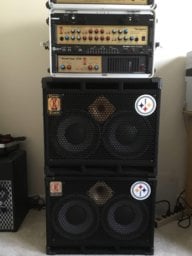
I just purchased my first 5 string. It is yamaha bb-235-rr with seymour duncan quarter pounders any hints,tips,tricks thanks in advance
‘In my experience is to not play the same songs on your 4 string on this 5 string if you can. Start working on your 5 string with songs that require sub E notes.
I had almost 50ys of playing a 4 string before I got my first 5 string. It was an adjustment, and that was 6 years ago. I still avoid playing the same songs on both.

+1.1: put your 4 strings away and only play the 5 until it becomes completely natural.
Put your 4 string away and play the 5 exclusively until you stop playing notes on the B from muscle memory where you mean to play the E. This is the big transition for most people.
Secondarily, figure out how to mute the B string. It's new; your right hand won't have a way to deal with it for a minute and it will resonate. If you're like a lot of people, you might find that you use the B as a thumbrest where you normally use a pickup. But I don't want to put that in your head as the right answer, it's just "an" answer.
It took me a few months of fairly heavy use to get past these. The good news is that once I did I was able to move back and forth between 4 and 5 string instruments without any problems.

I agree with the advice to put away the 4's for a while, and focus on learning the 5. For me that was tough to do, as I have gigs every weekend (and some in the middle of the week as well), so I don' t have periods of time where I can do stuff like that, but I did get there eventually.
For me, once I got acclimated on a 5, I flipped to all 5's (donated all my 4's) - the physical platform was comfortable enough, and I like consistency - I play a lot without looking at my hands, and having the same physical platform on every bass (my basses hav all the same neck contours, string spacing, etc) makes that work well.
In the transition, you will have times where you "re-harmonize" things - oops, off by a string. I also remember one time when I looked at my bass, my head was consumed with the thought "I have a middle string?" That stuff is part of the deal, and you will get past it.
For me, once I got acclimated on a 5, I flipped to all 5's (donated all my 4's) - the physical platform was comfortable enough, and I like consistency - I play a lot without looking at my hands, and having the same physical platform on every bass (my basses hav all the same neck contours, string spacing, etc) makes that work well.
In the transition, you will have times where you "re-harmonize" things - oops, off by a string. I also remember one time when I looked at my bass, my head was consumed with the thought "I have a middle string?" That stuff is part of the deal, and you will get past it.
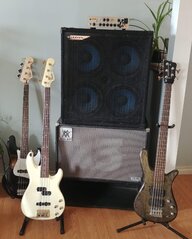
For me, the whole reason I picked up the 5er was because I wanted access to those notes I couldn't get with a 4... Eb/D#, D, Db/C#, C, and of course..... that LOW B. So I re-wrote most of my bass lines in my band's songs and selectively chose where I decided to utilize those lower notes. I didn't like the mentality of "just play everything you play on a 4string on a 5string" or "use the B string as an anchor for your thumb" because I felt like it defeated the purpose. The guitarist in my band tunes C/G/C/F etc so I felt I NEEDED access to those notes, especially that low C. I found the biggest hurdle wasn't transposing, OR selecting the best times to use those low notes... but it was string spacing (my Warwick Streamer 5 has a pretty narrow neck for a 5er). It makes for easier muting with both hands, but makes slap bass difficult (I need to go back to my 4 for that) and sometimes I'd plug/fret the wrong string entirely. Now when I go back to my four I think "man these strings are far apart".
I would kind of disagree, having had two basses with QP Jazz V pickups.SD QP > Scoop city !
They have a HUGE low end presence (maybe too much) which would cause one to feel they have no mid range. But they do - they growl and bite all day long.

Smooth_bass88
vaxx!
- Oct 31, 2006
- 12,122
- 16,793
- Disclosures
- have been on nationally released albums, charting on the Billboard 200
practice chromatic scales across the neck in each position starting in the first position. After a few weeks, the low B will start to feel more "natural"
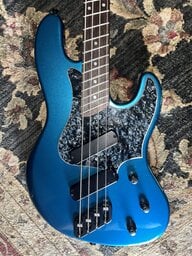

Jaco owned at least two 5 strings - there's plenty pictures online of him playing them (which is good enough a reason for me to never play anything else
He sure did! Those never>4 folks are still out there, though…
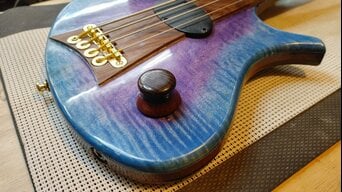
Pics or it didn't happen. I don't make the rules.I just purchased my first 5 string. It is yamaha bb-235-rr with seymour duncan quarter pounders ...


