
Enjoy the benefits of a premium membership!
Upgrade Account
-
TalkBass has been independent since 1998. Add your voice.
Create a free account to reply to discussions, view embedded media, and browse with fewer display ads.
Join free Log in
Want zero display ads or expanded classifieds tools? Compare plans.
You are using an out of date browser. It may not display this or other websites correctly.
You should upgrade or use an alternative browser.
You should upgrade or use an alternative browser.
First bass - neck through.
- Thread starter jimmy rocket
- Start date
-
- Tags
- bass first bass neck neck through
More options
Who Replied?
I know! I'm so excited about that. I'm one of those people who actually prefers a little color in ebony.Beautiful fingerboard you got there.

I routed for the truss rod last night. I still have to clear out the upper access, but I didn't have a round nose bit in the right size so I need to order one. I'm thinking 3/8" should do it. I'm using one of those bitteroot truss rods I've seen touted on the forums.
One question I keep going around about on is graphite reinforcement. Any thoughts on the necessity/benefits/drawbacks of that from other builders?

- Apr 18, 2008
- 16,027
- 1
- 31,767
- Disclosures
- I'm highly opinionated and extremely self-assured
Re graphite bars: I've never used them on the handful of necks I've built. Especially with a multi-lam neck like yours, if the grain was arranged symmetrically at glue-up, it should be fine.
It has been slow going for the past week, but I managed to rough out the neck, veneer the headstock and get the truss rod channel finished. It feels like a million little steps and I keep walking through them in my head to try and identify the most efficient process, but I already know the things I will do differently next time.
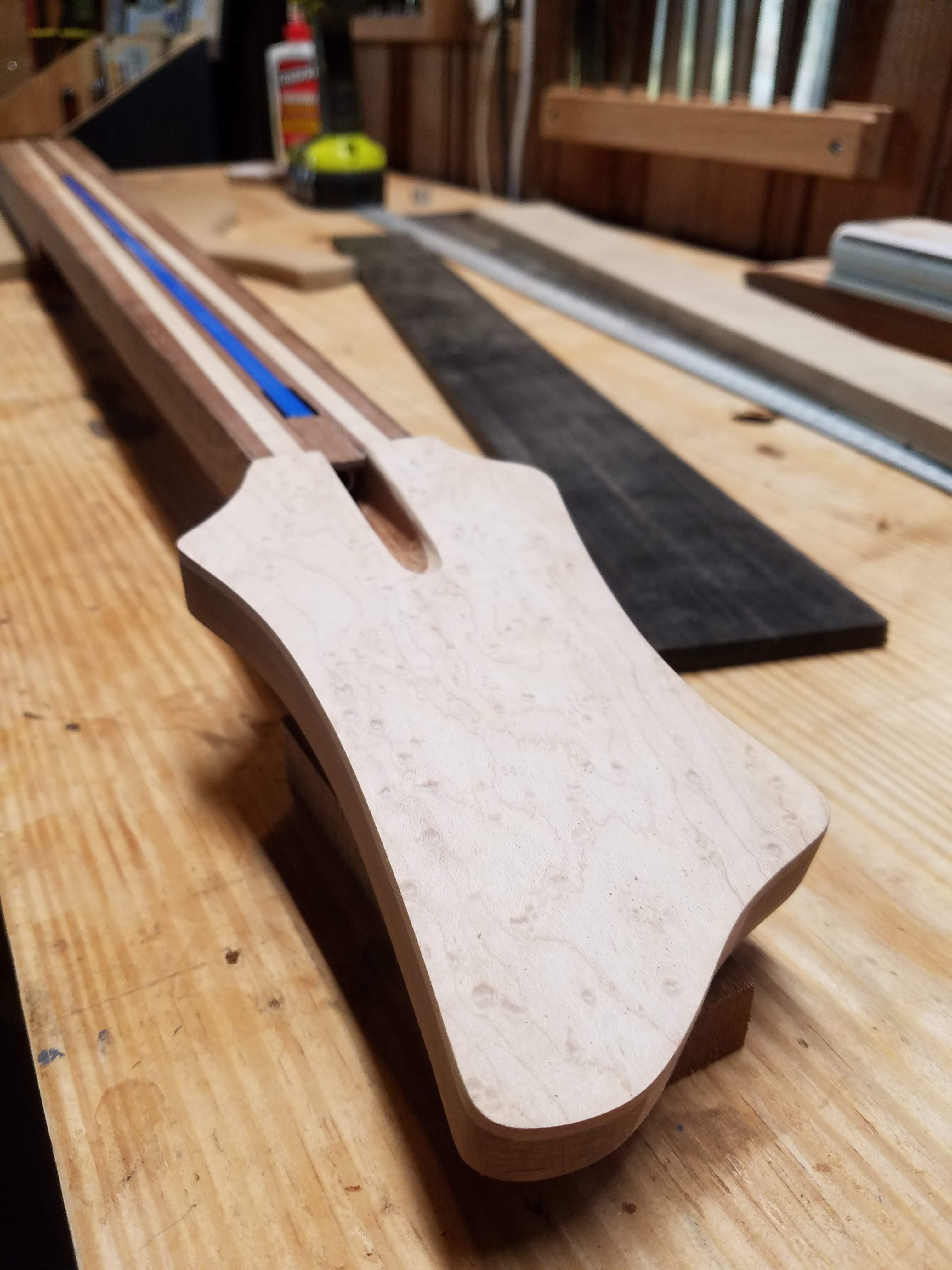
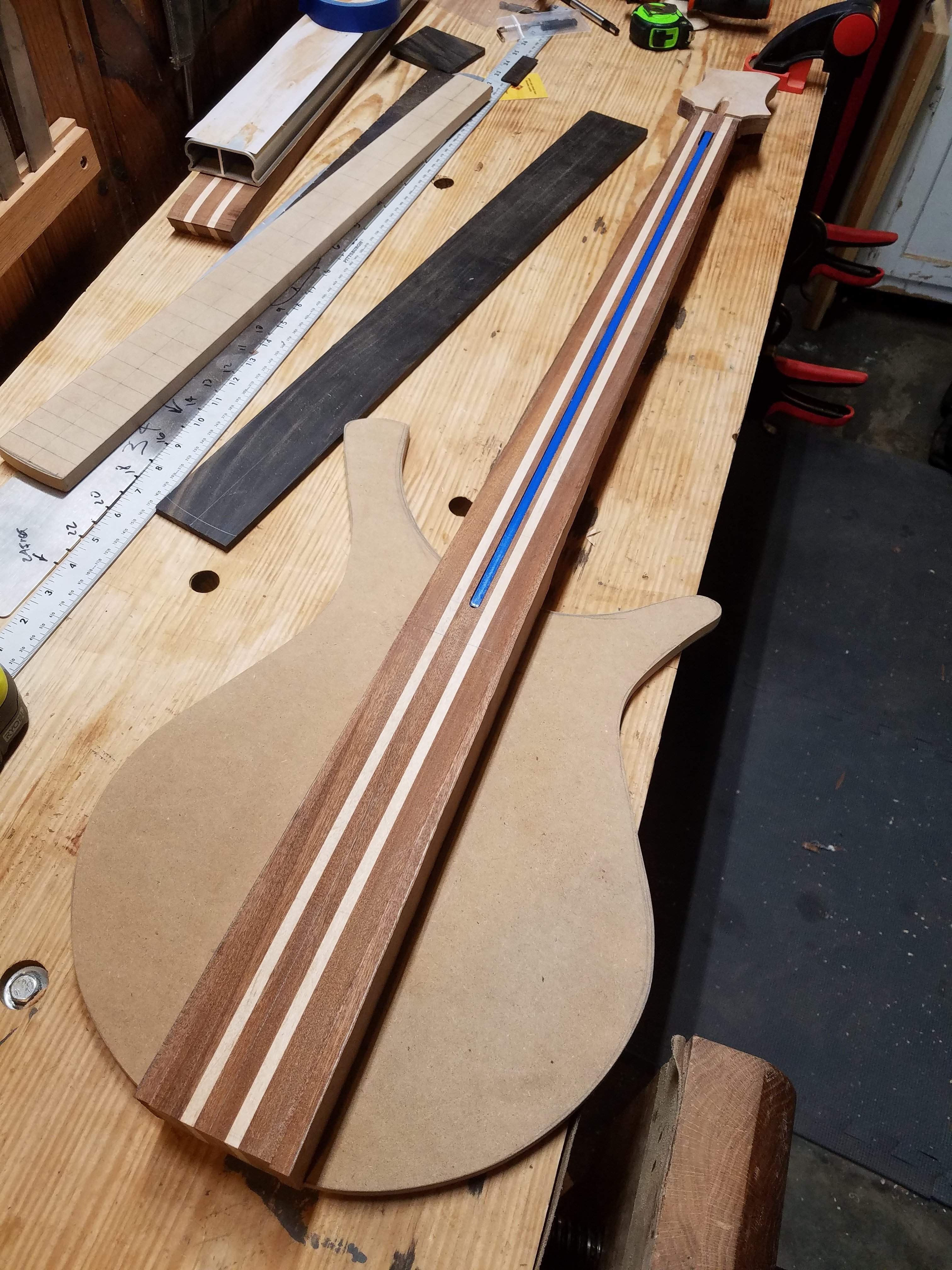
At least it's starting to feel like a bass.
At least it's starting to feel like a bass.
Ok, I'm starting over.
When making the first neck I didn't take into account the width of material I would need to carry the fretboard taper through the body. When I realized this, I added some material as wings to make up the difference, but I know the transition is going to annoy me visually.
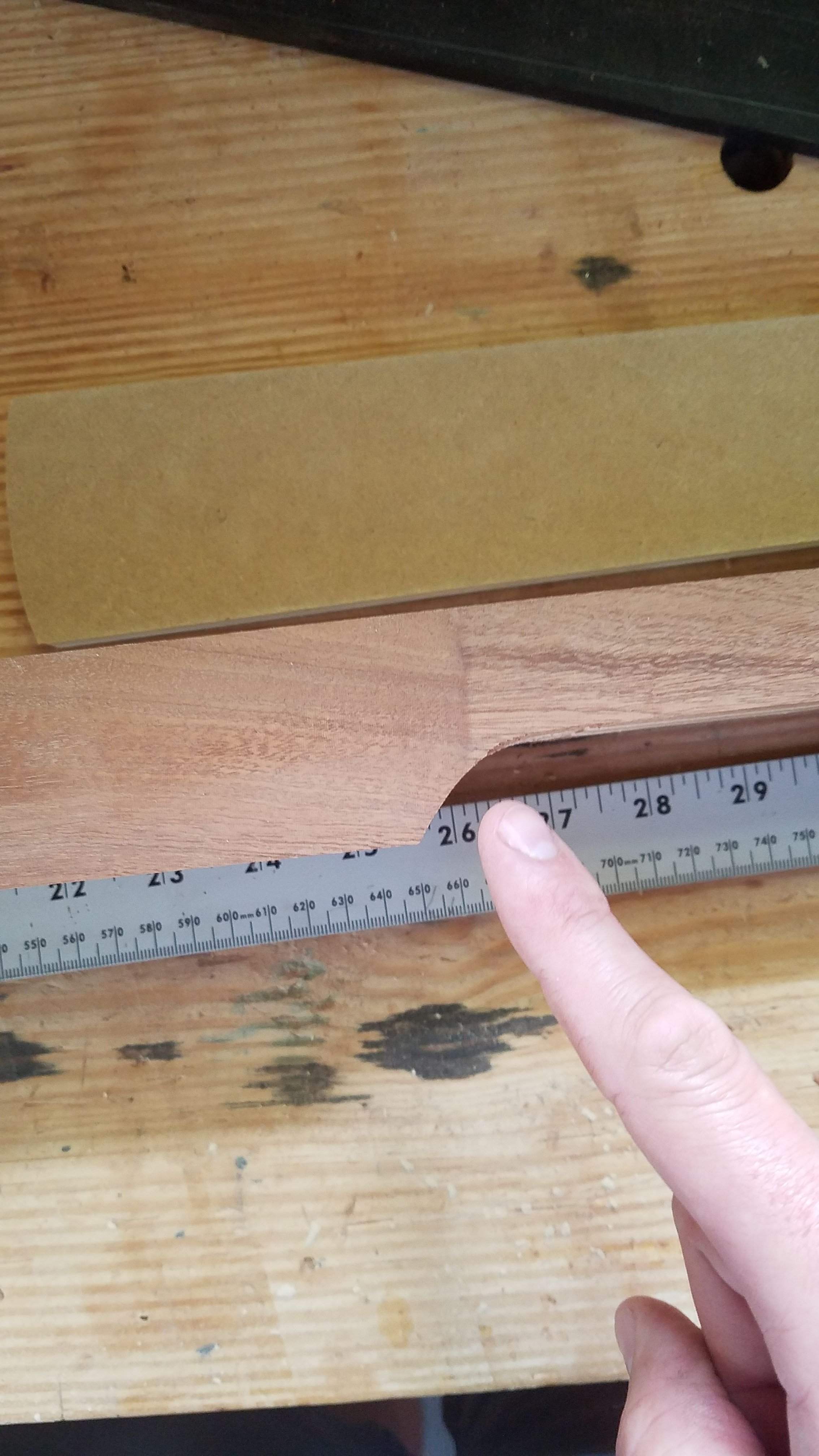
I have been asking myself if I can live with it, but I've learned in woodworking that if I have to ask that question, then I need to do it again.
Since starting the first neck, I got my hands on some wenge, and now I'm wondering, should I do the hippie sammich laminate thing again, or maybe just a maple core with wenge on either side.
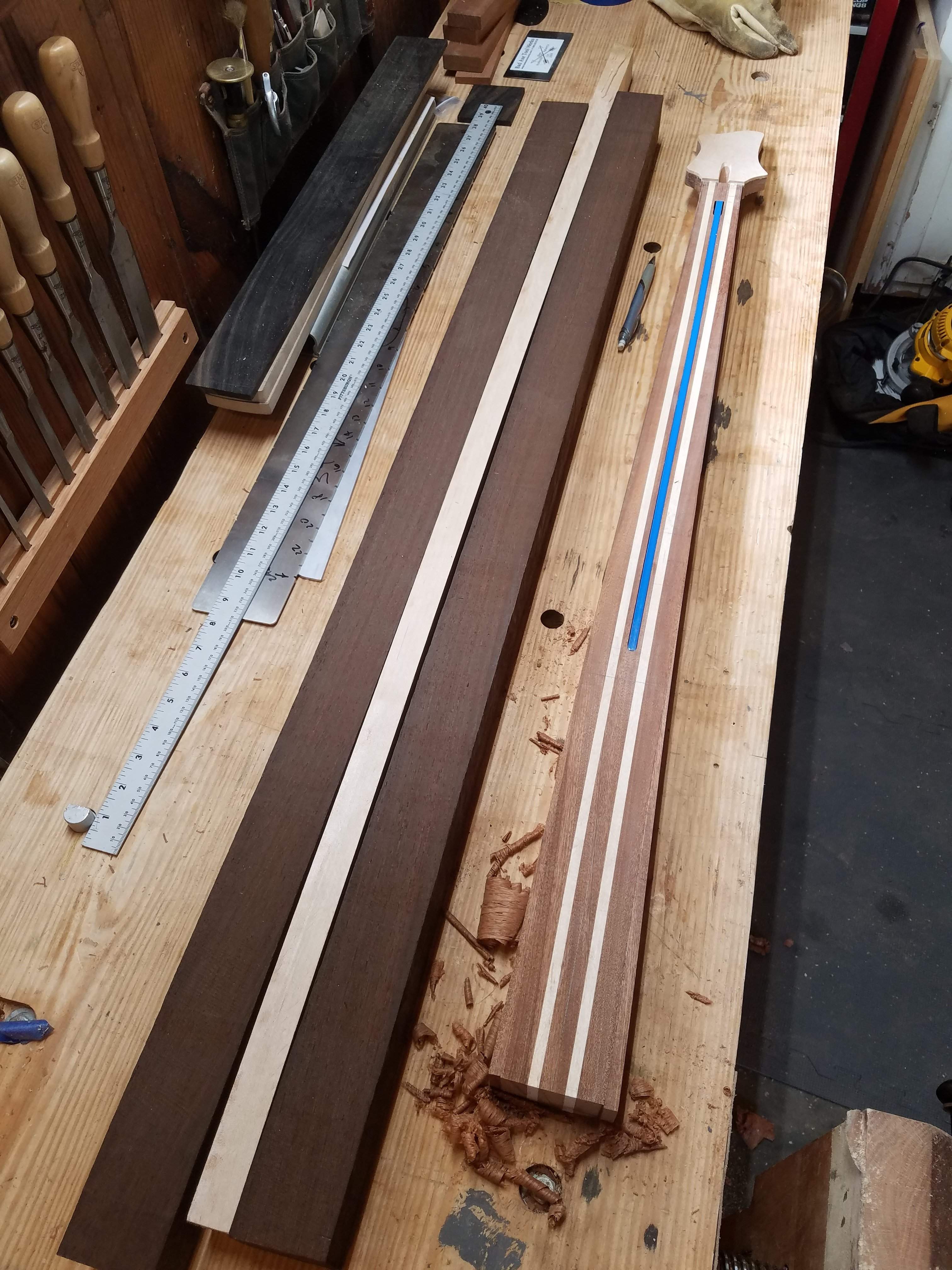
Straw pole: would you do Wenge/maple/ wenge or wenge/m/w/m/w ?
When making the first neck I didn't take into account the width of material I would need to carry the fretboard taper through the body. When I realized this, I added some material as wings to make up the difference, but I know the transition is going to annoy me visually.
I have been asking myself if I can live with it, but I've learned in woodworking that if I have to ask that question, then I need to do it again.
Since starting the first neck, I got my hands on some wenge, and now I'm wondering, should I do the hippie sammich laminate thing again, or maybe just a maple core with wenge on either side.
Straw pole: would you do Wenge/maple/ wenge or wenge/m/w/m/w ?

I love many layers, so I'd personally go with w|m|w|m|w but that's me. As for the other neck, what about putting a figured top on this? If you did that the extra pieces at the bottom end would look awesome. The hippie sandwich always looks better with many layers and pieces.
- Apr 18, 2008
- 16,027
- 1
- 31,767
- Disclosures
- I'm highly opinionated and extremely self-assured
I think w/m/w/m/w would be awesome. I actually think m/w/m/w/m would be even better, but that's just because I'm a huge fan of maple.
And don't scrap that first neck; I'd use it for a long-tenon set-neck ("set-thru").
And don't scrap that first neck; I'd use it for a long-tenon set-neck ("set-thru").
Truss rod access on v2 is at the base of the neck. I've always liked this arrangement better if there's proper access.
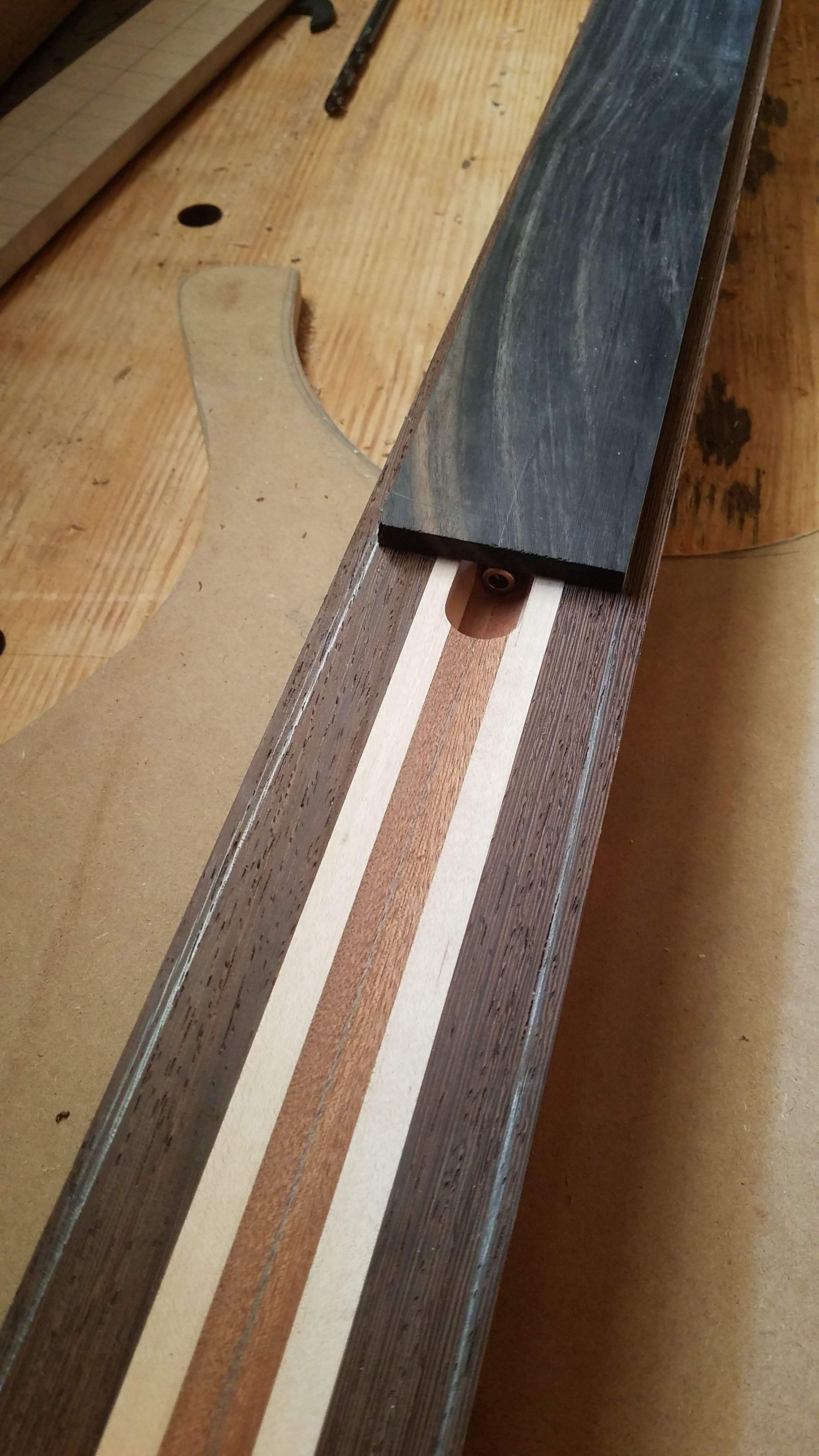
The technical hurdle I'm grappling with now is the fall-off at the end of the fretboard. How high does the top of the fretboard have to be versus the top of the body to get proper action with, say, a hipshot toploader? I know I'll have to cut away some of the neck blank to get it flush with the body, but I just cant find reliable info on how much.
The technical hurdle I'm grappling with now is the fall-off at the end of the fretboard. How high does the top of the fretboard have to be versus the top of the body to get proper action with, say, a hipshot toploader? I know I'll have to cut away some of the neck blank to get it flush with the body, but I just cant find reliable info on how much.
- Apr 18, 2008
- 16,027
- 1
- 31,767
- Disclosures
- I'm highly opinionated and extremely self-assured
Thanks, that's helpful. Theres no angle on the neck.Assuming no neck angle, about a quarter to three eighths of an inch.
So my plan is to do the following. More experienced folks can chime in if this sounds crazy.
I'm going to plane the fretboard down to 3/16, cut fret slots and rout it to pattern. After gluing the fretboard down I'm going to use a pattern bit to trim the neck to the fretboard including an additional 1/8" depth where the fretboard meets the body, leaving a total drop of 7/16 from the top of the fretboard to the body of the bass. I'll trim the remainder of that 1/8 off the top of the neck through portion on the bandsaw and clean it up before gluing the wings to the body.
After frets that should leave the top of the frets somewhere around .4625 inches above the plane of the body giving me plenty of adjustment range with the hipshot bridge.
I think.
I'm going to plane the fretboard down to 3/16, cut fret slots and rout it to pattern. After gluing the fretboard down I'm going to use a pattern bit to trim the neck to the fretboard including an additional 1/8" depth where the fretboard meets the body, leaving a total drop of 7/16 from the top of the fretboard to the body of the bass. I'll trim the remainder of that 1/8 off the top of the neck through portion on the bandsaw and clean it up before gluing the wings to the body.
After frets that should leave the top of the frets somewhere around .4625 inches above the plane of the body giving me plenty of adjustment range with the hipshot bridge.
I think.
- Apr 18, 2008
- 16,027
- 1
- 31,767
- Disclosures
- I'm highly opinionated and extremely self-assured
Any particular reason for planing the fretboard down to 3/16"? My personal preference is for at least a full 1/4" on my builds. I just like thick fingerboards.
Triple-check all the measurements on bridge height and fingerboard above body plane, maybe a quick and dirty mockup with the bridge screwed to a 2x4? No second chances with a neck-through! You don't want to be cutting the bridge in or shimming it up.
Any particular reason for planing the fretboard down to 3/16"? My personal preference is for at least a full 1/4" on my builds. I just like thick fingerboards.
Honestly, just that the tusq nut I have doesn't sit high enough to clear the frets if I installed it the way I planned to (Gibson style, between the fretboard and the headstock laminate). Maybe I need to look for a taller nut?
Good point. I guess I'm already on chance #2, but I like this neck a lot and I don't want to go for 3 just yetTriple-check all the measurements on bridge height and fingerboard above body plane, maybe a quick and dirty mockup with the bridge screwed to a 2x4? No second chances with a neck-through! You don't want to be cutting the bridge in or shimming it up.

- Apr 18, 2008
- 16,027
- 1
- 31,767
- Disclosures
- I'm highly opinionated and extremely self-assured
Honestly, just that the tusq nut I have doesn't sit high enough to clear the frets if I installed it the way I planned to (Gibson style, between the fretboard and the headstock laminate). Maybe I need to look for a taller nut?
3/16" is fine, I was just curious.
Agree with @Gilmourisgod 's advice too!


Yes, like the others have said, most basses are built with the fingerboard surface 3/8" above the body/pickguard surface. Most players are comfortable with that clearance under the strings. And most aftermarket bridges are designed for that 3/8" nominal string height. You certainly can go with more or less string height if you want to, but it will feel different, and you may have to raise or recess the bridge.
I call that dimension the Vertical Offset: the height from the fingerboard surface down to the body surface. When you make up a neck-through, you have to figure out how to get to that dimension. The usual way is to design for a 3/8" vertical offset, with a 1/4" thick fingerboard. Then the top surface of the tang (which goes through the body) needs to be trimmed down 1/8" below the neck glue line surface. You can do something different if you want to, but that's the usual combination.
But the main thing is that you need to plan out what you are going to do when you are laying out the thickness of the neck blank, thickness of the body, depth of pickup cavities, etc. On a neck-through, you've got to design the instrument before you build it.
To me, 3/16" thick fingerboards are troublesome, particularly if you are planning to radius and slot it before gluing it on. The fret slots go almost all the way through. It's fragile.
I call that dimension the Vertical Offset: the height from the fingerboard surface down to the body surface. When you make up a neck-through, you have to figure out how to get to that dimension. The usual way is to design for a 3/8" vertical offset, with a 1/4" thick fingerboard. Then the top surface of the tang (which goes through the body) needs to be trimmed down 1/8" below the neck glue line surface. You can do something different if you want to, but that's the usual combination.
But the main thing is that you need to plan out what you are going to do when you are laying out the thickness of the neck blank, thickness of the body, depth of pickup cavities, etc. On a neck-through, you've got to design the instrument before you build it.
To me, 3/16" thick fingerboards are troublesome, particularly if you are planning to radius and slot it before gluing it on. The fret slots go almost all the way through. It's fragile.


