
Enjoy the benefits of a premium membership!
Upgrade Account
-
TalkBass has been independent since 1998. Add your voice.
Create a free account to reply to discussions, view embedded media, and browse with fewer display ads.
Join free Log in
Want zero display ads or expanded classifieds tools? Compare plans.
You are using an out of date browser. It may not display this or other websites correctly.
You should upgrade or use an alternative browser.
You should upgrade or use an alternative browser.
First Project (Biting off more than you can chew)
- Thread starter Elmo Oxygen
- Start date
More options
Who Replied?
That, my friend, is a very good idea. Thanks. A blow dryer then razor just might be perfect.
Did it work?
I haven't had the chance to get some scrap records to test it on yet, but will as soon as possible.
Ok, over the last couple days I spent a couple more hours sanding and applying the first two coats of oil:
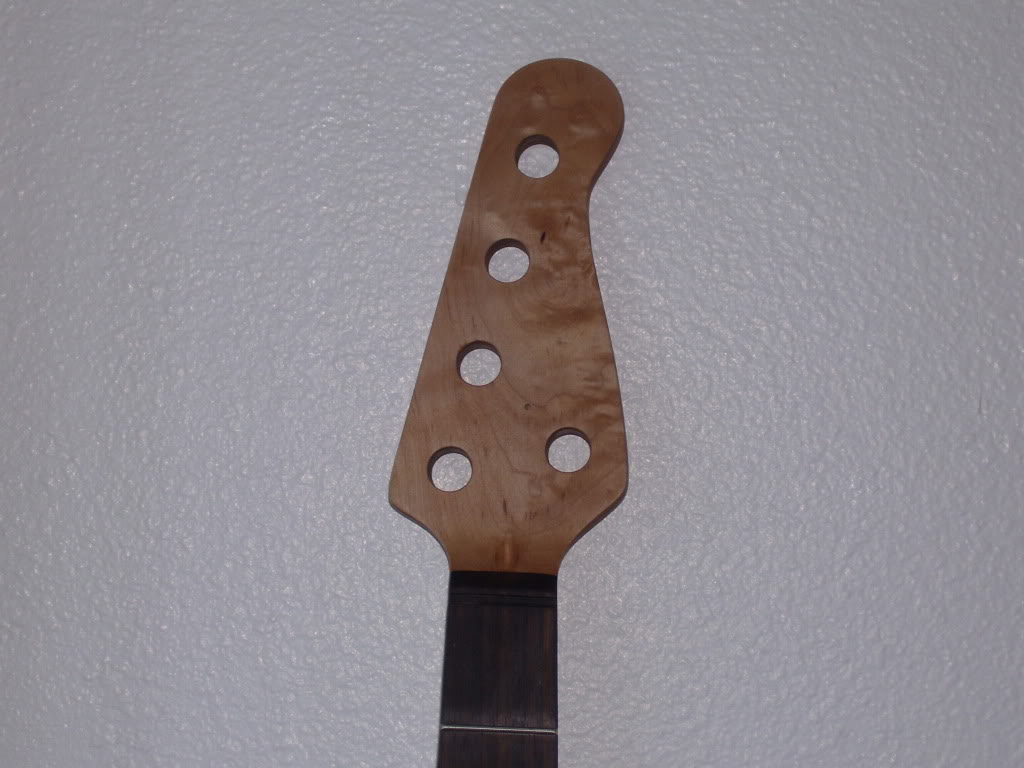
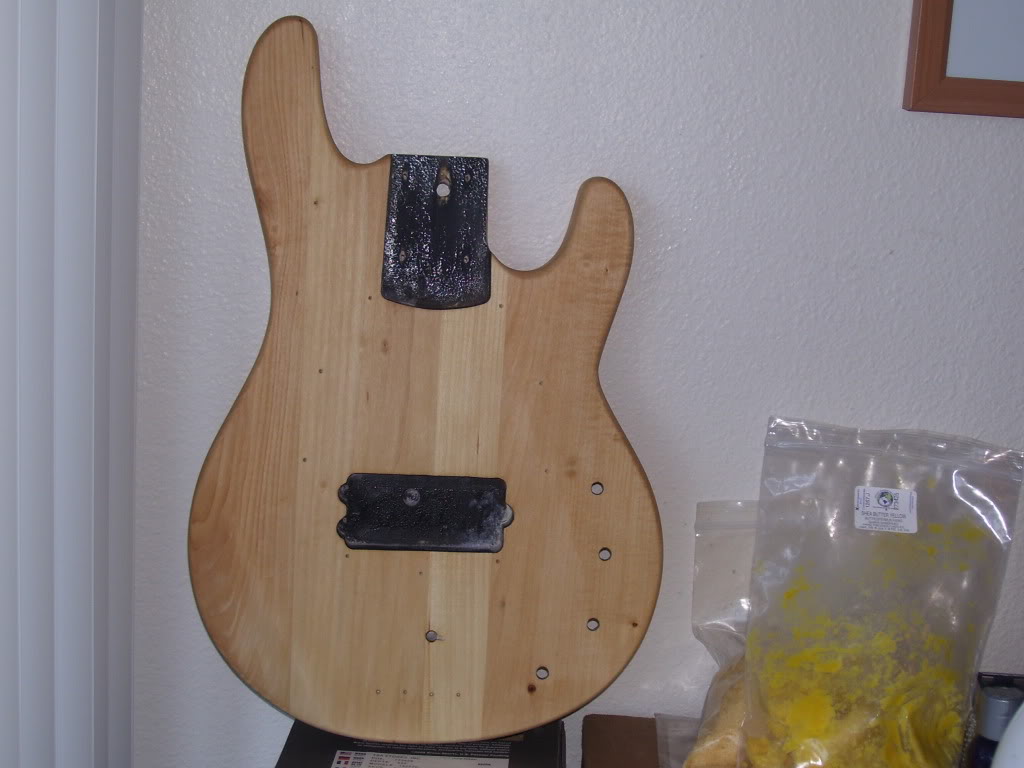
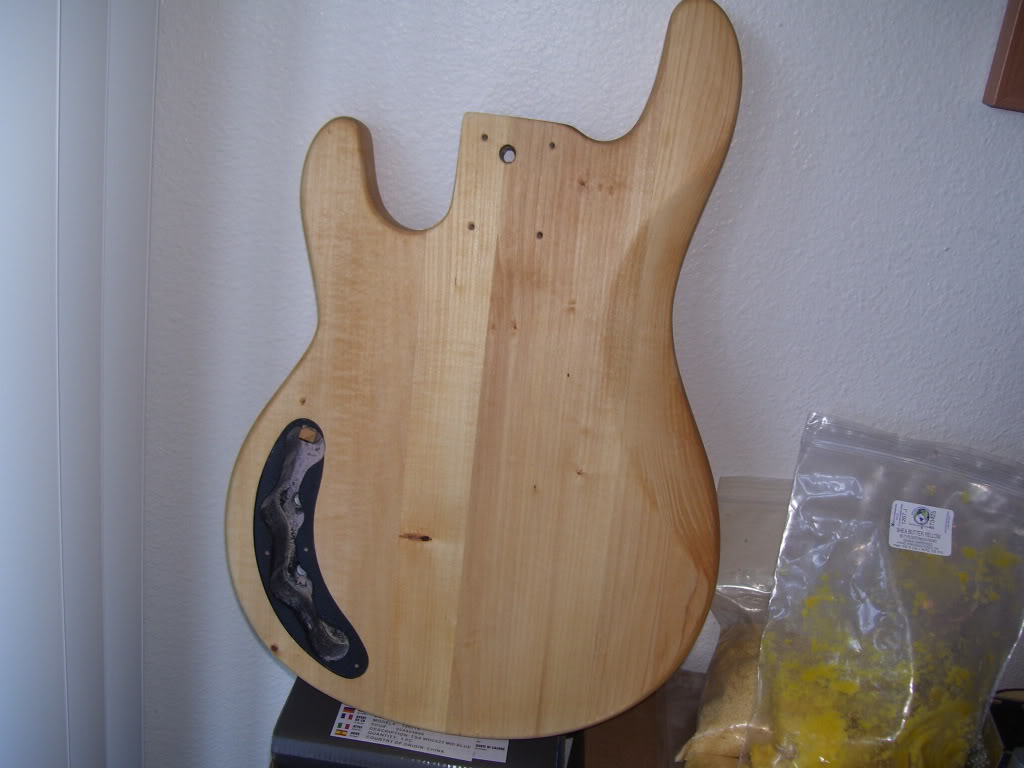
After 2 coats the headstock/neck/fretboard are looking really good, but the body is still leaving a little something to be desired. I'm thinking I may want to add a stain, just to throw a little golden-honeyness to the body.
After 2 coats the headstock/neck/fretboard are looking really good, but the body is still leaving a little something to be desired. I'm thinking I may want to add a stain, just to throw a little golden-honeyness to the body.

next time use Marine Stripper on the paint-- all the sanding you have done has probubly taken 1/8" or more of the wood away. Don't powder coat bridge parts--if it does stay on the metal--it will be real thick and suck up vibration and that's not good. I would cover the album with the blue tape on both sides and then draw the outline and then use a dremmel and just take as much time as you need and go slow.
The finish you want to use for the neck would be the gunstock oil and wax method like they do with Musicman guitars. Birchwood Casey oil and wax.
The finish you want to use for the neck would be the gunstock oil and wax method like they do with Musicman guitars. Birchwood Casey oil and wax.

If you've put oil on the body, then abandon any thoughts of using nitro or poly as a finish coat. They will not adhere to the body after oil has been applied.
You need to carry through this project with an oil-based finish coat. Most of them are a blend of oil and "something" (varnish, etc) but they will be compatible with the oil you already applied. I'd recommend that you consider using Birchwood Casey Tru-Oil as a final coat - it's used for gunstocks, but it dries hard and is easy to touch up if you ever damage the finish. You should be able to drip a bit of stain into the Tru-Oil if you need it - make sure to test on a block of scrap wood.
You've learned a lot about what NOT to do, right? The worst moment was using a grinder on the finish. That's a great example of "something-I'll-never-do-again."
You need to carry through this project with an oil-based finish coat. Most of them are a blend of oil and "something" (varnish, etc) but they will be compatible with the oil you already applied. I'd recommend that you consider using Birchwood Casey Tru-Oil as a final coat - it's used for gunstocks, but it dries hard and is easy to touch up if you ever damage the finish. You should be able to drip a bit of stain into the Tru-Oil if you need it - make sure to test on a block of scrap wood.
You've learned a lot about what NOT to do, right? The worst moment was using a grinder on the finish. That's a great example of "something-I'll-never-do-again."

loend68
Supporting Member
- Jan 14, 2008
- 1,384
- 126
- Disclosures
- Endorsing Artist: Spector Basses, T.C. Electronics
I'd flip the pickguard around so you can see the whole label and the pickup would be coming through the black. That way you can keep the 'Ktel' and all of the song titles..
Just a thought....
Just a thought....
I'd flip the pickguard around so you can see the whole label and the pickup would be coming through the black. That way you can keep the 'Ktel' and all of the song titles..
Just a thought....
I think so too. It has that Dixie cup Ford Ranchero charm to it.

If you've put oil on the body, then abandon any thoughts of using nitro or poly as a finish coat. They will not adhere to the body after oil has been applied.
You need to carry through this project with an oil-based finish coat. Most of them are a blend of oil and "something" (varnish, etc) but they will be compatible with the oil you already applied. I'd recommend that you consider using Birchwood Casey Tru-Oil as a final coat - it's used for gunstocks, but it dries hard and is easy to touch up if you ever damage the finish. You should be able to drip a bit of stain into the Tru-Oil if you need it - make sure to test on a block of scrap wood.
You've learned a lot about what NOT to do, right? The worst moment was using a grinder on the finish. That's a great example of "something-I'll-never-do-again."
After pretty extensive research into both nitro and poly finishes, the Tru-Oil is certainly the direction I'm leaning in.
And yes, this project has been full of "things I'll never do again", first and foremost was commiting to this type of a project at all without being fully prepared. This is something I surely will not be engaging in again for a long time, I'll just leave it to all you pros and not complain about the price of nicely finished instruments.
I'd flip the pickguard around so you can see the whole label and the pickup would be coming through the black. That way you can keep the 'Ktel' and all of the song titles..
Just a thought....
Honestly I did consider this. I think the main thing is that I don't want to see an open hole in the pickguard and I'd like to have the label just kind of peeking out as an accent instead of detracting from the overall funky/tacky aesthetic. Oh, not to mention some of the songs/artists wouldn't exactly "fit" on a bass that belongs to me.
next time use Marine Stripper on the paint-- all the sanding you have done has probubly taken 1/8" or more of the wood away. Don't powder coat bridge parts--if it does stay on the metal--it will be real thick and suck up vibration and that's not good. I would cover the album with the blue tape on both sides and then draw the outline and then use a dremmel and just take as much time as you need and go slow.
The finish you want to use for the neck would be the gunstock oil and wax method like they do with Musicman guitars. Birchwood Casey oil and wax.
Yeah, there may not even be a "next time", lol. But they use powder coating for things like motorcycle shocks/springs/parts because it does adhere to and stay on metal very well and is darn near indestructible. However, if it does interfere with vibration we could have a problem. Anyone have a solid/educated answer to the powder coating/vibration dilemma? I guess if need be, I could re-drill for an available replacement bridge, just didn't want to screw with it.

I wouldn't worry about the powder coating dampening vibration. It's only contacting the strings on the saddles and I seriously doubt the coating will be thick enough to cause any noticable difference. Oh, and if you DO ever decide to strip a finish again I highly recommend buying a cheap heat gun from Harbor Freight or somewhere similar. You could have stripped that paint off in less than an hour.

If you've put oil on the body, then abandon any thoughts of using nitro or poly as a finish coat. They will not adhere to the body after oil has been applied.
You need to carry through this project with an oil-based finish coat. Most of them are a blend of oil and "something" (varnish, etc) but they will be compatible with the oil you already applied.
Actually, if the OP wants to move from oil to nitro or poly there is a way. A barrier coat of shellac will bond to the oil. Shellac is compatible with just about anything.
Update:
I have switched to Tru-Oil (it took a lot of phone calls to find a store in town that carries it, but I found it). I haven't picked up a stain yet, so I've only applied it to the neck/headstock. The Tru-Oil looks great and is easy to use, but I do have one issue: Even the "microfiber" cloth I was using before leaves little bits of fuzz/hairs on the surface (it's worse with Tru-Oil because of the consistency) & you're supposed to buff with steel wool between coats but the #0000 steel wool I have also leaves little "hairs" on the surface (I found that out after the first coat of linseed oil so I won't even touch it to the Tru-Oil). Does anyone have any tried and true products/materials they use for this? I need a truly "lint-free" cloth.
I have switched to Tru-Oil (it took a lot of phone calls to find a store in town that carries it, but I found it). I haven't picked up a stain yet, so I've only applied it to the neck/headstock. The Tru-Oil looks great and is easy to use, but I do have one issue: Even the "microfiber" cloth I was using before leaves little bits of fuzz/hairs on the surface (it's worse with Tru-Oil because of the consistency) & you're supposed to buff with steel wool between coats but the #0000 steel wool I have also leaves little "hairs" on the surface (I found that out after the first coat of linseed oil so I won't even touch it to the Tru-Oil). Does anyone have any tried and true products/materials they use for this? I need a truly "lint-free" cloth.
Tru Oil is a very good product. My tips are:
1. Apply with a clean, bare forefinger. Sounds crazy, but that way you'll pick up any flecks of crap on the surface, and (unless you're a yeti with hairy pads!) you won't leave lint in the finish.
2. For cutting back between coats, use well-worn 400-grit paper on the early coats when you're building up the finish, and then successively finer grades of Micromesh for final finish and polish.
HTH
Adrian
1. Apply with a clean, bare forefinger. Sounds crazy, but that way you'll pick up any flecks of crap on the surface, and (unless you're a yeti with hairy pads!) you won't leave lint in the finish.
2. For cutting back between coats, use well-worn 400-grit paper on the early coats when you're building up the finish, and then successively finer grades of Micromesh for final finish and polish.
HTH
Adrian
Quick update with pics to come: I tried the bare finger method for applying the Tru-oil and while it did eliminate the debris/fuzz, I found it hard not to apply too much. After it dried there were spots with drips or clumps that I had to sand back down again.
I found another kind of "microfiber" cloth (they're a lot like a guitar polishing cloths) that still can leave a little fuzz if the oil has set for a minute, but otherwise get the job done pretty well. I find I have to wait a good 6-10 hours before hitting it with steel-wool, or the fibers get stuck in the stickyness.
All in all, the neck is finally starting to look good. I'm going for one more thin coat, then buffing. Then I'll throw some more pics up.
I'm sure it'll still be rewarding when it's done, but I'm certainly starting to doubt that it's worth all the trial 'n' error and work.
I found another kind of "microfiber" cloth (they're a lot like a guitar polishing cloths) that still can leave a little fuzz if the oil has set for a minute, but otherwise get the job done pretty well. I find I have to wait a good 6-10 hours before hitting it with steel-wool, or the fibers get stuck in the stickyness.
All in all, the neck is finally starting to look good. I'm going for one more thin coat, then buffing. Then I'll throw some more pics up.
I'm sure it'll still be rewarding when it's done, but I'm certainly starting to doubt that it's worth all the trial 'n' error and work.
For anyone interested; I've been in the middle of a move for the last 5+ days and have to get situated before I can get back to work on this.
*mental note: a project such as this will take someone like me 20x longer than expected*
*mental note: a project such as this will take someone like me 20x longer than expected*


