I know there’s a lot of “does it fit” talk with tele straight neck heels and rounded bodies/pickguards. I wanted to post my latest experience so that people understand why the answer is “kinda.” I also want to show people that this isn’t exactly rocket surgery, and pretty much anyone with some 80 grit and some time can make this transition look pretty decent.
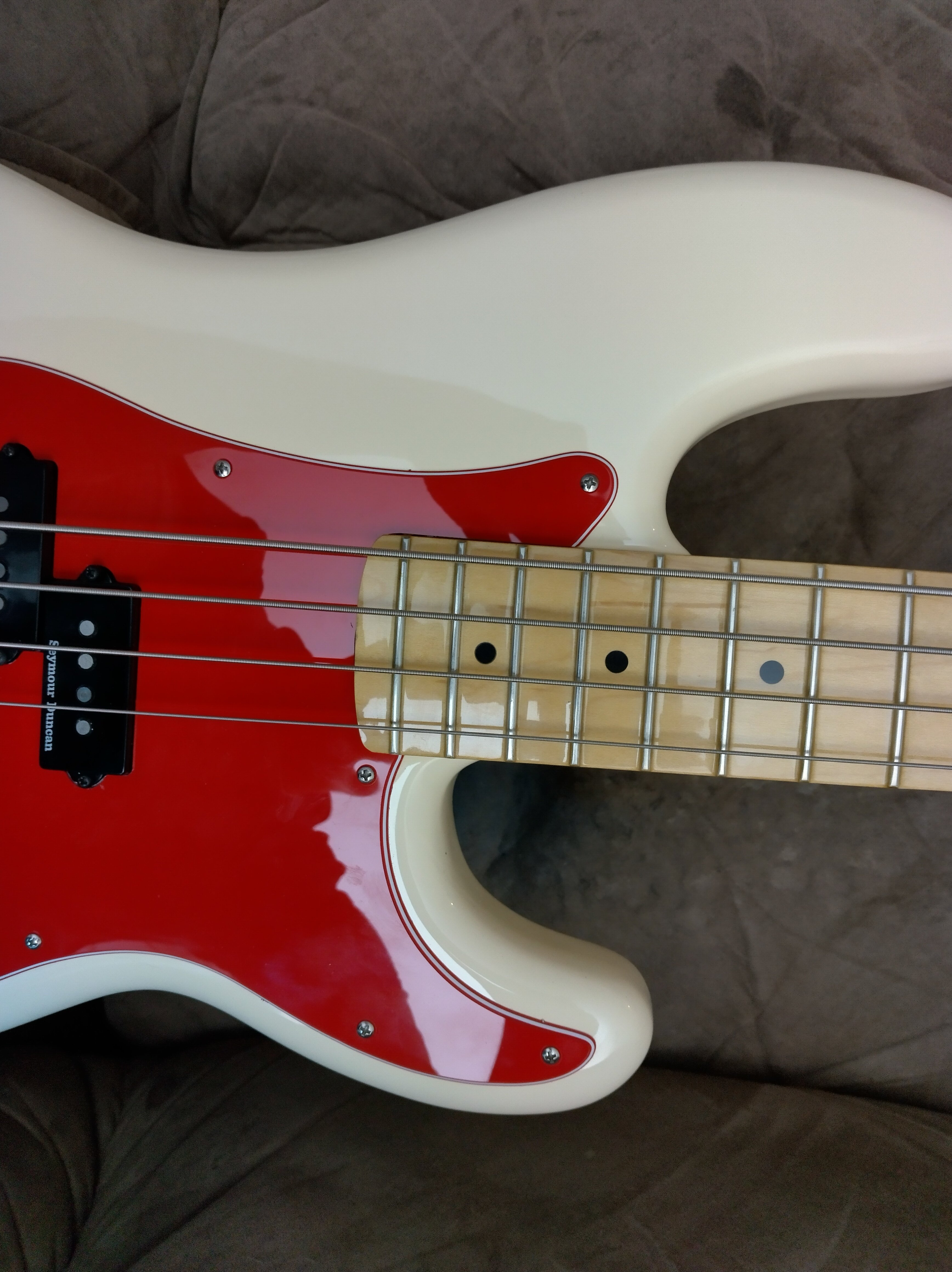
The body was this Fender MIM body with mickey mouse neck pocket: Invalid Link Removed
The neck was this Fender MIM tele neck: Invalid Link Removed
1. Yes, it “fits” without modification in that I could have screwed the body to the neck without modification. However, as you’ll see, it left an ugly gap that I did not like.
2. No, the finished product does not have intonation issues at all. For some reason, a lot of people seem to think it will throw off the string lengths. The length of the bridge adjustment screws more than makes up for the .07” that this might have moved
3. The fit would have been perfect if I had used a standard bridge. Because I used a hi-mass bridge, I needed to shim, but this isn’t because of the neck pocket combo at all (I’m not sure why someone might assume this situation might need a shim, but a friend asked me the other day so I figured I’d include it).
4. What about non-mickey body routes? To be fair, I haven’t tried it. It wouldn’t be too much different aside from trying to get the curve right, but that’s mostly what you’re doing with the pickguard. I just can’t speak to experience on that.
A lot of people have the idea that a flat neck with completely fit a mickey mouse route because of the wider corners. However, that’s not exactly the case. The neck can’t get far enough back because the neck corners won’t completely seat against the body. Plus, the pickguard clearly doesn't cover. You'll end up with a gap something like this.
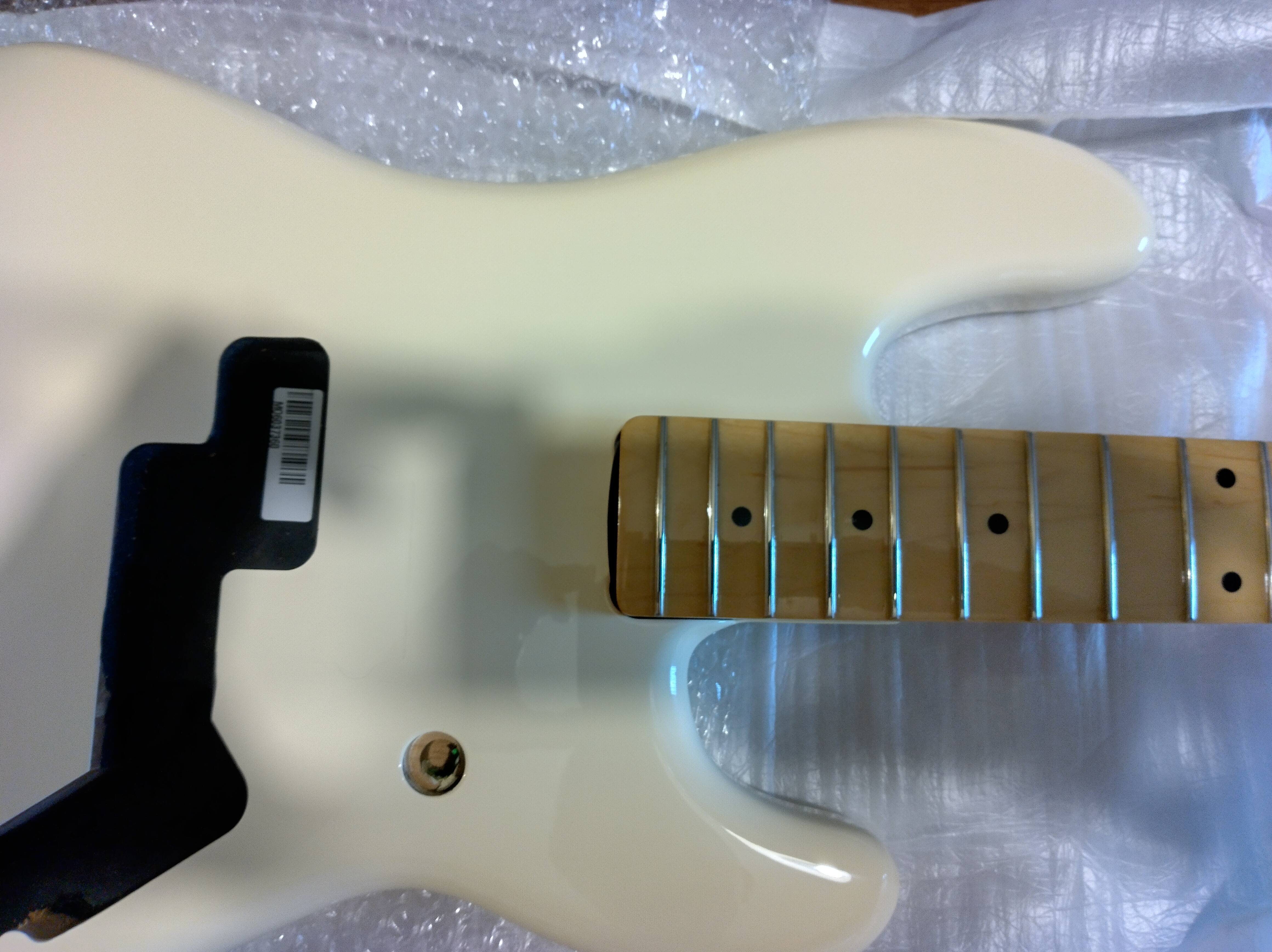

Now, I’m not really a big “tone is in the wood joints” proponent in general, but if nothing else, it looks sloppy and disjointed, so I didn’t like the idea of leaving it like this. Of course, the options are to square the body and guard, or to round the neck. In my estimation, rounding the neck was easier and more likely to leave a quality look.
To get the curve, I used some playdough (ordinarily I’d use a big blob of silly putty, but I couldn’t find it) to make a print of the body-- Sorry I didn't get a picture of this step but I wasn't specifically planning to post this. Then I laid it on the neck to trace my lines. I knew they didn’t have to be perfect, and that I could sand to fit once I was close. These were more so that I had a visual guide to get approximate. My original plan was to trace the pickguard neck slot to get the curve, but I couldn’t get a line I felt comfortable with. (black line, not the red line- close but still needs a little more). Be sure to sand flat to get the entire neck, not just the top or bottom of the heel.
It took maybe about 30-45 minutes of sanding with 80, then 120 grit to get the shape where it needed to be. I thought about a Dremel with the sanding drum, but I didn’t want to get too aggressive. It’s not too big an issue to do by hand, so I recommend that. Periodically, I’d lay it into the body to make sure it cleared the pocket corners, then laid the pickguard to see how the curve looked on the guard.
After it was in shape, I taped it off and sprayed it with a few coats of polyurethane to match the original neck finish. I highly recommend doing this step. Without it, the unfinished wood really shows against the gloss finish. In the picture it looks a little discolored because of the flash, but in normal use it blends really well.
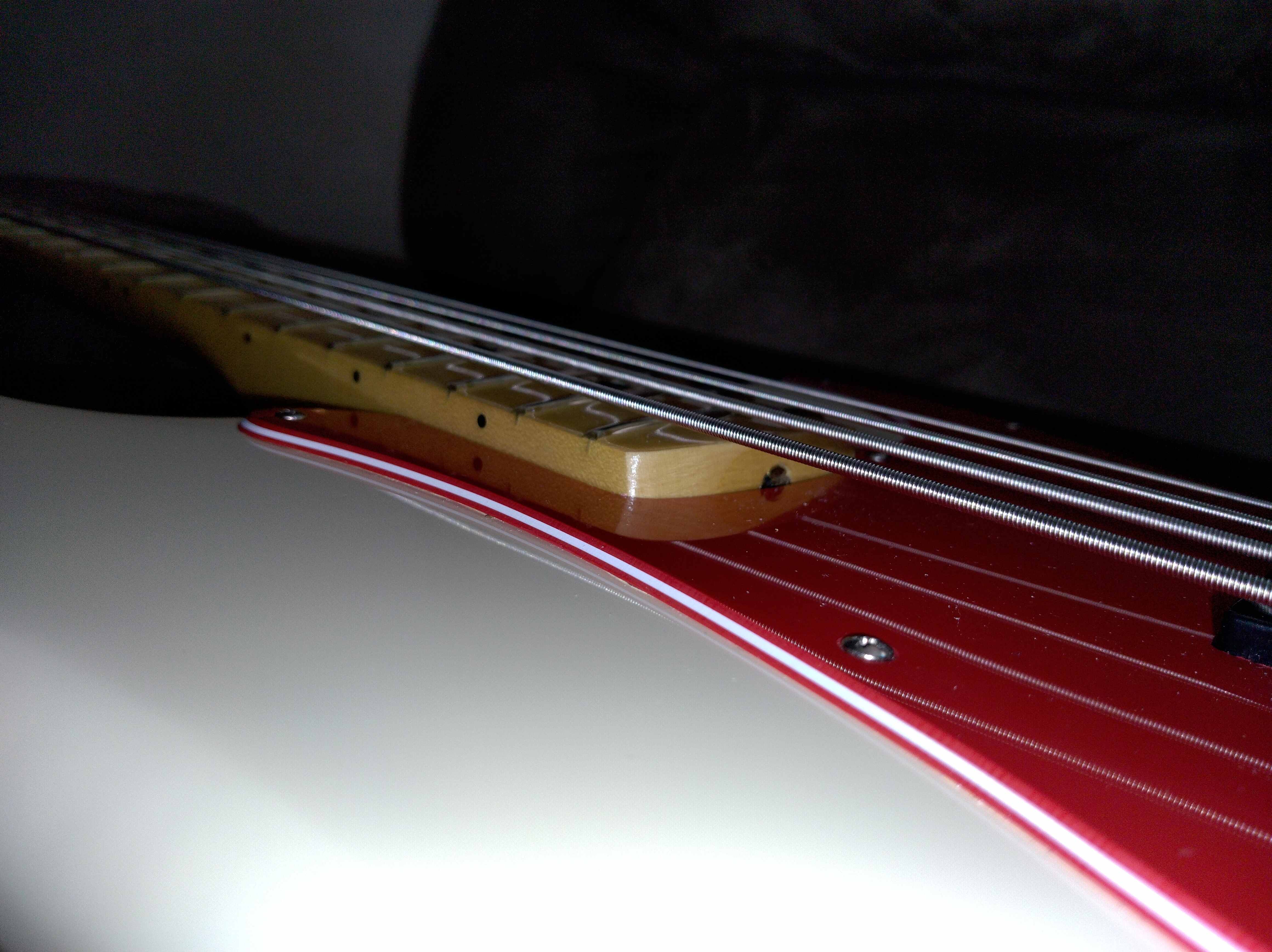
That’s all. I know a lot of people are looking to swap in tele necks on their basses, and I hope this shows you that in general it’s a pretty easy conversion. Don’t let the fact that it’s not a direct drop in fit deter you from making that switch if you want it.
The body was this Fender MIM body with mickey mouse neck pocket: Invalid Link Removed
The neck was this Fender MIM tele neck: Invalid Link Removed
1. Yes, it “fits” without modification in that I could have screwed the body to the neck without modification. However, as you’ll see, it left an ugly gap that I did not like.
2. No, the finished product does not have intonation issues at all. For some reason, a lot of people seem to think it will throw off the string lengths. The length of the bridge adjustment screws more than makes up for the .07” that this might have moved
3. The fit would have been perfect if I had used a standard bridge. Because I used a hi-mass bridge, I needed to shim, but this isn’t because of the neck pocket combo at all (I’m not sure why someone might assume this situation might need a shim, but a friend asked me the other day so I figured I’d include it).
4. What about non-mickey body routes? To be fair, I haven’t tried it. It wouldn’t be too much different aside from trying to get the curve right, but that’s mostly what you’re doing with the pickguard. I just can’t speak to experience on that.
A lot of people have the idea that a flat neck with completely fit a mickey mouse route because of the wider corners. However, that’s not exactly the case. The neck can’t get far enough back because the neck corners won’t completely seat against the body. Plus, the pickguard clearly doesn't cover. You'll end up with a gap something like this.
Now, I’m not really a big “tone is in the wood joints” proponent in general, but if nothing else, it looks sloppy and disjointed, so I didn’t like the idea of leaving it like this. Of course, the options are to square the body and guard, or to round the neck. In my estimation, rounding the neck was easier and more likely to leave a quality look.
To get the curve, I used some playdough (ordinarily I’d use a big blob of silly putty, but I couldn’t find it) to make a print of the body-- Sorry I didn't get a picture of this step but I wasn't specifically planning to post this. Then I laid it on the neck to trace my lines. I knew they didn’t have to be perfect, and that I could sand to fit once I was close. These were more so that I had a visual guide to get approximate. My original plan was to trace the pickguard neck slot to get the curve, but I couldn’t get a line I felt comfortable with. (black line, not the red line- close but still needs a little more). Be sure to sand flat to get the entire neck, not just the top or bottom of the heel.
It took maybe about 30-45 minutes of sanding with 80, then 120 grit to get the shape where it needed to be. I thought about a Dremel with the sanding drum, but I didn’t want to get too aggressive. It’s not too big an issue to do by hand, so I recommend that. Periodically, I’d lay it into the body to make sure it cleared the pocket corners, then laid the pickguard to see how the curve looked on the guard.
After it was in shape, I taped it off and sprayed it with a few coats of polyurethane to match the original neck finish. I highly recommend doing this step. Without it, the unfinished wood really shows against the gloss finish. In the picture it looks a little discolored because of the flash, but in normal use it blends really well.
That’s all. I know a lot of people are looking to swap in tele necks on their basses, and I hope this shows you that in general it’s a pretty easy conversion. Don’t let the fact that it’s not a direct drop in fit deter you from making that switch if you want it.
Last edited: