lethargytartar:
take it to a pro.
Yah. I'd still rather fix it myself if it doesn't require special tools. I'm pretty handy and reasonably intelligent and figure if I can get my head around what's going on I might be able to do it myself.
I figure I'll get more enjoyment out of a bass I've worked on myself, but I hope I'm smart enough to know when I'm out of my league as well... hence the OP.
lethargytartar:
first, I'm not sure that cylinder of darker wood has any structural relation to the truss system. Figure, the neck is maple, and the truss has to bow that whole piece of maple, so it's braced against the wood of that piece itself -- take a look at pics (there must be hundreds here) of people building a neck with a truss, and you can see how it's braced on either end of the channel in the wood.
I'm not sure either, that's why I asked. It
is obvious that the piece shouldn't be extruding like that, and the only pressure I could think of that would cause such a thing would be from the truss rod pushing it out from the inside.
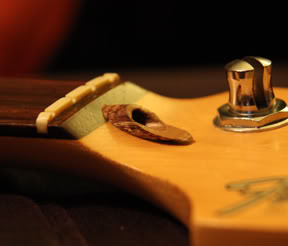
On the heel end, the truss rod is either braced against or screws into a metal disk. Here's a picture:
lethargytartar:
how do you know you NEED to adjust it? is it really really tight, but you still feel the neck has too much relief? ... Can you give us a measure of the relief when the neck is at full tension (that is, the strings are tuned up)?
When strung, the guitar has far too much relief in the neck - as if the truss rod were providing no tension at all against the strings. I didn't measure relief before destringing and disassembly, but it was about half an inch at the eighth fret. Far too much to be playable even on the first three frets.
The truss rod adjustment nut offers some resistance to turning - about what I expect from a functioning one: not loose, not a strain, but a fair amount of resistance. I can hear a subtle squeak as of metal against wood as it turns. It offers the same amount of resistance in both directions. I can see the rod turning inside the pocket shown in the photo above as the adjustment screw is manipulated.
Turning provided no relief (pun fully intended). I suspect the guitar has spent a long time in this condition. Here is a photo down the neck, unstrung. As you can see, there is still a fair amount of relief.
lethargytartar:
Does it turn the exact same in either direction, but never comes off and never tightens -- then it's probably fully stripped.
That would truly be major blowage. Twenty-two fret P-bass necks aren't that common.
Thanks for the reply, BTW. I appreciate the support.