OK, I have managed to install the Pyramid strings on my GS mini. It was very interesting. I have attached some pics.
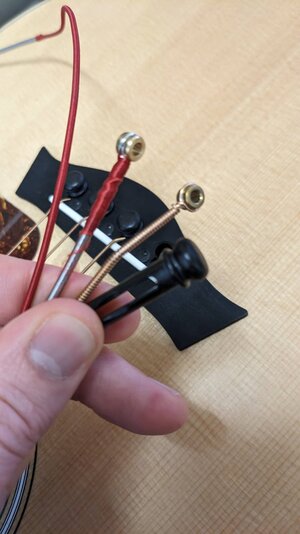
So I started with the E string since it was obviously going to be the biggest challenge, and sure enough, the larger diameter and the silk winding made it a fair amount too large to fit in the slotted bridge pins, see pics 1 and 2. I was pretty keen not to have to modify the pins, since I haven't even found a source for them in the UK and I anyway wasn't keen on getting a second set at Taylor prices just to try these strings, so at this point I stopped and emailed the issue to Pyramid - they advertise the strings as fitting this bass so how? I got a response from Max Junger of Pyramid literally 4 minutes later:
thank you for your notes and message. Sorry to hear that the low E is to “fat” to be fixed.
Please try to cut a little off the silk – if it is not working, we will make you a new one as free replacement.
Best regards
PYRAMID STRINGS
Max Junger
Von:
Gesendet: Mittwoch, 6. November 2024 12:02
An: [email protected]
Betreff: Taylor mini bass and flatwound strings question
Hi,
I have purchased a set of your strings for my Taylor GS Mini Bass, the special Chrome-Nickel Flat Wire Wound set for 23.5” scale length. When I attempt to install them, I find that the red silk windings on the bridge end of especially the E string are too thick to fit in the Taylor’s special split bridge pin. Do you have any advice on how to install the strings? For example, can I remove some or all of the silk winding for a better fit? Or will this cause the chrome nickel windings to unravel?
Some great service! So I unwound some of the silk, see pic 3, but it was soon fairly obvious that there are actually slightly protruding end of the nickel winding wire under the silk that are actually the problem. So I took another tack, and got a pair of pliers and firmly squeezed the end of the string, with the ball end in the right orientation (I squeezed in a direction across the diameter of the end rather than along its length, hope that makes sense). This seemed to flatten the end slightly and I was able to get the pin to seat in and just about pull the string through until I could feel that the ball end was snug against the underside of the bridge. Actually it helped to reach through the sound hole and push on the end at the same time as pulling. The pin sits fairly high, see pic 5, but this is no more than an aesthetic issue, there's definitely no chance of the pin coming out, and it's mostly because the diameter of the string pushes it up rather than the string not fully seated in place.
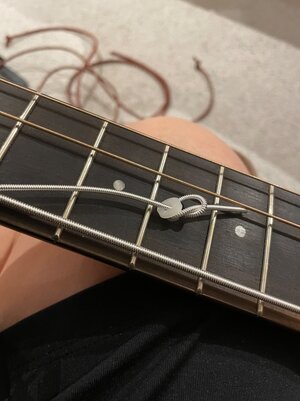
The rest of the strings were no issue at all to fit. But I wasn't that happy to see the difference in the length of the silk wrapping at the bridge end, see pic 4. I even unwound a bit of silk from the A string, it was even longer than you see in the pic. However, the other end looks really nice.
I attached a before and after sound clip that is just acoustic with no amp, sorry for the terrible playing. To be honest, while I am very happy with the flatwound sound, I'm not that happy with the very different intonation of the different strings. The E string is very dead, while the G string is so shrill that it's almost like it's roundwound. Does anyone have any idea what to try to fix this? I first thought it might be the silk at the bridge end extending over the bridge, but the G string has silk but is by far the most shrill while the E string has no silk but is by far the deadest. I'm wondering if it's maybe because the slots in the nut are now a little too small for the new strings so they sit up a little out of them? I have a friend who is a somewhat accomplished amateur luthier, so I'll probably have him look at it.
So the upshot is that while it is very hard to fit the Pyramid strings, it is possible without modifying the bridge pins at all.