
Enjoy the benefits of a premium membership!
Upgrade Account
-
TalkBass has been independent since 1998. Add your voice.
Create a free account to reply to discussions, view embedded media, and browse with fewer display ads.
Join free Log in
Want zero display ads or expanded classifieds tools? Compare plans.
You are using an out of date browser. It may not display this or other websites correctly.
You should upgrade or use an alternative browser.
You should upgrade or use an alternative browser.
floating thumb techniqe
- Thread starter Torvus
- Start date
More options
Who Replied?

When I'm playing my lowest string the E my plucking hand thumb is poised just above the string to be ready to mute and move (along w/my entire plucking hand) to mute. Todd Johnson calls it the "moving mechanism" for this reason. My point is at no point does my thumb or any part of my plucking hand touch the bass body. Just the strings..... until you get to the lowest string.


Then you either float unanchored or use the surface of the bass..... until you get to the lowest string.
Respectfully what your describing is not proper floating thumb. Which isn't to say its "wrong" per say..just not what has been atributed as "floating thumb. Not that I'm some arbiter of what is correct or incorrect. I'm merely conveying the technique as I learned it from Todd Johnson.I have used the E-string sometimes as a rest, and if I do the thumb is always in contact with the body. I don't use this particular technique. I tend to whack the strings pretty hard.
I didn't check to see if these vids are posted...but here they are.
Last edited:
Hey everyone,
I've been using the floating thumb technique for a while and I find it vastly superior to anchoring. The thumb glides up and down effortlessly on the strings, muting them and making the plucking action consistent regardless of the string that's being played.
That said, one can't help but notice that the vast majority of the best bass players in the world anchor their thumb to the strings and pickups. This even led me to try to use the anchoring technique again, but my performance declined greatly when I did so.
Anyway, I have two questions :
- Why don't we see more renowned players using the floating thumb ? Is it just because anchoring is part of a long tradition and culture in bass playing or does it have real advantages that I'm not aware of ?
- Do you have examples of high level bassists using the floating thumb ? Gospel bassist Alan "Snoop" Evans is a great one :
I've been using the floating thumb technique for a while and I find it vastly superior to anchoring. The thumb glides up and down effortlessly on the strings, muting them and making the plucking action consistent regardless of the string that's being played.
That said, one can't help but notice that the vast majority of the best bass players in the world anchor their thumb to the strings and pickups. This even led me to try to use the anchoring technique again, but my performance declined greatly when I did so.
Anyway, I have two questions :
- Why don't we see more renowned players using the floating thumb ? Is it just because anchoring is part of a long tradition and culture in bass playing or does it have real advantages that I'm not aware of ?
- Do you have examples of high level bassists using the floating thumb ? Gospel bassist Alan "Snoop" Evans is a great one :
In the Gary Willis vid above he states that it's better to have the bass in a "classical guitarist"position.
This is what I use.
But even with this position it's still easy to drop the elbow.
You really have to make an effort to keep the elbow up.
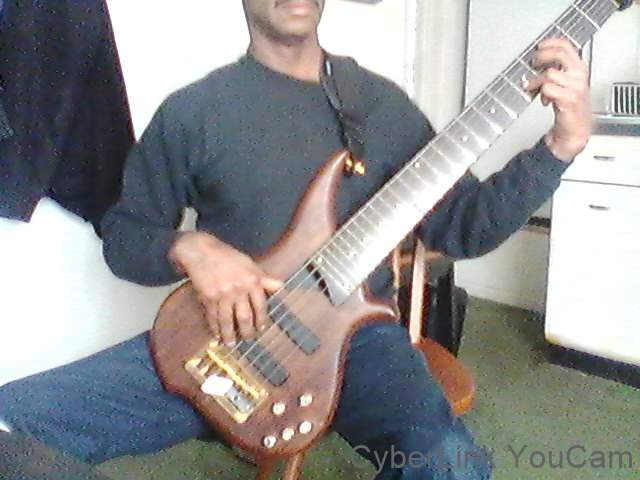
This is what I use.
But even with this position it's still easy to drop the elbow.
You really have to make an effort to keep the elbow up.
TLDR warning.
I too have noticed that the overwhelming majority of bassists I see are using some manner of anchoring technique. Why this is? It could be for the very reason you say you went back to it briefly after having implemented floating thumb...conformity. Its in our nature to want to fit in. I was trying out a bass at a big box guitar store (that was my first mistake) and had a guy tell me I should work on my technique. No joke. Now if I had been less experienced or a bit more naive. Lacking the will to know that the technique I have studied and implemented has tremendous advantages. I might have given up and done what he would have no doubt suggested (anchor). As it was I sort of chucked and said "i'm good" and proceeded to play some Peter Hook lines and moved on.
Non Conformity for the sake of it is silly. We have to think for ourselves and look at what the group is doing and ask ourselves as objective as possible...is this the correct way? If so then join the crowd.
In the case of (a rather decidedly specific subject no doubt) Bass Guitar plucking hand technique. Floating thumb just makes sense...objectively.
I do not. I would say this informs my conformity theory above.
Hey everyone,
- Why don't we see more renowned players using the floating thumb ? Is it just because anchoring is part of a long tradition and culture in bass playing or does it have real advantages that I'm not aware of ?
I too have noticed that the overwhelming majority of bassists I see are using some manner of anchoring technique. Why this is? It could be for the very reason you say you went back to it briefly after having implemented floating thumb...conformity. Its in our nature to want to fit in. I was trying out a bass at a big box guitar store (that was my first mistake) and had a guy tell me I should work on my technique. No joke. Now if I had been less experienced or a bit more naive. Lacking the will to know that the technique I have studied and implemented has tremendous advantages. I might have given up and done what he would have no doubt suggested (anchor). As it was I sort of chucked and said "i'm good" and proceeded to play some Peter Hook lines and moved on.
Non Conformity for the sake of it is silly. We have to think for ourselves and look at what the group is doing and ask ourselves as objective as possible...is this the correct way? If so then join the crowd.
In the case of (a rather decidedly specific subject no doubt) Bass Guitar plucking hand technique. Floating thumb just makes sense...objectively.
- Do you have examples of high level bassists using the floating thumb ? Gospel bassist Alan "Snoop" Evans is a great one :
I do not. I would say this informs my conformity theory above.
Last edited:
I think that conformism is indeed an important factor. Especially when you're starting out, one of the common (and best IMO) reflexes is to imitate the players that you admire. But conformism alone cannot explain the fact that 99% of players use anchoring, because many people -especially artists- are not interested in conformity (it's often quite the opposite actually, the tendency is to fight conformity to create something new and unique). Music and innovation go hand in hand, and you see many people experimenting with all sorts of new sounds and techniques... That makes the relative staticity of right hand technique all the more puzzling.

- Do you have examples of high level bassists using the floating thumb ?
Steve Harris of Iron Maiden:

- Why don't we see more renowned players using the floating thumb ? Is it just because anchoring is part of a long tradition and culture in bass playing or does it have real advantages that I'm not aware of ?
Good question. I think because the technique is relatively new. Although the Gary Willis video must be 20 years old now already.
Second reason is that it is mainly used for fusion type light playing. It’s easier to dig in with regular technique. A lot of player like that type of playing. Also it is based more on linear playing.
Also in classical guitar playing they don’t use FT. Right hand bass technique resembles that technique pretty much.
But I more players getting into it lately.
In the Gary Willis vid above he states that it's better to have the bass in a "classical guitarist"position.
This is what I use.
But even with this position it's still easy to drop the elbow.
You really have to make an effort to keep the elbow up.
View attachment 3791573
Thanks. I studied classical guitar for a long time and use this posture when I play classical guitar. I like it. But it doesn’t feel comfortable to me with bass because of the thin body. There is an imbalance because of that and it feels like the bass body (and neck) is to close to me. It doesn’t feel as natural as on guitar even if I use a foot stool. Any tips on how to keep the bass more balanced in this position?
Use a short strap.Thanks. I studied classical guitar for a long time and use this posture when I play classical guitar. I like it. But it doesn’t feel comfortable to me with bass because of the thin body. There is an imbalance because of that and it feels like the bass body (and neck) is to close to me. It doesn’t feel as natural as on guitar even if I use a foot stool. Any tips on how to keep the bass more balanced in this position?
If you don't already.
Use a short strap.
If you don't already.
Thanks for the picture. I always practice strapless though. I just check it again with and without strap.
The problem isn't the body but it is the neck. When playing strapless and holding the upper horn against my body (like you do) I feel the neck is too close for my left hand, causing G string side of the neck is coming up so to speak. It also feels like my arm is too close to the body in the higher range of the bass. What is do therefore is placing the upper horn 10 cm or so away from my body. This feels better but it makes the position of the bass a bit more unstable because I only holding it with my underarm on the body.
Also checked it with strap but that's the same. Hope this makes sense?
Gary Willis is resting his bass on his right leg when seated and having the bass pointed upwards. That also feels weird for me.
Gary Willis | ARTISTS | Ibanez guitars
Last edited:
Hi With me I play a short scale bronco bass with tapewound flatts.I have short fat fingers,carple tunnel in my left hand and a torn right shoulder.For me its about comfort.The neck is well ballanced and easy for me to traverse.I play sitting with the body between my legs.with a strap so i can move the body out to fit my arms comfort zone.I move from position to position.and slide up and down to where I need to be.Instead of having my left hand in some ungodly cramping position trying to stay there.I find this traveling,floating thumb method to be the best for me.Its very smooth and fun once you get the hang of it. It goes against most technique taught to new players but works well for me.Floating thumb and jumping positions.Not recomended but great for the handycapped.

Why don't we see more renowned players using the floating thumb ? Is it just because anchoring is part of a long tradition and culture in bass playing or does it have real advantages that I'm not aware of ?
Floating thumb and anchored thumb are just ways of playing a bass. If you use either, that's fine.
Floating thumb is a technique that isn't in more general use because it isn't significantly better or more effective than anchored thumb, which most players use because that's what most players see being used.
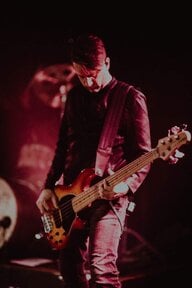
Just bumping this to further praise the floating thumb technique. I used to anchor on the pickup and mute the low strings with my pinky and ring fingers, but once I switched from 4 to 5 strings, that was no longer an option.
I tried movable anchor, which seemed to be the most common approach, but I could never get it fluent. It just took too much brain power, and it felt slow and clunky.
I heard about floating thumb technique, but after a very quick attempt, I didn't feel it was for me. I was so used to having an anchor point, so just letting my hand "hang" like that was very uncomfortable.
But after a few weeks, I started noticing that my thumb was starting to naturally float when I played certain phrases, so I worked on it for a little while. And I really mean a *little* while - I think it took less than a week to really start getting comfortable with it and figure out how best to change my wrist approach. Once that initial period was over, I just let it develop pretty much naturally, and after 3-4 months I don't even think about it at all.
I'm sure results vary from person to person, but I was really surprised at how easy it was to adapt this technique.
Rundown of my personal approach to floating thumb:
The trick with my wrist was to move away from resting it on top of the bass and push my elbow out a bit further, while still keeping my shoulder in a relaxed position. My wrist is still touching the forearm carve, but it's not resting there. This allows me to freely "slide" my forearm and wrist over the top of the bass in order to move my hand up and down across the strings. If you look at my right wrist as I jump between strings, you can see that it's not just hanging there.
When standing up, the technique doesn't change much. My wrist and forarm are a bit more vertical, but I still let them loosely touch the forearm contour of the bass and let my wrist slide freely across it. This really lets me keep in touch with the bass, instead of trying to let my arm not touch the bass at all.
Bonus tip: The wristband really helps with reducing friction too, especially on glossy finishes. Whether or not it's a good look is probably debatable, but in my rock band context it works visually as well.
Disclaimer: I'm not an expert, or a professional or even a really experienced player. These tips are just what worked for me in adapting this technique. They may not work for you.
I tried movable anchor, which seemed to be the most common approach, but I could never get it fluent. It just took too much brain power, and it felt slow and clunky.
I heard about floating thumb technique, but after a very quick attempt, I didn't feel it was for me. I was so used to having an anchor point, so just letting my hand "hang" like that was very uncomfortable.
But after a few weeks, I started noticing that my thumb was starting to naturally float when I played certain phrases, so I worked on it for a little while. And I really mean a *little* while - I think it took less than a week to really start getting comfortable with it and figure out how best to change my wrist approach. Once that initial period was over, I just let it develop pretty much naturally, and after 3-4 months I don't even think about it at all.
I'm sure results vary from person to person, but I was really surprised at how easy it was to adapt this technique.
Rundown of my personal approach to floating thumb:
The trick with my wrist was to move away from resting it on top of the bass and push my elbow out a bit further, while still keeping my shoulder in a relaxed position. My wrist is still touching the forearm carve, but it's not resting there. This allows me to freely "slide" my forearm and wrist over the top of the bass in order to move my hand up and down across the strings. If you look at my right wrist as I jump between strings, you can see that it's not just hanging there.
When standing up, the technique doesn't change much. My wrist and forarm are a bit more vertical, but I still let them loosely touch the forearm contour of the bass and let my wrist slide freely across it. This really lets me keep in touch with the bass, instead of trying to let my arm not touch the bass at all.
Bonus tip: The wristband really helps with reducing friction too, especially on glossy finishes. Whether or not it's a good look is probably debatable, but in my rock band context it works visually as well.
Disclaimer: I'm not an expert, or a professional or even a really experienced player. These tips are just what worked for me in adapting this technique. They may not work for you.
Just bumping this to further praise the floating thumb technique. I used to anchor on the pickup and mute the low strings with my pinky and ring fingers, but once I switched from 4 to 5 strings, that was no longer an option.
I tried movable anchor, which seemed to be the most common approach, but I could never get it fluent. It just took too much brain power, and it felt slow and clunky.
I heard about floating thumb technique, but after a very quick attempt, I didn't feel it was for me. I was so used to having an anchor point, so just letting my hand "hang" like that was very uncomfortable.
But after a few weeks, I started noticing that my thumb was starting to naturally float when I played certain phrases, so I worked on it for a little while. And I really mean a *little* while - I think it took less than a week to really start getting comfortable with it and figure out how best to change my wrist approach. Once that initial period was over, I just let it develop pretty much naturally, and after 3-4 months I don't even think about it at all.
I'm sure results vary from person to person, but I was really surprised at how easy it was to adapt this technique.
Rundown of my personal approach to floating thumb:
The trick with my wrist was to move away from resting it on top of the bass and push my elbow out a bit further, while still keeping my shoulder in a relaxed position. My wrist is still touching the forearm carve, but it's not resting there. This allows me to freely "slide" my forearm and wrist over the top of the bass in order to move my hand up and down across the strings. If you look at my right wrist as I jump between strings, you can see that it's not just hanging there.
When standing up, the technique doesn't change much. My wrist and forarm are a bit more vertical, but I still let them loosely touch the forearm contour of the bass and let my wrist slide freely across it. This really lets me keep in touch with the bass, instead of trying to let my arm not touch the bass at all.
Bonus tip: The wristband really helps with reducing friction too, especially on glossy finishes. Whether or not it's a good look is probably debatable, but in my rock band context it works visually as well.
Disclaimer: I'm not an expert, or a professional or even a really experienced player. These tips are just what worked for me in adapting this technique. They may not work for you.
Great post. Looks comfortable. Maybe something you can try is when going to the B string that your thumb is not resting on the pick up but stays floating. Especially when doing scale runs. If you stay longer on the B string you can rest on the pickup.
Just something to try and see if it works for you or not. There are no rules in this.
Great post. Looks comfortable. Maybe something you can try is when going to the B string that your thumb is not resting on the pick up but stays floating. Especially when doing scale runs. If you stay longer on the B string you can rest on the pickup.
Just something to try and see if it works for you or not. There are no rules in this.
Yeah, I did that before, but it's just gravitated to that position naturally; it wasn't a conscious choice.
I think it's because it gives me abit of a sense of where I am, whereas if I leave it completely floating it feels a bit disconnected.


