Depends on the Tea my friend!Tea is not generally considered very intoxicating, even in Britain.

Enjoy the benefits of a premium membership!
Upgrade Account
-
TalkBass has been independent since 1998. Add your voice.
Create a free account to reply to discussions, view embedded media, and browse with fewer display ads.
Join free Log in
Want zero display ads or expanded classifieds tools? Compare plans.
You are using an out of date browser. It may not display this or other websites correctly.
You should upgrade or use an alternative browser.
You should upgrade or use an alternative browser.
Floating thumb
- Thread starter -Asdfgh-
- Start date
More options
Who Replied?

It was a very conscious decision for me after decades of only playing fours. I always anchored on the pickup. When I got my first 6-string (definitely didn't buy it at the five and dime), the ringing B-string was driving me insane. When you're used to resting all that arm weight, it was initially difficult to pull back. But it only took a few days to get used to it. Now, I will often use floating thumb even when playing fours because it makes muting so much easier.


I also picked it up mostly by osmosis, but it was driven by tendinitis, specifically “tennis elbow” in my plucking arm.
Stretching to pluck the D and G strings from the anchor just became too painful, and my body just adapted with no conscious process involved.
It evolved into moveable anchor, and then floating thumb fairly seamlessly.
Stretching to pluck the D and G strings from the anchor just became too painful, and my body just adapted with no conscious process involved.
It evolved into moveable anchor, and then floating thumb fairly seamlessly.

I don't think what you're describing is properly described as the "floating thumb" (FT). FT refers to a specific technique in which your thumb lays across ("floats on," like a boat on water) the strings below the one that you're plucking in order to mute them. As your plucking moves across strings your thumb simply follows. It has nothing to do with "floating" your thumb in the air.Floating thumb.
For me, I rest my thumb on the E string but when I note on the E, I float off of it. I do this automatically and don't think about it.
That said, if you're using FT you have to decide what to do with your thumb when plucking your lowest string, since there are no strings below that to "float" on. In this case, some players rest the thumb against a pickup or the pickguard; others don't anchor it anywhere and (like you) let it "float" in the air. (Personally, I tend to do the latter if I'm only playing a couple/few notes on the lowest string, but sometimes rest it gently against the pickguard if I'm going to be there awhile.)

I started using FT when I was playing a Ibanez ATK305. It had no thumb anchor so FT was my only option without having an anchor made and I thought it would ruin the look of the bass. I now use Ft when playing any of my basses, even those with a good thumb anchor.
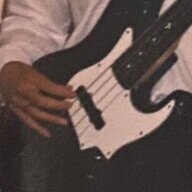
I got into the FT style because I prefer playing behind the neck pickup most of the time. So you have to rest your thumb on the E string, and depending on the phrase it's natural to rest on the A string when playing on G and D strings.
I made a conscious adjustment recently to make sure the back of my thumb touches the E string to damp it when I have the thumb on the A. Otherwise it can ring.
When playing over the bridge pickup I mostly anchor on the pickup because I like to play a bit more aggressively in that position cos the strings are harder to move near the bridge.
I reckon a lot of this happens naturally. I have no idea how some parts of my muting and plucking technique evolved. Sometimes I have to look at my hands to work out what they're doing.
I made a conscious adjustment recently to make sure the back of my thumb touches the E string to damp it when I have the thumb on the A. Otherwise it can ring.
When playing over the bridge pickup I mostly anchor on the pickup because I like to play a bit more aggressively in that position cos the strings are harder to move near the bridge.
I reckon a lot of this happens naturally. I have no idea how some parts of my muting and plucking technique evolved. Sometimes I have to look at my hands to work out what they're doing.

I have no idea how some parts of my muting and plucking technique evolved. Sometimes I have to look at my hands to work out what they're doing.
I wish I could "like" this post a zillion times.
My feelings/thoughts/experiences exactly, worded better than I could ever do it myself. Thank you.
Too kind! It's funny to think that muting should be such a hot topic on a music forumI wish I could "like" this post a zillion times.
My feelings/thoughts/experiences exactly, worded better than I could ever do it myself. Thank you.


This does sound more like the moving anchor than true floating thumb. TBH, in many ways I'm past caring about distinctions and differences - they are all valuable elements of the technical 'lexicon'. On the other hand, for people learning, the distinctions are useful because, IME/IMHO, it helps to learn things atomically and in isolation, not confounded with other things. Of course instinct kicks in with experience and eventually all techniques become subsumed. I just wish I'd known back then what I know now...I got into the FT style because I prefer playing behind the neck pickup most of the time. So you have to rest your thumb on the E string, and depending on the phrase it's natural to rest on the A string when playing on G and D strings.
I made a conscious adjustment recently to make sure the back of my thumb touches the E string to damp it when I have the thumb on the A. Otherwise it can ring.
...
I just wish I'd known back then what I know now...
Yuh. As Steve Jobs said, life has to be lived forwards but you can only join the dots looking back.
The great thing about sites (and threads) like this is they create opportunities to 'put a bit back' and hopefully help others to 'join the dots' earlier and more effectivelyYuh. As Steve Jobs said, life has to be lived forwards but you can only join the dots looking back.

“This is space coke. You never tasted this before. Hey man try this. It’ll blow your head off”

Oh. Is the FT when it doesn't touch at all? Sometimes I do that too. I guess I try to keep a light anchor. But I like a positive "click" in my attack and having a stable hand helps that.This does sound more like the moving anchor than true floating thumb. TBH, in many ways I'm past caring about distinctions and differences - they are all valuable elements of the technical 'lexicon'. On the other hand, for people learning, the distinctions are useful because, IME/IMHO, it helps to learn things atomically and in isolation, not confounded with other things. Of course instinct kicks in with experience and eventually all techniques become subsumed. I just wish I'd known back then what I know now...
Is the FT when it doesn't touch at all?
No. The thumb is laying across the strings all the time - except when you’re playing the lowest one of course. It’s not floating as in “up in the air”. This makes it pretty clear I think:
Last edited:
I hadn't considered it until it cropped here a few years ago. My initial reaction was "What is the fuss about? Isn't it a comnon thing? I've been playing that way for years." But like you I couldn't recall making a conscious decision. Then I found a picture from 1990 which clearly showed me 'floating'! Funny how the small changes through natural development and progress often go unnoticed.
Maybe it's moving anchor I am using. I seem to anchor my thumb on the A string, but it's also flat against the E string. Either way, this was not a conscious decision and I spotted by accident with a "WTH is my hand doing" reaction.
I never think about floating thumb. That's just how I was taught to play and now it just happens. Then again, a lot of muting takes place in both hands without a lot of thought put into it. If I had to think about it, I probably couldn't do it anywhere near as well as it happens on its own.


