The difference is audible when you play the bass unplugged. Through the front-of-house? Don't think so.

Enjoy the benefits of a premium membership!
Upgrade Account
-
TalkBass has been independent since 1998. Add your voice.
Create a free account to reply to discussions, view embedded media, and browse with fewer display ads.
Join free Log in
Want zero display ads or expanded classifieds tools? Compare plans.
You are using an out of date browser. It may not display this or other websites correctly.
You should upgrade or use an alternative browser.
You should upgrade or use an alternative browser.
- Status
- Not open for further replies.
More options
Who Replied?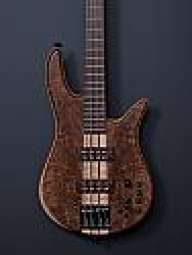
Just Thumpin'
Commercial User
- Mar 7, 2008
- 4,534
- 1,664
- Disclosures
- Manager and Partner, Fodera Guitars (10/14/09 - 12/16/19)
In practical terms you are replacing a roughly 1/4" thick by 3" wide by 10" long piece of whatever top material you have with an equal amount of whatever neck material you have. Compared to all of the other wood choices in the mix, that change alone will have virtually zero tonal impact in relative terms.
Yes, if you had the exact same instrument where the only thing that varied was solid top vs. non-solid top (and EVERYTHING else about them was identical), you likely would hear a difference. But again, for all practical purposes when it comes down to things to think about when spec'ing a new build, the difference should be considered virtually nil IMHO.
Regards,
Jason
Yes, if you had the exact same instrument where the only thing that varied was solid top vs. non-solid top (and EVERYTHING else about them was identical), you likely would hear a difference. But again, for all practical purposes when it comes down to things to think about when spec'ing a new build, the difference should be considered virtually nil IMHO.
Regards,
Jason
For me that's surprising. A solid top adds a thick part of wood between the bridge and the remaining parts - either the through-neck or the body core. Therefore I expected that this has an impact how the string vibrations are transferred into the body and from there resonating back to the strings... like a wooden filter...
Additionally for me the structure and amount of laminates in general has an impact on the sound - not only in the neck. Even the same wood laminated together will sound different against a one-piece.
I know from another well-known US luthier that he is convinced that the top wood - even NON-solid - has more tonal impact than the body wings. Not sure about that, but virtually ZERO impact ? I would be less surprised if there are (very very subtle) differences....
Basically all these differences are below the differences coming from environment, fingers, string sets, etc. So it won't be possible to isolate and generalize them.
As always - I might be wrong ...
Just Thumpin'
Commercial User
- Mar 7, 2008
- 4,534
- 1,664
- Disclosures
- Manager and Partner, Fodera Guitars (10/14/09 - 12/16/19)
Yes, the further away from the neck material that your top material is (in tonal terms), the more the theoretical difference in tone between a solid and non-solid version of the same instrument would be.
That said, in terms of deciding how to spec an instrument and being faced will all of the other, far more important choices that a player is faced with, I still believe that this difference should be viewed as virtually none...
Regards,
J
That said, in terms of deciding how to spec an instrument and being faced will all of the other, far more important choices that a player is faced with, I still believe that this difference should be viewed as virtually none...
Regards,
J
I suspect that, say, a buckeye burl top will have a different effect on tone from, say, a maple top. Those woods have very different physical characteristics and it's hard for me to imagine that their influence on tone isn't at least audible.

One word - tubes. Listening to recordings from last night's duo gig (ultra sparse - bass and percussion). This was the rig I was running
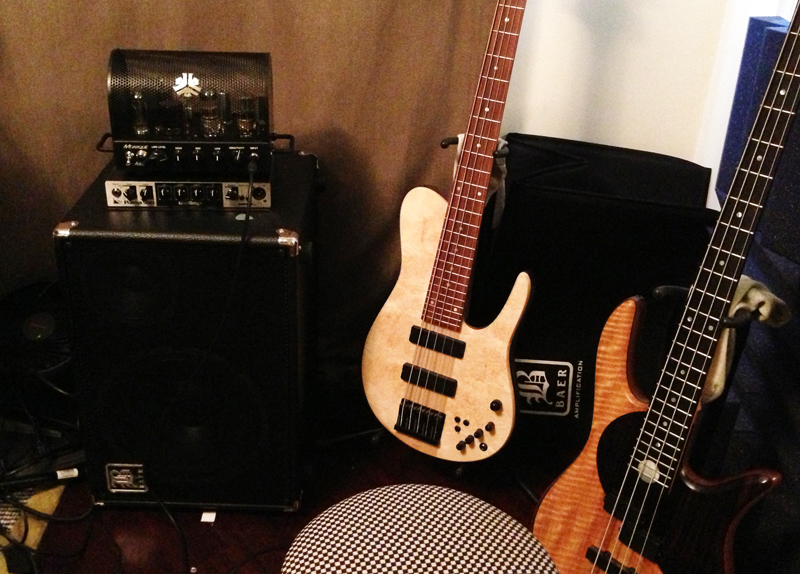
Something about those glowing glass bottles really made both basses sing. Especially the upper registers of the MGS.
Something about those glowing glass bottles really made both basses sing. Especially the upper registers of the MGS.

nostatic said:One word - tubes. Listening to recordings from last night's duo gig (ultra sparse - bass and percussion). This was the rig I was running
Something about those glowing glass bottles really made both basses sing. Especially the upper registers of the MGS.
Looks great
nostatic said:Chambered body. My Yin Yang Deluxe has that (was the first YYD they did that way). The pair of Monarch 5s I have on order will also be chambered. I love the tone. Photo of my YYD:
Would like to see how a chambered MG would look like!

Too bad I got rid of my Ampeg V4B before I got my MGS in.
That was one hell of an amp but really can't deal with the weight...
Every bass I played through it really smoked.
I miss it...
That was one hell of an amp but really can't deal with the weight...
Every bass I played through it really smoked.
I miss it...
One word - tubes. Listening to recordings from last night's duo gig (ultra sparse - bass and percussion). This was the rig I was running
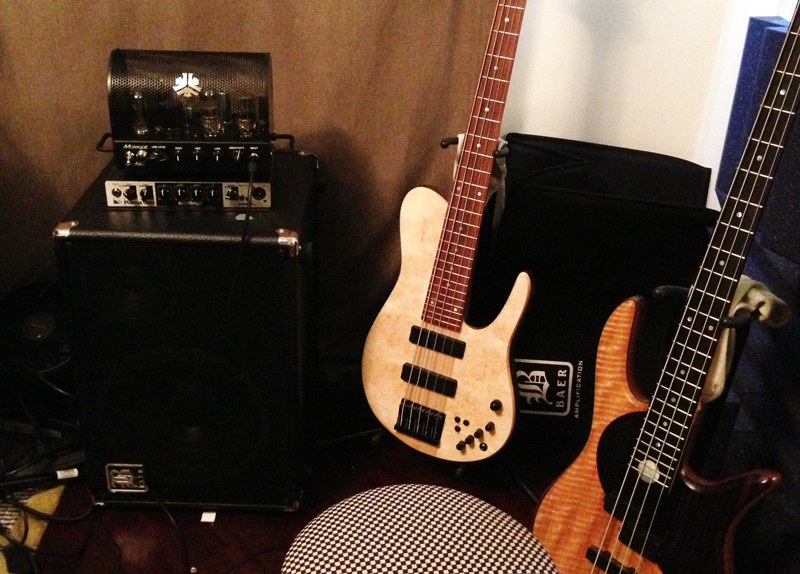
Something about those glowing glass bottles really made both basses sing. Especially the upper registers of the MGS.
The Moniqe is about 10 lbs. point to point hand wired. Running it into the effects return of the Puma. Demeter is making a class d power amp to fit underneath. About as close to "pure tube" you're gonna get in light weight package.
Interesting. How do you like the Monique compared to your Tecamp?
The Moniqe is about 10 lbs. point to point hand wired. Running it into the effects return of the Puma. Demeter is making a class d power amp to fit underneath. About as close to "pure tube" you're gonna get in light weight package.

Yes, I understand, but why should the board have more impact than the top in that terms ? The board is also only a small slab (sometimes a laminate on old Fenders) on top of the mass of the neck, but it holds the frets and has the FIRST task to forward (or absorb) string vibrations to the neck, similar to the bridge with the top ...
It is the exposed position of any TOP and any BOARD that makes the difference ... not the mass at all.
Anyway - you are right - choose whatever you like, I agree that the top - solid or not - will have less impact than worth to notice... ;-)
It is the exposed position of any TOP and any BOARD that makes the difference ... not the mass at all.
Anyway - you are right - choose whatever you like, I agree that the top - solid or not - will have less impact than worth to notice... ;-)
In practical terms you are replacing a roughly 1/4" thick by 3" wide by 10" long piece of whatever top material you have with an equal amount of whatever neck material you have. Compared to all of the other wood choices in the mix, that change alone will have virtually zero tonal impact in relative terms.
Yes, if you had the exact same instrument where the only thing that varied was solid top vs. non-solid top (and EVERYTHING else about them was identical), you likely would hear a difference. But again, for all practical purposes when it comes down to things to think about when spec'ing a new build, the difference should be considered virtually nil IMHO.
Regards,
Jason
Interesting. How do you like the Monique compared to your Tecamp?
The preamps sound pretty different. I run the Monique into the effects return, and it is easy for me to swap the plug to A/B the preamps. The Tecamp has a bit more edge, is a bit more open. The Monique is smoother, though the sensitivity control really changes the way the preamp feels and behaves. You can get an Ampeg edge if you want, though not an overdrive type thing.
When I run them back to back, I find that the Tecamp sounds a little harsh by comparison. But my ears adjust quickly. Going by the recordings I did last night at a gig, that smoother tone carries into the room, at least on the recorder.

- Jan 7, 2008
- 2,196
- 224
- 39
- Disclosures
- Endorsing Artist: Olinto, La Bella, JuleAmps, Epifani
I bought the first Demeter class D amp to go under my Monique. Greatest sound I've ever heard with my fodera imperial!
The importance of the fretboard is clear to me, and it definately affects the tone and response of the bass.
The body top wood is something entirely different.
The question is: Does a maple body with a 1/4" buckeye top sound any different than a solid maple body?
I heard from a well-known luthier that has worked with buckeye burl quite a lot, that the extra layer of buckeye burl has almost zero effect on the tone, because of the unique pattern of bb.
However, he told me that certain woods and wood combinations do make a difference (he uses 3/8" thick top laminates):
mahogany body + maple top (maple brightens up the tone)
ash body + maple top (brightens up the tone and makes the bass sound more "even")
The body top wood is something entirely different.
The question is: Does a maple body with a 1/4" buckeye top sound any different than a solid maple body?
I heard from a well-known luthier that has worked with buckeye burl quite a lot, that the extra layer of buckeye burl has almost zero effect on the tone, because of the unique pattern of bb.
However, he told me that certain woods and wood combinations do make a difference (he uses 3/8" thick top laminates):
mahogany body + maple top (maple brightens up the tone)
ash body + maple top (brightens up the tone and makes the bass sound more "even")

I heard from a well-known luthier that has worked with buckeye burl quite a lot, that the extra layer of buckeye burl has almost zero effect on the tone, because of the unique pattern of bb.
However, he told me that certain woods and wood combinations do make a difference (he uses 3/8" thick top laminates):
mahogany body + maple top (maple brightens up the tone)
ash body + maple top (brightens up the tone and makes the bass sound more "even")
Sounds like Michael Tobias...

From my experience listening to other Foderas on youtube and live, to me my Fodera Koa/Ash BO has a little more midrange than most other Foderas I heard. I choosed Koa top for looks and was not aware that it had such impact on sound.

Damian Coccio
Supporting Member
From my experience listening to other Foderas on youtube and live, to me my Fodera Koa/Ash BO has a little more midrange than most other Foderas I heard. I choosed Koa top for looks and was not aware that it had such impact on sound.
Was this a Solid top?
I have to believe that a solid top has a larger affect on tone because the bridge is mounted to it. When the bridge is screwed down I guess a lot of vibration is transferred right to the neck billet though. My favorite Fodera is my old imperial with a buckeye burl top which IMHO is not a good tone wood so maybe the impact is minimal. It does have suppression in the high end, but that could be a the ash neck I guess. I'm excited to hear you had more mids because koa is the top I chose too. My view of tone woods has always been to look at what acoustic instrument manufacturers are using. Good luck finding a buckeye top acoustic.
All that said, if Jason says the top has minimal affect on the tone I have no reason to disbelieve this.

nuwavedc said:Was this a Solid top?
I have to believe that a solid top has a larger affect on tone because the bridge is mounted to it. When the bridge is screwed down I guess a lot of vibration is transferred right to the neck billet though. My favorite Fodera is my old imperial with a buckeye burl top which IMHO is not a good tone wood so maybe the impact is minimal. It does have suppression in the high end, but that could be a the ash neck I guess. I'm excited to hear you had more mids because koa is the top I chose too. My view of tone woods has always been to look at what acoustic instrument manufacturers are using. Good luck finding a buckeye top acoustic.
All that said, if Jason says the top has minimal affect on the tone I have no reason to disbelieve this.
All bolt-ons are solid top.


I bought the first Demeter class D amp to go under my Monique. Greatest sound I've ever heard with my fodera imperial!
Mitch,
What were you using before? Any real difference with the Demeter?
I have a new Crest ProLite 2.0 that seems to work great. I am considering the Demeter for mainly aestetic reasons but can't see it making much (or any) tonal difference. Thoughts?
Also, my Emperor Standard won't be arriving until mid-Feb now (retailer told me mid-Jan), so another 2 months before I can try Monique with a Fodera.

All bolt-ons are solid top.
So are dovetails. Elites are the only models that can have a "non-solid" top.

- Status
- Not open for further replies.
Latest posts
-
 Post a funnier picture than the one above - Parallel Universe Edition
- Latest: buldog5151bass
-

-

-

