• TalkBass has been independent since 1998. Add your voice.
    Create a free account to reply to discussions, view embedded media, and browse with fewer display ads.
    Join freeLog in
    Want zero display ads or expanded classifieds tools? Compare plans.

Fodera Club Part XVI

Status
Not open for further replies.
This is a complicated process.

It helps to have experience with enough different basses that you can predict its playability and general sound characteristics with the options you choose. Things to consider:

Body style - Monarch, Emperor, Emperor II, Imperial, Viceroy, AJ, other artist model

Modifications to body shape

Woods - body, neck, fretboard, top, tone block (if any)

Pickups - EMG PJ, JJ, Fodera/Duncan dual coil, single coil, etc.

Pickup location - '60s, '70s, other

Pickup covers.

Scale - 33-, 34-, 35-inch

Bridge spacing - 17.5mm, 19mm, etc.

Number of strings - 4, 5, 6

Inlays

And much more ...

So you can see that there are thousands of possible combinations of features. Without some idea of what influence each of these factors will have on the finished product, you're kind of swinging in the dark. Jason can help you figure it out, but you have to at least know what you're looking for in tone, playing characteristics and, most importantly, looks.

I had a real good idea of what I was looking for tonally when I ordered each of my Foderas, and each met my goals nicely. I based my choices on my experience with other basses that I either owned or played previously.

I know I like ebony fretboards, so both basses have them with maple necks. I wanted a kind of reserved tone in my Emperor, so I got a walnut body with maple top. On my Viceroy, I wanted a little more "throaty," mid-rich tone, so I went with a mahogany body and koa top. I still wanted the articulation of the ebony board. I really like the big Fodera/Duncan dual coils, so both basses got those.

I'm a little concerned that you could end up with a bass that doesn't work for you. If you're going to make that kind of investment in an instrument, you might want to do some fairly extensive investigation into what different components contribute to the sound and playing characteristics.
 
I bet. I'm gonna have to have a few sit downs with Jason before I order.

This will be great, but really getting your hands on as many different foderas as you can will help you out a lot. I had 5 foderas go through my hands before I decided on my final specs, and that's very few compared to a lot of people, but it helped me figure out what I did and didn't like.
 
Find out what you want to sound like and then find bass players that sound like what you're looking for and do research on their woods. Here's what I would consider to be pretty the two big "poles" when it comes to bass tone.

The James Jamerson - Alder body, maple neck / rosewood fretboard

The Marcus Miller - Ash body, maple neck / maple fretboard

I agree with Nostatic that the fretboard wood probably has the biggest impact on tone, so you should familiarize yourself with the characteristics of different fretboards. In my experience, this is how I'd describe the 3 most popular fretboard woods.

Rosewood - By far the most common fretboard wood, rosewood has the smoothest sound and is the most mellow of them all. Rosewood is traditionally paired with alder but it goes really well with mahogany too.

Maple - Bright, maple has more of a snap in the high end that's perfect (to my ears at least) for slap bass. Maple / ash is a classic combination and is easily the most distinguishable wood combination to recognize by ear.

Ebony - Bright like maple but in a different way, it has more of a "ping" to it in the high-end and is more clear and articulate than maple. With Foderas, I notice that ebony is commonly paired with walnut and mahogany bodies.

My personal bass has the same exact tone woods as Munjibunga (mahogany body / koa top paired with a maple neck / ebony fretboard) and I gotta say it's the most versatile wood combination I have ever played. It's extremely balanced and articulate in end of the tonal spectrum without being too boomy or bright. I can dial it to pretty much fit any situation I'm in but it will never have the EXACT characteristics of the sweet combination of rosewood / alder or the punchy combination of maple / ash.
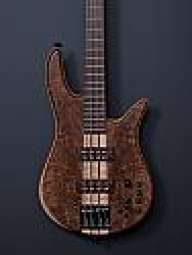
 
My personal bass has the same exact tone woods as Munjibunga (mahogany body / koa top paired with a maple neck / ebony fretboard) and I gotta say it's the most versatile wood combination I have ever played. It's extremely balanced and articulate in end of the tonal spectrum without being too boomy or bright. I can dial it to pretty much fit any situation I'm in but it will never have the EXACT characteristics of the sweet combination of rosewood / alder or the punchy combination of maple / ash.

Exactly.
 
What he said!

J

Well, it's a top. Bolt on and dovetails have a body and neck which are then either bolted or glued together. In each case though there is a body, and that body can have a glued on top (usually two book matched pieces). A neck through doesn't really have a body per se. Wings are glued onto the neck. So those wings can have a top, or with more work, put a top over the wings and the top of the neck billet. That's the "solid" option - in that you can't then see the neck billet.
 
It is, but we are here to guide you through it and we don't expect you to be an expert...that's our job and we take it seriously. Also, remember, even after a deposit is placed we allow you to change EVERY spec up until roughly 7 months before your delivery date. So, with us presently running at around 13 months for new deliveries, you have a solid 6 months after an order is placed during which you can ask a lot of questions and make a lot of changes!

Cheers,

J

This is a complicated process.
 
On AVERAGE, the order of importance on tone follows this...

Body, Neck, Fingerboard, Tone Block (where there is one), Top.

With certain very heavy / dense tops, the importance towards overall tone can actually jump up to being more important that the Tone Block and even of equal import to a fingerboard...

J

I think that fretboard wood has the most impact on tone, then followed by body. I think the tone block actually may have more influence than the wings for a neck-through, but I could be wrong.
 
I am on board with everything said below, except for the FB having the greatest impact on tone. IMHO, the body wood choice plays a more significant role.

Additionally, remember that back in James Jamerson's day Fender was using Brazilian Rosewood which is a whole different animal than Indian Rosewood (what is most commonly used today). Brazilian is much denser and covers a wider range of the tonal spectrum (from warm to bright) than does Indian (which tends to be concentrated on the warm side of the spectrum).

Cheers,

J


I agree with Nostatic that the fretboard wood probably has the biggest impact on tone, so you should familiarize yourself with the characteristics of different fretboards. In my experience, this is how I'd describe the 3 most popular fretboard woods.

Rosewood - By far the most common fretboard wood, rosewood has the smoothest sound and is the most mellow of them all. Rosewood is traditionally paired with alder but it goes really well with mahogany too.

Maple - Bright, maple has more of a snap in the high end that's perfect (to my ears at least) for slap bass. Maple / ash is a classic combination and is easily the most distinguishable wood combination to recognize by ear.

Ebony - Bright like maple but in a different way, it has more of a "ping" to it in the high-end and is more clear and articulate than maple. With Foderas, I notice that ebony is commonly paired with walnut and mahogany bodies.
 
Status
Not open for further replies.