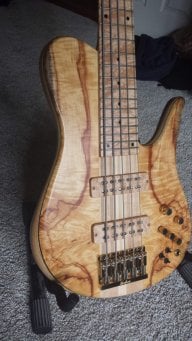
I both agree and disagree with this lolTruth (to me) is that, yes they are expensive, and you might need to wait a very long time, but they will only just sound like a bass. They might play well, sound great, but at the end of the day, it's a piece of wood with some strings. In my mind you only pay 3x because you want a fodera (and whatever comes with it), not because I expect to get something 3x better.
We are not in the 90's anymore, « normal » basses are incredibly better than they used to be even for a fraction of the price. The fact that cheap basses got better doesn't mean that expensive basses also got significantly better.
On the one hand, I'm with you that they "only just sound like a bass" and are "a piece of wood with some strings." But, on the other hand, isn't sounding like a bass the fundamental goal? I certainly don't want my Fodera to sound like a celesta or an oud
 And aren't we missing some key elements when we reduce quality to "they might play well, sound great" and price?
Let's start with quality: I had long thought Foderas were marketing hype because solid-body guitars don't require nearly the same level of craftsmanship as an acoustic instrument. With acoustic guitars and double bassi I can hear and see the difference in the best instruments. With bass guitars I felt that the differences, while real, disappeared at a much lower point than with acoustics. (Indeed, this is your point about us not being "in the 90's anymore.") But one day I saw a Fodera on Craigslist near me in Manhattan so I went to check it out. And it floored me. I genuinely heard and felt the quality difference. That wasn't the right bass for me (it was 33" scale, for one, and I play 35" and 36" because they're closer to the mensur of my double bass), but it got me thinking. So I made a point of playing more Foderas whenever I could for a couple years. (That was fairly easy to do because Rudy's Music in Soho would have one in on occasion. I think I found one at Sam Ash as well.) And then I found mine in the classifieds here. Other than wishing the neck were a bit chunkier (thicker/deeper, not wider), it's perfect for me and I'm very, very happy with it. I get it's not the bass for everyone, but the quality of sound (and craftsmanship, materials, and ergonomics) cannot be denied and I have yet to play a bass guitar which surpasses it. If I were to do so, I'd sell my Fodera and buy the superior tool.
This brings us to your point about price: I don't think anyone seriously expects a Fodera to sound "3x better" (however one evaluates that) than instruments which cost 3x less; I'm pretty sure bassists understand that our instruments follow the law of diminishing returns and therefore the price difference will never reflect 1:1 the quality difference. A $15,000 Fodera does not sound three times better than a $5,000 Elrick or Marleaux—or, for that matter, a $5,000 Fodera.
But this doesn't mean the quality difference is negligible or that the more expensive instruments aren't worth it. Worth, of course, is something that is highly personal and highly subjective. I think the price difference is worth it—certainly when buying secondhand; when buying new, some Fodera prices can be quite silly (looking at you, upcharge for Brazilian Rosewood fingerboard)—but this determination is something each of us must make for ourselves. Are you willing to pay twice the money for something that is just 25% better? Are you willing to pay twice that again for another 10%? What about twice that yet again to squeeze out another 5% in quality? Can you hear the differences between these price points? Can your fellow musicians? Can your audience? Or maybe you can't hear a difference, but you can feel one—ergonomics matter as well. My point is the difference in price will never be reflective of the difference in quality—you can successfully perform most gigs with a $200 bass or with a $20,000—so focusing on a return in quality that reflects the additional money spent misses other factors we should consider. For example, there's the pleasure of playing an instrument that feels or sounds just a bit better to you. I find this inspires me to practice more (if I'm fighting an instrument or it makes my wrist ache after an hour, I'm not going to play it as much) and to play more confidently (because I'm finally getting the sound I want, the sound I hear in my head) and thus more freely and creatively as well.


 )
)