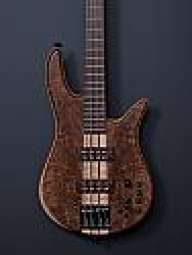
I’m thinking seriously about purchasing an E5S and thought it might be interesting to consolidate all the info I could find regarding this instrument into one post.
(
I'm no longer thinking about purchasing... I now own one!)
What I’ve included here only pertains to the Emperor 5 Standard, and not the Emperor 5 Standard Special that was just recently announced.
First off, the standard specs:
- Neck: 1-pc. Hard rock maple (quartersawn)
- Neck construction: Bolt-on
- Fingerboard: Pau Ferro
- Fingerboard inlay: Mother-of-pearl dots
- Scale: 34”
- Frets: 24 large frets
- Nut: Brass
- Strings: Fodera 45-125 stainless steel strings
- Body: Ash (medium weight)
- Top: Bi-color 5A flame maple
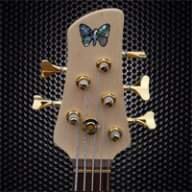
- Peghead: Fodera 2+3
- Finish: Hand-rubbed acrylic lacquer
- Tuners: Gotoh
- Bridge: Fodera non-locking (19.0mm spacing)
- Hardware color:
o Gold = bridge, tuners, string tree, output jack and strap pins.
o Black = preamp control knobs and pickups.
- Electronics: Fodera/Pope Standard 3-Band
- Pickups: Fodera Dual Coils
- Strap pins: Dunlop Flush mount straploks
Other info has come to light thanks to some of you who have posted in other threads. The following is what I’ve gathered.
Preamp
The control layout for the preamp is:
- Volume/Tone (stack)
- Pup Blend
- Treble/Bass (stack)
- Mids (low mids pot - thanks, Baird6869)
- Active/Passive toggle switch
- Coil Split toggle switch
(Some call it coil tap, but apparently the two terms are not synonymous and coil split more accurately describes the function of the switch.
See the linked Fender document for details: Invalid Link Removed)

Mike Pope (preamp creator) sells a dual mids (stacked low mids/hi mids) pot that is an easy DIY install plug and play modification turning the preamp into a 4 band configuration. Mike Pope says the install only takes a couple of minutes to do and is as easy as changing batteries.
It was posted that the stack Hi Mid/Low Mid control knob for this modification can be obtained from Fodera.
Also available is a hi mids pot.
Since there is only one hole in the body of the bass for the mids portion of the preamp, only one pot; low mid only, dual mids (stacked low mids/hi mids) or hi mids only can be used on the bass at any one time.
Here is a link to Michael Pope's web site for further info regarding the preamp and all of the options available:
http://www.michaelpopedesign.com/
The frequencies and center points of the preamp are as follows:
Bass +/- 12dB @ 46Hz or 90Hz
Lo Mid +/- 12dB @ 330Hz or 473Hz
Hi Mid +/- 15dB @ 1kHz or 1.8kHz <-- relevant only if the change to a dual mids pot is made as noted above
Treble +/- 15dB @ 6kHz or 10kHz
Headstock
The E5S’ headstock is straight (as opposed to angled) and uses a string tree to add the proper tension and avoid string vibration passed the nut for the E and A strings. The flat headstock allows for the use of one piece of Maple for the neck billet without any glue-up. This method of construction saves a significant amount of time and labor. With the string tree properly in place there is plenty of string tension and the bass plays beautifully.
Neck
According to Jason, the E5S’ neck has a compound radius fingerboard. Since they are hand sanded, they will vary slightly, but generally they are roughly 9" at the nut and 18" at the 24th.
Jason explains further…
The advantage (of a compound radius fingerboard) playability-wise really happens in the upper finger positions (say north of the 14-16th frets) where the natural shape of your playing hand starts to change and a flatter board is better suited to that shape...plus if you execute bends in that region of the fingerboard, a compound radius allows this technique to be executed cleaner.
Regarding one piece vs. 3 (or more) and quarter sawn, Jason says:
Tonally there is no difference between a one piece and three piece neck...at least that we have been able to discern. Same thing for the tonal difference between flat and quarter sawn material...no difference in tone.
In terms of stability, quarter sawn material is more dimensionally stable and less prone to movement, warping, flexing, twisting, etc. We use flat sawn maple on the YYS and quarter sawn on the E5S because of the greater forces in play on a 5-string vs. 4-string neck. Quarter sawn material costs significantly more.
Graphite reinforcement(s) are not used in any Fodera necks. Vinny and Joey experimented a bit with graphite reinforced necks, but they never made it into production as neither felt that the change in tone was worth the potential additional stability.
Fingerboard
Pau Ferro will be the only material offered on this model (at least for the first 60). However, this is not just any Pau Ferro... this has all been in the shop for at least 20 years and it is a FANTASTIC material. Tonally it's like splitting the difference between Indian Rosewood and Ebony.
Jason says: Pau Ferro is an incredibly under-respected FB material. It's easy to work, has its own look and sounds wonderfully balanced and rich. In working through our initial designs for the E5S, we fought the urge to choose one of the more "popular" FB materials because we knew that Pau Ferro would perfectly round out the tone of the E5S.
When asked about the difference between Maple and Pau Ferro as a finderboard wood, Jason responded:
After listening to two basses (an Emperor II Custom with a Maple fretboard and an E5S with Pau Ferro) side by side all day at the 2011 Bass Player Live event, I would have to say that the Pau Ferro has a more expansive tonal range...both deeper and brighter at the same time, while the Maple tends to be more focused in the upper mids and highs (but not as crystalline as the Pau Ferro's highs...the Maple's high come across as more rounded).
FWIW, Joey, Vinny and I all describe Pau Ferro's tone as a hypothetical blend of Indian Rosewood and Ebony.
Pickups
The E5S pickups are 60’s wound and 70’s spaced.
Instrument weight
I’ve seen info from various sources that indicates the weight of E5S’s varies from 9 to 10 lb. My E5S weighs 9lb 15oz.
Jason’s take on the E5S’ sound as compared to an Emperor Deluxe:
The E5S’ are wonderfully punchy and rich sounding. When building these we were going for a very well rounded sounding instrument...one that could be taken out on 99% of the gigs any player would realistically go out on.
As a bolt-on it has a bit more punch than does a Deluxe with the same woods, but to notice that you'd really need to play them both side by side.
Between the wood selection, the dual coil pups and the preamp, there are a ton of great, useable tones available. We would stack this up side by side tonally with ANY Fodera 5-string and be very confident that it will hold its own and make the person playing it grin.
Factory changes
The E5S may be ordered with all-black hardware (black tuners, black string tree, black bridge and black output jack).
Please let me know if I've made in errors and/or post any further info that you might have…
Thanks,
Allen