• TalkBass has been independent since 1998. Add your voice.
    Create a free account to reply to discussions, view embedded media, and browse with fewer display ads.
    Join freeLog in
    Want zero display ads or expanded classifieds tools? Compare plans.

Fodera Headstock Joint

Hey Y'all,
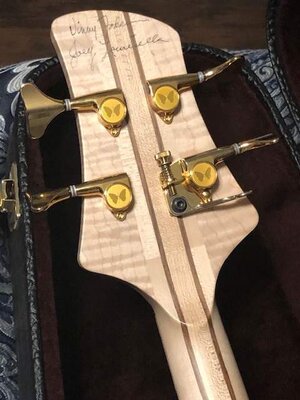
I'm CADing up some new plans for a bass I've designed. I was looking at a few different builders for inspiration for (angled) headstock attachment. I came across this on some Foderas, and was curious how this was staying attached. It looks like just an endgrain-endgrain butt-joint with the wings acting as braces- but that seems potentially weak. Is this just a scarf joint hidden behind the wood? Or perhaps some other black magic that I'm missing? Let me know what you think!
Screen Shot 2022-02-22 at 4.41.13 PM.png
 
There's two kinds of scarf joints typically used for headstocks. There's the first kind where the headstock piece extends into the neck underneath the fretboard, and the second kind has the neck piece extending into the headstock with the headstock piece glued underneath. Given that the joint sits quite far back into the headstock, I'm pretty sure it's the second variation. There's a more detailed explanation here Headstock and Scarf Joints Explained - Glued to Music
 
I can certainly understand arriving at something like that on a one-off build, because one thing led to another and workarounds for miscalculations had to be employed. I'm not sure why that construction and look would be done deliberately by an experienced builder, on a whole line of basses.
I'm not questioning it because I have no idea what's going on there, structurally or why it was done. But it does look a little funky.
That said, I doubt that 90% of bass players would even notice unless you pointed it out and 90% of them wouldn't be bothered by it, once you did.
The front probably looks good.
 
I guess I'm seeing something different there. To me, when I look at that joint, it doesn't look odd at all. It looks like they have done this -
Screenshot 2022-02-23 095116.jpg

and then glued wings on it. But the trick here is, the scarf section is the exact same width as the neck section, then the wings are glued on in line with the headstock scarf section and the volute is carved to only be as wide as the neck section. You're just looking at it from the back, which skews the "look" a bit. The wood grain is also playing tricks on your eyes. but at the end of the day, it's that joint above ^^. There's nothing about what they've done that says to me "endgrain-endgrain butt-joint with the wings acting as braces". I agree with @TFM94 and @Gilmourisgod, it's a scarf joint with wings glued on, you're just visualizing it weird.
 
I'll buck the trend. I think it looks nice.

It flows well to have the ears line up with the width of the neck, compared to having ears that are joined at an arbitrary seam some distance between the neck width and the tips of the headstock shape.

In terms of the grain not matching - to me, there are two good looking options. Either you have to get the match 100% perfect - such that it's not at all noticable - or you might as well make it look deliberately mismatched. Having a seam where the grain match is somewhere in the middle creates a look of "I tried to match this but did poorly" versus one that's obviously mismatched, which looks more intentional.

At any rate I think it's pretty clear that Fodera can build a nice bass, and the factors being discussed here are much more about personal preference in terms of appearance versus there being a legitimate right or wrong judgement.
 
The method 2 version seems like it would be stronger because the fingerboard glues over it, but again, never seen a break test on the two methods. I have seen plenty of glue joint break tests for furniture, and the wood always breaks before the glue anyway. That at least seems to imply that making a laminate neck would be stronger than a single scarf joint. I’m picturing a glued joint on a hockey stick vs. one cut out of plywood, I think the glued one would break first.
 
View attachment 4596986
Just another example you can see how it was flipped.

Yes, this is a much better example of a typical Fodera scarf joint. They do use Method 2, not method 1. This allows the wings to cover the sides of the joint, and the front overlay covers the joint on the face. I believe Ken Smith (or whomever is building Smiths these days) does this in a similar fashion.

So for those asking "why?"... here is a short list.
  • First and foremost, where scarf joints are concerned, there are no drawbacks in terms of strength.
  • When done well, as above, it looks just fine
  • It is easier to source 6/4 or smaller rough lumber for neck blanks (in most species)
  • It is cheaper to source 6/4 or smaller rough lumber for neck blanks (in most species)
    • Going from 6/4 to 10/4 can be non-linear and non-trivial in cost depending on the species
  • There is less material waste
  • The materials take less space to store
I'm sure there are other reasons that can be added to the list. But in a nutshell... it's just more practical. It's not really a labor saver, it's primarily a material saver... and likely a production/business decision that was made early on.