• TalkBass has been independent since 1998. Add your voice.
    Create a free account to reply to discussions, view embedded media, and browse with fewer display ads.
    Join freeLog in
    Want zero display ads or expanded classifieds tools? Compare plans.

Four or Five? I like this perspective.

I never understood this four-string, five-string, or six-string argument.
Play what you think is more appropriate to your style.

As a former guitarist, for me the 6 strig bass was the easiest way to visualize the bass, I have 6 strings on guitar, I have six strings on bass. When I started playing the 6 string bass my abordation was different because I tuned the bass: B E A D G B.

It made more sense to me, on the 6 string guitar I'm going from E to E, on 6 string bass I want the same, not from B to C, but from B to B. This helped a lot because at that time I played a 7 string Steve Vai Universe Ibanez (B E A D G B E) and I had a solid muscle memory after years to memorize the scales on guitar.

So, few years I played only on 6 string basses. In early 2000s I bought a USA made 5 string Peavey Cirrus, the same model was used at that time by Mike Porcaro in Toto, same colour (Tiger Quilted Top). After I never played again 6 string basses, and I never owned a 4 string bass. I don't hate them, they are not my cup of tea.

Many of my favorite bass players are 4-string bass players (Mark King, Louis Johnson, Vincen Garcia, Stu Zender), also a lot of them are on 5s (Tom Kennedy, Justin Raines, Johann Asmundsson) or 6 string basses (John Patitucci, Andrew Gouche), I like them no matter how many strings they have on the instrument.
 
  • Like
Reactions: LadyLoveStingRay5
I never understood this four-string, five-string, or six-string argument.
Play what you think is more appropriate to your style.

As a former guitarist, for me the 6 strig bass was the easiest way to visualize the bass, I have 6 strings on guitar, I have six strings on bass. When I started playing the 6 string bass my abordation was different because I tuned the bass: B E A D G B.

It made more sense to me, on the 6 string guitar I'm going from E to E, on 6 string bass I want the same, not from B to C, but from B to B. This helped a lot because at that time I played a 7 string Steve Vai Universe Ibanez (B E A D G B E) and I had a solid muscle memory after years to memorize the scales on guitar.

So, few years I played only on 6 string basses. In early 2000s I bought a USA made 5 string Peavey Cirrus, the same model was used at that time by Mike Porcaro in Toto, same colour (Tiger Quilted Top). After I never played again 6 string basses, and I never owned a 4 string bass. I don't hate them, they are not my cup of tea.

Many of my favorite bass players are 4-string bass players (Mark King, Louis Johnson, Vincen Garcia, Stu Zender), also a lot of them are on 5s (Tom Kennedy, Justin Raines, Johann Asmundsson) or 6 string basses (John Patitucci, Andrew Gouche), I like them no matter how many strings they have on the instrument.

The OP was talking about a first bass for a new player. A new player does not know what her or his style is going to be yet. Anyone can start on anything, he just gave some reasons for starting on a four.
 
The OP was talking about a first bass for a new player. A new player does not know what her or his style is going to be yet. Anyone can start on anything, he just gave some reasons for starting on a four.
I started on 6 strings (ok, after ten years on guitar).
Learn the hard way.
Yes, I know that the video guy argued about a beginer and I don't know what is better for a beginer. But a lot of players that started playing bass on 4s, when they move to 5s they don't use the 5s like 5s, but like 4s with extra one string (and imediatelly I see that: "this guy is playing a 5 string bass, but is a 4 string player"). For them the E string is the main string, like on the 4s, for me the B string is the main string, that is the base of my playing. From the B string I visualize all the scales, arpeggios.
When I exercise scales (for warming up my fingers before practice, rehearsal and concerts) I always start from the B string in every position on the neck on two octaves. And that's my daily exercise, and it's the same routine from my guitar playing past (10-15 minutes scale exercise before any practice).
 
I'm a 6, sometimes 5 player, and are seldom stuck in the first 7 frets.

Why? If I was starting again today, it would be on a 5.
For a beginner, it may be easier to control sympathetic string vibration and focus on playing cleanly on a four stringer, until strength and technique develops.

It is easy to forget how awkward the bass felt for some of us, way back.
 
I'm joining a bluegrass band. It's going to be Progressive Bluegrass. I grew up on 4 string bass, then played only 5 string basses for many years. But knowing what I know now, I would have preferred starting on a 6 string had they been available.

Forces me to think "outside the box". Box? What box? :smug::bassist:

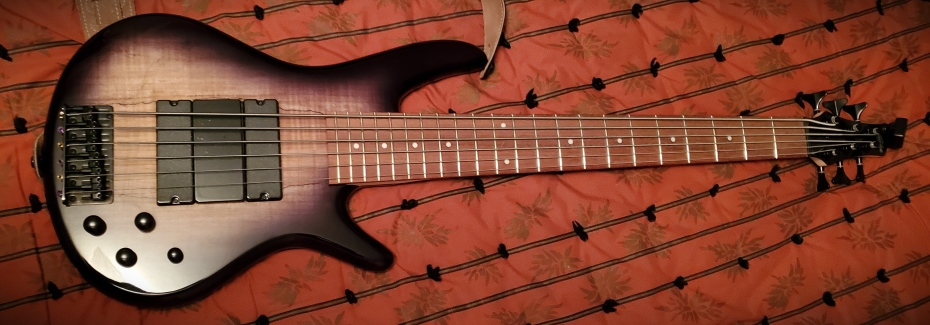
And...I'm going to use this as my bluegrass bass. BEADGC.

FunkGrass-Bass.jpg
 
  • Like
Reactions: Fuzzbass
For a beginner, it may be easier to control sympathetic string vibration and focus on playing cleanly on a four stringer, until strength and technique develops.

It is easy to forget how awkward the bass felt for some of us, way back.

Beginner guitarists have 6 strings to deal with, but of course bass strings are more difficult to play, bass necks longer and chunkier, etc. I was playing 4 string for over 20 years before I switched over to five. I like to think I would have been OK starting on five, but you've made a fair point about forgetting what it was like way back when.

I happen to know a bassist who decided to take the deep dive from the get go and start out on five string fretless, but I'm gonna say he's an exception!
 
I am a guitar player, who also plays bass, and I put down the bass for a just a few years. I'm picking it back up again. While the preference for 4 vs. 5 is highly personal, it does seem to me that 5 strings (and I could be totally wrong) seem to be steadily gaining in popularity with players, and increasingly used in many styles of music. I'm hearing more players say they NEED those lower notes. Is the time soon coming, or do some players think the time is here, that we start recommending 5 string basses to new electric bass players? Because a bass player will all too often be expected to play those lower notes? Does anybody believe that the standard electric bass now has 5 strings? At the very least, the standard electric bass for a particular style of music? And, if not now, are we approaching this time soon? I feel like that time may be coming. This video implies that you have a choice. Does anybody feel like they don't have a choice?
 
  • Like
Reactions: Dr. Cheese
I learned on a Yamaha BBN-5. That was back in 1998 and my perspective was that the five string was the next step as we entered the 21st century. I now have six basses. A five string, a five string fretless, a four string acoustic electric, a six string, a blue four string Jazz and another four string jazz in tobacco sunburst with the chrome covers over the bridge and pickup.

The reason I bring that all up is because I just recently made a change for gigs. About three months ago the six string became my go-to for playing at church - pretty much every sunday. There is significant need of everything down to the open low B. And I actually now do arpeggios using the high C string, which is how I have it tuned. It works out great and is also an incredibly beautiful metallic silver.

But the big change is in my gigging band. I've always used the Yamaha fiver, which was upgraded to 18 volt bartolinis. And because it was my main bass, I learned to rarely play open strings. But as I occasionally forced myself to use my four strings, I got more comfortable playing down closer to the nut.

Anyway, my band plays classics from the 50's all the way to the 90's including classic rock, folk and country. Lots of variety. However, I found that I NEVER needed to go below the low E, except for on Hick Town, which obviously uses drop D. So, I pulled out my "retro" sunburst bass and started using that at rehearsals. And guess what? I play a lot better. That is, much more fills and solo work. It's like moving from a car to a go-cart. It's just so much easier to do all the complex stuff in all the standard stuff.

But this is something I already knew. What changed is that I finally abandoned the fiver as my main bass. It has its place, so I'll bring it as a back up, And I still enjoy playing the six string in church, and it keeps my "five string chops" fresh. But I just don't need it with the rock/pop/country stuff. And I can throw that four string around like a toy. i.e. HUGE increase in stage presence.

BTW, I sometimes have jazz guys come over to jam in my rehearsal space. Then I tend to use the six string and the fretless.

BTW #2: The biggest challenge for me when I first tried four string basses was getting used to not having the low D string. I tried to play Summer of 69 once at "howl at the moon" and at the key change, I suddenly realized I didn't have the B string. And having no experience with a four string at the time, I didn't really know where to go for a couple of bars. Very embarrassing.
 
Last edited:
1. 4s are lighter? Not necessarily.
2. 4s force you to play across the neck vs diagonally? I think he means vertically. And no, not necessarily.
3. 4s “cause” you to play more creatively? No.
4. Why would playing a 5 encourage someone to stay in the 1st position area? In most cases you’re still going to need to access notes above what’s available in 1st position. That argument only works (somewhat) if your bass is tuned E to C.
Completely agree. High G is in the same place with four or five strings. I do like that my five and six string basses are two octaves of frets. I actually miss the "very high G" on occasion with the four, but I'll live...

The biggest challenge I had with going from five to four was having to use more open strings. My habbit was to always play a fretted string. Having to throw in open strings in the middle of an arpeggio was something I had to learn when I tried to gig with a four string. With the fiver I tened to go from first position up the neck - rarely down. However, after becoming proficient in doing it with the four, I found my skillset with the five had increased. i.e. I spent more time near the nut and became much more comfortable adding that to the stuff I was comfortable with on the neck, which I admit seems backwards. Kinda weird.