• TalkBass has been independent since 1998. Add your voice.
    Create a free account to reply to discussions, view embedded media, and browse with fewer display ads.
    Join freeLog in
    Want zero display ads or expanded classifieds tools? Compare plans.

Four or Five? I like this perspective.

One man's opinion.

BTW, I never knew a good player who did not know where every note was on the fingerboard regardless of how many strings, and if multi-string guys only play across, if I had a nickel for every time I've heard old-school four-string guys say 'no money past the fifth fret', I'd have enough money to leave a spare Alembic in the car.


The long and short of it is play WHATEVER it is that feels and sounds right to you and lets you make your best music. Who cares WTH anybody else thinks and NEVER get bullied into doing something or playing an instrument that feels wrong to you 'cause you think you're 'supposed to'. Screw That.

That's all there is to it.
 
Last edited:
One man's opinion.

BTW, I never knew a good player who did not know where every note was on the fingerboard regardless of how many strings, and if multi-string guys only play across, if I had a nickel for every time I've heard old-school four-string guys say 'no money past the fifth fret', I'd have enough money to leave a spare Alembic in the car.


The long and short of it is play WHATEVER it is that feels and sounds right to you and lets you make your best music. Who cares WTH anybody else thinks and NEVER get bullied into doing something or playing an instrument that feels wrong to you 'cause you think you're 'supposed to'. Screw That.

That's all there is to it.
I am not a great player by a long shot, but I definitely fell into the trapped in the first five frets thing on my five string and getting a four certainly helped me break out of it. Currently I do not have a fretted five because it electronics gave out, so I have fretless four and five and a fretted four.
 
  • Like
Reactions: Lo-E
1. 4s are lighter? Not necessarily.
2. 4s force you to play across the neck vs diagonally? I think he means vertically. And no, not necessarily.
3. 4s “cause” you to play more creatively? No.
4. Why would playing a 5 encourage someone to stay in the 1st position area? In most cases you’re still going to need to access notes above what’s available in 1st position. That argument only works (somewhat) if your bass is tuned E to C.
 
If anything, frets 8 through 12 will give you the leg up out in the real world. So many players don't know the middle of the neck, yet there is a lot of value there. If you're the guy who can play the whole neck, you can play most anything thrown at you.
The middle of the neck on a 5 string is even more valuable. All of the 4 string real estate without having to shift much.
Saying all that, I stay proficient on both 4 and 5 string basses. Different gigs call for different numbers of strings.
 
Although the vid is engagingly articulate, I have substantively different views about the different instrument configurations.

The choice of instrument ought to be based on the details of the parts that need to be played; as opposed to some kind of personal expression.

HipShot detuners can be fitted on to 4 string basses, to drop either a whole step or two whole steps. I’ve been doing more gigs lately with DADG on a 4 string, when lower notes are needed; most typically due to vocal transpositions. I’m getting more adept with fingering patterns in DADG; but, that can take some shed time. CADG tuning makes my brain explode ATM; and I haven’t gotten that far.

The 5 string bass is the simplest for transpositions. But, I don’t alter my finger pattern approach at all between EADG and BEADG.

Comparing DADG to BEADG, you’ve only got three additional lower half tones with BEADG at the cost of a an extra string and some extra wood. Most of my gigs don’t have parts that require the extra notes. Uptown Funk, for example, does have the lower passing C in the line; but, I don’t believe audiences miss the absence. I do like and use the 5 string for on the fly transpositions; because, I don’t have to sort out fingering.

One of my gigs does Stuck in the Middle in C; and that line took a bit of study in DADG tuning. Shifts are required. The reality is that shifts are required on 4’s, 5’s, or 6’s. Avoiding shifts is limiting. Much better to embrace them. IMHO.

Last point, I strongly feel that lower notes in DADG sound significantly better than the same notes in BEADG. Longer string length. But, it’s a fine point.

For the TL;DR crowd: just play the part correctly; and use whichever bass lets you do that.
 
  • Like
Reactions: Lo-E and J_Bass
The reason I do not play a 5 string is simple. When I began and for a few good year - they did not make them - so I never got comfortable with them.

I have tried what Ross Valory used to do - set up a four string bass BEAD - that works for me, but having 5 different strings seems odd to me. And 6 is a nightmare for me.

But to each his own, if you want a 4,5 or 6 - go for it. I have even seen a 2 string bass, Sandberg make a 2 string California series bass - go figure.
 
  • Like
Reactions: RomanS


I agree that there is a lot to be said for learning to use the whole neck a four instead of going straight to a five and getting super comfortable in the first five to seven frets


Nope, I'll stick with 5. As my signature says...more bass. And less travel up and down the neck (no for me on a BEAD 4-string, too).


I agree that there is a lot to be said for learning to use the whole neck a four instead of going straight to a five and getting super comfortable in the first five to seven frets
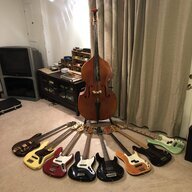
The choice between 4 or 5 isn't directly, or solely mine as a matter of sheer whim. It's always pragmatics: I pick 4 (or usually now) 5 based on the songlist to play the bass that has the right range for the bass (or keyboard) part(s) as-recorded, as well as stage space to have multiple instruments (or not), and whether the flow allows me to switch between 4 or 5, and how distracting or not that might be to that flow. Pragmatics.

Good video though.
 
  • Like
Reactions: Lo-E
Why would playing a 5 encourage someone to stay in the 1st position area? In most cases you’re still going to need to access notes above what’s available in 1st position. That argument only works (somewhat) if your bass is tuned E to C.

Agree with all you said, but especially this. BEADG only goes lower than EADG. Why on earth would it hinder someone from traveling to the very necessary middle and upper registers? I play the low B string above the fifth fret more than I do below.