• TalkBass has been independent since 1998. Add your voice.
    Create a free account to reply to discussions, view embedded media, and browse with fewer display ads.
    Join freeLog in
    Want zero display ads or expanded classifieds tools? Compare plans.

Fret Sprout on a Fretless?

Don’t tempt me!:bassist: The Spectorcore is a great bass, but it pretty much does what my Pedulla does. This Jazz is fretless, but it can sound more fretted when I want it to, if that makes sense to you.

Honestly, I'd return the Jazz if it is having problems like that. No reason whatsoever to try and sink money into something that is making the bass unplayable.
 
  • Like
Reactions: Dr. Cheese
I just fixed my Vintage Modified Squier Fretless neck that had a similar problem. Different materials of course. I used a radius sanding block and then buffed it out with an automotive buffer and some compounding (cutting) polish.
Hey fellow North Dakotan! Was your Squier fretless neck the one with the ebonol fretboard? I have one of those that I've sanded with a radius block as well. (Sorry for the semi-derail, Doc!)
 
  • Like
Reactions: Dr. Cheese
Hey fellow North Dakotan! Was your Squier fretless neck the one with the ebonol fretboard? I have one of those that I've sanded with a radius block as well. (Sorry for the semi-derail, Doc!)

Yes! One of probably only a handful of members from North Dakota!

Yeah it’s the ebonol. Vintage Modified precision fretless neck. Turned out pretty decent actually.
 
Mine too--It's been a few years, and the lines are protruding just a tiny smidge again now. I'll have to take the block to it again one of these days. I sold the body it was on, so I'm not using the neck at the moment, but I like it so much I can't seem to part with it.
 
...but I am very disappointed that the position markers have sprouted like frets in a few positions.

So now you get to know why us blank-plank lovers like what we like: different materials expand and contract at different rates with differing temperature and/or humidity. You can't see the lines from a normal playing position anyway. Side dots should be more than enough. Violin players have been doing it for centuries without fret inlays and with much smaller tolerances.
 
  • Like
Reactions: Dr. Cheese
So now you get to know why us blank-plank lovers like what we like: different materials expand and contract at different rates with differing temperature and/or humidity. You can't see the lines from a normal playing position anyway. Side dots should be more than enough. Violin players have been doing it for centuries without fret inlays and with much smaller tolerances.

I could go unlined, but I am old dog and getting good intonation on lined fretlesses is not instant either.
 
I could go unlined, but I am old dog and getting good intonation on lined fretlesses is not instant either.

Instant? Everybody wants everything right now!

Do you see the lines when you are playing? That means you are leaning forward quite a bit to see the front of the fingerboard. Do you do that when playing fretted? You can actually get much better intonation on a fretless, and not by following the lines: sometimes you play that C# a little bit behind the "line", sometimes a little in front of it; depends on if it's a minor third or a major third. I hate to sound like like an old cliche, but what you hear is more important than what you see.
 
Is this with the out-of-the-box setup?

Unless you play extremely lightly with your right hand, very low strings are going to be a problem – even on fretted, but especially on fretless. The board slap/buzz is actually a big part of the tone and the appeal of fretless IMO. I don't want it, then I play fretted.

This is not to say that the neck is up to snuff. Maybe is isn't. But no instrument comes out of the box perfectly set up for every player.

FWIW, I learned on fretless, and played it exclusively for the first 20 years of my bass playing.

My instinct and experience says that you should be going higher with your strings, not lower. That will give you more of the upright feel and tone. And if you want to stay low, then embrace the board slap and learn to use it...or start playing with a feather-light right hand.
 
Last edited:
  • Like
Reactions: Dr. Cheese
These inserts are light wood, not plastic, and I do not think the loose ones were ever glued into the fingerboard. The high fingerboard is an indication that construction was lax on this bass even though it is very good looking.

I think the ones on mine are white plastic (in an ebanol board), but it's an '08 if I remember right, things might have changed in the past eighteen years. They've grown a bit, too; I've been tempted to try a cabinet scraper on them. Can't complain for $140, though.


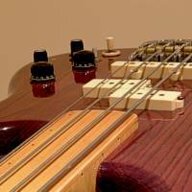
Finally got the fretless Squier Classic Vibe Fretless. In short, the bass is craptastic. The tone is very good, but I am very disappointed that the position markers have sprouted like frets in a few positions. Looking at them, I don’t think they were ever glued in at all. I cannot lower the bridge very much or the notes choke out past the 15th fret. The lower fingerboard is a bit too high; my teacher suspects the bass was made from green wood.

After a week, it has settled somewhat and the action is not so high. I glued the loose fret spacers in myself and sanded down the glue with 220 grit sandpaper and the high G# on the E string plays much more cleanly now. At the end of the day, I think it is a great sounding bass, and is easy to play, especially considering the price.

My experience with this Fretless and a Sixties Classic Vibe Jazz I played that was about 11lbs. with fret issues is making me think that Squier is getting a bit too comfortable lately.


I have the old Squier Vintage Modified fretless with the Ebonol fingerboard. It has the white plastic 'fret' markers.
No trouble with them yet but, again though, they're mounted in the Ebonol, not Indian Laurel so I don't know.

Matter of fact, now that I'm thinking about it. I don't even know why I opened my big mouth in the first place.
:( :D
tenor.gif
 
At its' price-point it is what it is and as a 'first fretless' or a backup horse-of-a-different-color it'll do just fine. Dissimilar woods in fretless fingerboards can do this (of COURSE it's green wood for 350 bucks . . . . ) but at least Squier spec'd real wood instead of those god-awful and so hard to blend in plastic lines . . . . and of course, you could match it in Fender's more up-market choices for as many multiples of the Squier MSRP as you care to contribute.

Alongside of one of the two best fretless electrics ever built (your PentaBuzz, the other being the terrifying F-Bass Alain Caron), it's eating steak at Golden Corral vs. Ruth's Chris. Have it touched up or turn it, life's too short to sweat it.
 
  • Like
Reactions: Dr. Cheese
Just sloppy QC, not uncommon in Squier or other lower end basses. I have a Warmoth fretless, ebony fingerboard with maple fret line inlays, never a hint of raised lines on that one after 30 years owning it. Same old tired arguments about lined Vs unlined trotted out I see. Are any position markers on any guitar a “crutch”? Nonsense. If you want play in tune right away, get a lined fretless, after a while you won’t need to look at it, but it’s a giant leg up on getting that muscle memory. Ever notice how a lot of fretless players are out of tune?
 
Last edited: