• TalkBass has been independent since 1998. Add your voice.
    Create a free account to reply to discussions, view embedded media, and browse with fewer display ads.
    Join freeLog in
    Want zero display ads or expanded classifieds tools? Compare plans.

Fretboards and Cracks

I just bought a bass, being sold as new (demo). After I got it home and gave it a wipe down, I see a narrow, almost hairline crack about 4" long in the fretboard towards the bridge end. It extends to the end of the board.
I can't see how deep it goes, and it doesn't effect the playability.

Is there some way to tell how deep it is? My first thought was to clean it with some acetone type
drying agent, and put a very light coating of super glue on it.

Is that a stupid idea?

Will it get worse if I keep it from drying out? I don't really want to try and return it. I really, really
like everything else about it, and got a super deal on it.
It makes me think the seller might have known about it.
Would you try and contact the manufacturer (in a different country)?

Thoughts?
 
Last edited:
I know you like it and got a super deal, but... you'll see it and be reminded every time you pick it up. It'll drive you to distraction, and in the end you'll wonder why you kept it.
Take it back. There are tens of thousands of basses out there.

Fretboard cracks are the sort of thing we try our darnedest to avoid.
 
A crack like that is basically a cosmetic thing. If you like the bass otherwise, keep it and fix it. With a little care it can be completely fixed and be nearly invisible. Yes, the simple fix is to fill the crack with careful, multiple applications of superglue. The most important thing is to get the wood inside the crack sealed up, so that it doesn't soak in moisture, swell, and crack more.

Be real careful not to let the superglue run out the heel end of the crack, down onto the body or into the neck pocket! I would take the neck off the body while doing this. A little at a time, let it soak in, add a little more, etc. Be patient.
 
Pics, please...

I've done repairs on wenge fingerboards which exhibited the same behavior. The fissure may remain stable for the life of the instrument. OTOH, as the wood "moves" in response to drying, time, the environment, etc, the crack may widen. You can't glue & clamp the margins together but you can "dust" & glue using fine matching sawdust and thin super-glue.

Riis
 
  • Like
Reactions: SteveCS
crack1 - Copy.jpg crack2 - Copy.jpg Here's some pics - and the info.

It's not wood, I guess: Invalid Link Removed

"...Fingerboard: Resinator™ with Hagstrom 6mm Dot Position Marks / 15 Inch Radius / Graph Tech™ Black Tusq XL 40mm nut..."

Wow - it looks a lot worse in the close up picture. Just holding and looking at the bass it's not as noticeable.
Repair or return?
Any ideas what might have caused it?
 
Last edited:
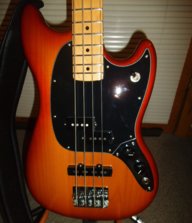
whole - Copy.jpg Those look really horrible. Here's a pic of more what it looks like when you pick it up.
Workmanship on this bass is not good, but the sound is great, and I really like the design.
I think I'm pretty well set with taking my chances and gluing it somehow.
If it doesn't work out, (I think it will), I might put a different neck on it somewhere down the road.
 
I hope the deal was excellent enough to warrant keeping it. I agree that those are very nice looking. Not the first time they've caught my eye.

It is difficult to know for sure what caused it; could be a number of things but I would look closely at the butt of the heel to make sure the wood isn't split causing the resin FB to split before making a final decision on keeping it.
 
The fingerboard is wood. It's just something cheaper than ebony, which has been saturated with a black resin to make it look like ebony. Resinator is a marketing term. The crack is a classic example of a board that wasn't fully dried when it was processed into a fingerboard. As it dried out, it tried to shrink across its width. But it couldn't, so it cracked. They usually crack in the middle like that because that area has been weakened by the drilling of the marker dot holes.

It's fixable. The best way would be to pull the frets and fill the crack with black-tinted marine epoxy. Sand, polish, refret. It could also be done with the frets on there, working patiently. The black epoxy will probably match the black resin quite well.

The important thing, as I mentioned above, is to immediately get some superglue in there to seal up the side walls of the crack against moisture. If it swells up locally, then it may twist, push up, and break free from the neck.
 
  • Like
Reactions: Zooberwerx
The fingerboard is wood. It's just something cheaper than ebony, which has been saturated with a black resin to make it look like ebony. Resinator is a marketing term. The crack is a classic example of a board that wasn't fully dried when it was processed into a fingerboard. As it dried out, it tried to shrink across its width. But it couldn't, so it cracked. They usually crack in the middle like that because that area has been weakened by the drilling of the marker dot holes.

It's fixable. The best way would be to pull the frets and fill the crack with black-tinted marine epoxy. Sand, polish, refret. It could also be done with the frets on there, working patiently. The black epoxy will probably match the black resin quite well.

The important thing, as I mentioned above, is to immediately get some superglue in there to seal up the side walls of the crack against moisture. If it swells up locally, then it may twist, push up, and break free from the neck.

+1. I did mine with the frets intact, alternating between wenge dust and CGA, and then finishing the whole mess with a J blade (...make your own with a razor blade). Like an idiot, I forgot to snag an "after" photo before giving the bass to my brother....I'll talk him into sending a couple shots. Here's the "before":

FingerboardCrack2-1.jpg


Sidenote: this particular bass was essentially given to me. Purchased new or used from a retailer or private seller? I would probably return it unless you really like the challenge.

Riis
 
Ah,RESINATOR is wood. I thought it was 100% synthetic after the OP linking the web page to Hag. That's why I worried if the maple had split.

I was also concerned about how adhesives generally dislike adhering to cured resins ie repairing this.

I would be inclined to take it back and ask for warranty through Hag since it is a new instrument. Doesn't matter that it was a floor model. Check it out; I say you are owed a new neck no matter how cheap you bought it. To Hag you are still first owner.
 
Last edited:
View attachment 544616 View attachment 544613 Here's some pics - and the info.

It's not wood, I guess: Invalid Link Removed

"...Fingerboard: Resinator™ with Hagstrom 6mm Dot Position Marks / 15 Inch Radius / Graph Tech™ Black Tusq XL 40mm nut..."

Wow - it looks a lot worse in the close up picture. Just holding and looking at the bass it's not as noticeable.
Repair or return?
Any ideas what might have caused it?

I can't see the back of the neck, but if the truss rod is fitted from the front (no 'skunk stripe' up the back) this 'could' be a sign of something far more serious. I have seen an example of a foobar'd truss rod pushing the skunk stripe right out of the back of the neck... Have you tested truss rod function?
 
I just started this thread because I wanted to know if it would get worse.
I don't think anyone can say for sure - only time will tell.
Also to find out if using superglue was a dumb idea.
If it's merely cosmetic, I don't have a problem with it. It looks and sounds great.
 
It's very difficult to stabilize an open crack with CA.
CA is usually used to stabilize a crack that can be opened, CA run into the crack, and then closed up/clamped. Yours doesn't fit that criteria.
The best you can do is use a filler as some have suggested using CA as a bonding/hardening agent. This will keep moisture and crud out.
Just CA and hardener can be used if you don't want to fill the crack but merely to seal the raw wood inside the crack. Not sure I'd bother.

Only time will tell whether the crack is stable or not. The crack may or may not progress. Temp and humidity swings will always play havoc with an open defect of this sort.
As to whether it's merely cosmetic or structural...you'll find out over the next few years.

Play it...enjoy it for what it is.
 
Bruce Johnson and Zoobeerwerx know what they're doing. WIth all due respect for other posters in this thread, my suggestion is that you follow Bruce and Zooberwerx' advice. Given the situation, that's what I'd do. The bass is yours - keep it, invest a bit of work in it and you will not have to worry about it.

I've had one of the HB-4 basses and found it to be well made and solid, just not my sound. The pickups and multi-option switch are either what you like, or they're not.

Enjoy!
 
  • Like
Reactions: sissy kathy
Bruce Johnson and Zoobeerwerx know what they're doing. WIth all due respect for other posters in this thread, my suggestion is that you follow Bruce and Zooberwerx' advice. Given the situation, that's what I'd do. The bass is yours - keep it, invest a bit of work in it and you will not have to worry about it.

I've had one of the HB-4 basses and found it to be well made and solid, just not my sound. The pickups and multi-option switch are either what you like, or they're not.

Enjoy!

Here's a pic from my brother, Kile, in Raleigh. This is a beater Grendel 5 which was trashed (...and reimbursed) by the courier. The repair, as I previously described, is sound but I could have spent some time addressing the cosmetic issues and matching the surrounding wood....but that would have resembled work and I won't have any part of that! The end product is the result of repeatedly back-filling small amounts of wenge dust (wear a mask!) and then wicking in a scant amount of thin CGA. Compare to my "before" pic in an earlier post.

GrendelCloseUp_zpsewblnfic.jpg


Riis
 
A good tinted or filled epoxy can make a permanent fix-
IF the wood in the sides of the crack is clean and the epoxy can bond directly to it...
if there are any contaminants or other in the crack, the epoxy can only hold as well as the mat'l it encounters.
But, the epoxy itself, used correctly, will be stronger than the wood (or most anything else there) that it bonds to.
To an extent, the same applies to CA glue.