• TalkBass has been independent since 1998. Add your voice.
    Create a free account to reply to discussions, view embedded media, and browse with fewer display ads.
    Join freeLog in
    Want zero display ads or expanded classifieds tools? Compare plans.

fretless side markers help

Hey guy and gals

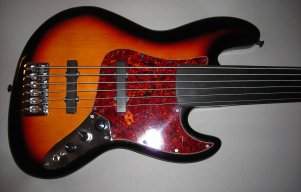
i got myself a fretless not long ago , it's one of those ebay custom builds so no name associated with it. since im new to fretless and never setup any guitars before , i wanted to place a side markers on it to help me play . I found one of the site to provide me with fret measurements (http://www.tundraman.com/Guitars/FretCalc/index.php) , but when i test marked it the notes were way off (around 5mm) . Guitar Scale is 34.5 Inches .
Question is are those measurment correct , and i should make some type of adjustments to the bridge , or should i just mark the frets with a tuner ?
Dont hate , help the newb out.

Thanks.
 
On the Stewart MacDonald website, they have a device called a fret calculator. It may be under fretting supplies. Don't fret :p it's not something you buy.

You enter the scale length, instrument type, etc, and it tells you where to cut fret slots. The same principle would work for side markers also as long as you want the fret marker where the line (fret) would be. My lineless G&L has side markers where the dots would be on the board, not where the fret would be.


Edit: Immigrant throws self on sword in post below.
 
Fret positions for 34" scale:

1: 1.908"
3: 5.410"
5: 8.529"
7: 11.308"
9: 13.783"
12: 17.000"

Make sure you measure from the nut, and not the bridge saddle (it may appear to be a 34.5" scale because the saddle is set back to account for intonation).

If you really have 34.5" scale:

1: 1.936"
3: 5.489"
5: 8.654"
7: 11.474"
9: 13.986"
12: 17.250"

-Alex
 
On the Stewart MacDonald website, they have a device called a fret calculator. It may be under fretting supplies. Don't fret :p it's not something you buy.

You enter the scale length, instrument type, etc, and it tells you where to cut fret slots. The same principle would work for side markers also as long as you want the fret marker where the line (fret) would be. My lineless G&L has side markers where the dots would be on the board, not where the fret would be.

Sorry to sidetrack here but why would G&L put side dots where dots would be on a fretted instrument? Does not make sense to me and frankly really annoys me.

Logipunk, I purchased dry transfer position dots off Ebay a year ago. I tried them on one of my fretless basses. They worked really well and were reversable if I decided to remove them. The bass I put them on had lines so it was not as daunting to position as a bass without lines. If you don't have your dots yet I can find out where I got them exactly.
 
Sorry to sidetrack here but why would G&L put side dots where dots would be on a fretted instrument? Does not make sense to me and frankly really annoys me.

Logipunk, I purchased dry transfer position dots off Ebay a year ago. I tried them on one of my fretless basses. They worked really well and were reversable if I decided to remove them. The bass I put them on had lines so it was not as daunting to position as a bass without lines. If you don't have your dots yet I can find out where I got them exactly.

Same on Warwicks, and Yamahas, and Fenders IME

Infact everybody usin' fretless basses just plays a lil' further than dots, in search of correct (invisible) frets position. This works especially on the first octaves. On higher positions, correct notes are more on dots than on wider low register

Cheers,
Wallace
 
Most dots IME are in between the frets too. When I bought a custom stingray it had dots on the lines which took some getting used too. I'd have it no other way if by choice. It is simply easier.
 
Most dots on pure unlined fretless basses are placed where the fret lines should be. This includes Fender fretless precisions. Unless my 1975 maple neck fretless, is a one of a kind.

I would strongly suggest you place the dots where the lines go. Mid fret is of no use.
 
thanks guys for all your replies , yes i am planning to place markers on a fret lines , starting with 1,3,5,7,9,12 etc. , not in between. So i watched some u tube vid , and it looks like my intonation ( i believe its the term) is off , so i will make some adjustments to meet with the measurement posted since they are way off.
 
I'd actually recommend just getting a tuner and marking out the positions yourself. Functionally it'd be the same, and probably a lot easier than precisely measuring out fret positions. The longer you play fretless the more natural the positions become; the dots aren't meant to be incredibly precise, just a reference.
 
I won't play a fretless bass with lines. I want the dots ON the note. I sing all the time and I ain't got time to look at the dot and THEN go find the line slightly above it and all that stuff. Simple is how I like it. Besides, I sing in pitch. Why would I ever play out of pitch? I don't.
 
Most dots on pure unlined fretless basses are placed where the fret lines should be. This includes Fender fretless precisions. Unless my 1975 maple neck fretless, is a one of a kind.

I would strongly suggest you place the dots where the lines go. Mid fret is of no use.

Correct. Defretted basses will obvously have dots in the fretted places and some cheapo (and some not so cheap but older) fretless lined basses have dots in fretted positions. On those you have to use the edges of the fretlines for reference!

The correct place is ON the fret postions.

I've converted a couple basses to unlined fretless and the way I positioned the markers was as follows:

I used the edge of a credit card to "finger" notes in conjunction with a tuner.

First you get intonation and tuning set precisely right for open strings and 12th fret on every string. The line of 12th fret notes must be straight across the neck by setting bridge intonation.

Then using the credit card and tuner I found the place for the notes for each string at a given in between dot. Typically with most strings these will NOT form a true straight line across the neck like those at the 12th fret. But they won't be off very far, either. I marked each string note location with a pencil

Then for each dot marker I sort of eye-balled the marks and estimated a kind of "average" line through the variations over to the edge which then became the side dot marker.

This worked out very well. But I realized it's just for a given brand/style of string set. If I were to change the strings to a different type the dots may be slightly off, but so long as you keep the same kind of strings you set the dots with, it's better than the calculated dots which are just sort of "theoretical" positions.
 
Put the dots where the frets would be and play just to the
"nut side" of the fret. Your finger will squish and expand.
The note will be formed sharper than the center of your finger. That's where you have to adjust using your ear.

Another point, My Azola Bugbass has side markers where the fret would be, not in between the frets.

The Double Basses in my Middle school had temporary markers on the side of the neck to facilitate learning.
They were located at the 3rd, 5th and 7th POSITION, not "in between".
 
logipunk, if there are no markers, how did you determine the scale length? Measure from the nut to the bridge saddle? If so, a bass at hand I have measures about 34.5" from nut to bridge saddle. But that is with intonation compensation. It is a 34" scale, and the 12th fret is at 17" (from the nut).

Also, I noticed the numbers I came up with match the numbers on the Stew-Mac site. These are just based on the math -- 12th root of two, equal temper tuning. I don't know what kind of math the site in the OP is using. Perhaps he's more of an acoustic guitar builder, and adds compensation for a fixed bridge? (Perhaps a topic for another thread.)

But since you don't know what strings you might be using, or the action or other setup of the bass, you cannot reasonably compensate for that. So go with the math, and that will get you in the ballpark. And if (when) you do adjust slightly, which way you adjust will also be determined by the key you are playing in!

-Alex
 
Use a tuner! Even though music notes have math associated with them, if your tuner and intonation is accurate, why would you put a mark where your ruler said to if the tuner said it was wrong?

FYI,

Math is used to design the circuits in the tuner.

Using a mechanical method, the octave is exactly 1/2 the
scale length. For all of the "frets" in between, the intonation set up would have to be correct for the tuner to hold any merit.

That being said, fretted instruments are not "perfectly in tune", fretless instruments allow for the player to compensate for those imperfections.
 
I guess one advantage of not being properly taught how to play bass is that in my case at least, have always played a fretted instrument on the frets. It wasn't until after a lot of years that I learned that you are supposed to play in between the frets, but I never got the hang of that.

It definitely makes it easier to play fretless IMHO.